What GitHub's 2025 Data Says About Web Development
The web development field continues to change as developers adopt new frameworks, languages, and AI-assisted tools. GitHub's 2025 Octoverse report provides useful evidence of this shift. GitHub reported more than 180 million developers on its platform, while TypeScript became the most-used programming language on GitHub in August 2025, moving ahead of Python and JavaScript based on contributor activity. The report also recorded more than 4.3 million AI-related repositories, showing how quickly AI is becoming part of software development.
For students, the takeaway is straightforward: learning web development should not mean memorising one language and stopping there. A strong foundation in HTML, CSS, JavaScript, frameworks, databases, Git, deployment, and responsive development provides a better base for adapting to changing technologies. Practical project work also helps learners understand how these technologies function together in real development workflows.
Why This Course Stands Out
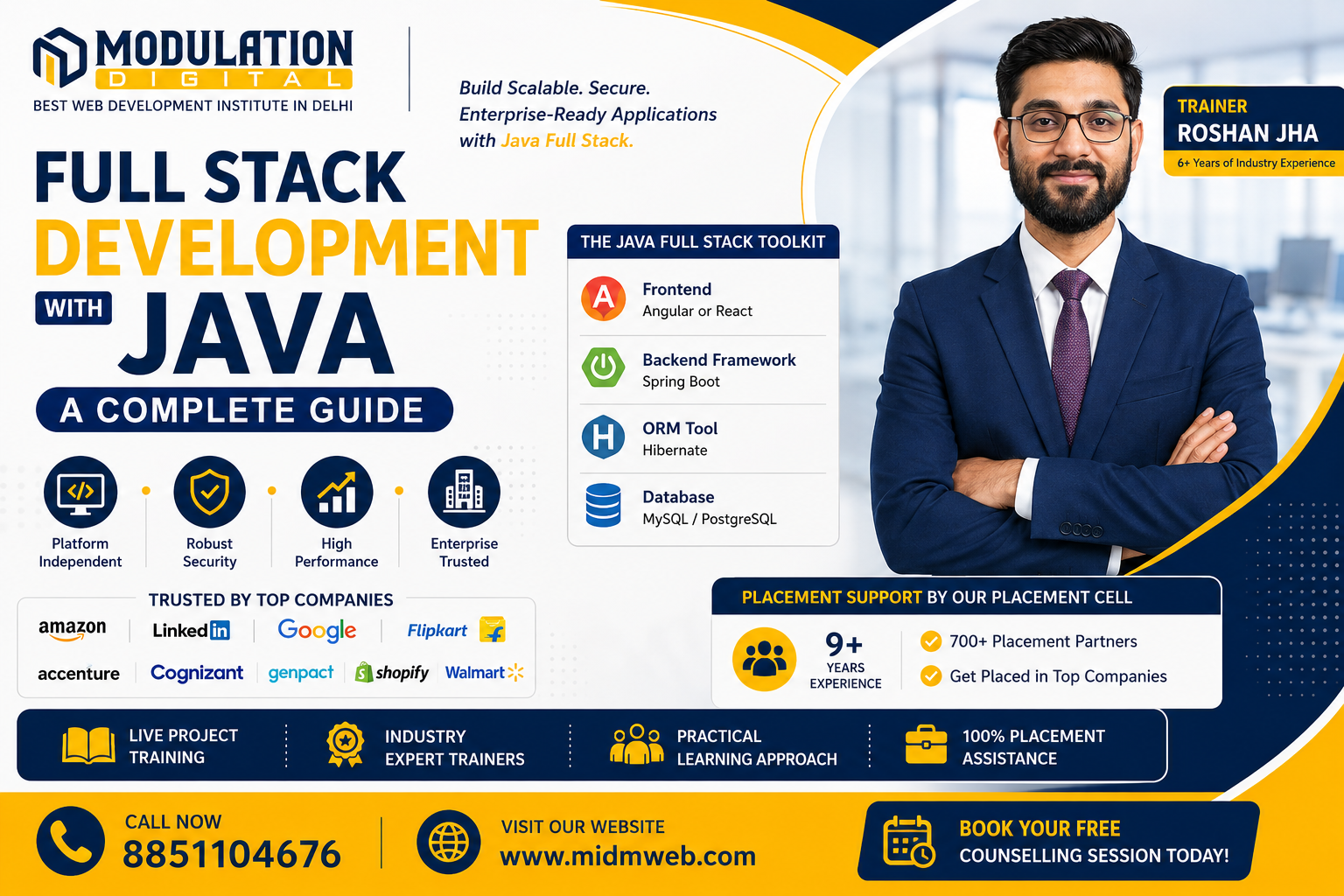
The course is led by Roshan Jha, an experienced web development trainer focused on practical implementation rather than lecture-only teaching. Training runs on current tools — HTML, CSS, JavaScript, React, Node.js — with an emphasis on the "why" behind each concept, not just syntax memorization. Combined with lifetime LMS access and 700+ placement partners, the structure is designed to carry you past the certificate stage into an actual job.
Course Highlights at a Glance
| Feature | What You Get |
| Trainer-led instruction | Practical, project-based teaching approach |
| Lifetime LMS access | Revisit videos, code samples, and materials anytime |
| Live project work | Real websites and apps, not just exercises |
| Career support | Resume building, mock interviews, placement help |
| Student rating | 4.7 stars across hundreds of reviews |
Do You Get Lifetime Access to Course Material?
Yes. Every student receives ongoing access to the Learning Management System — videos, code examples, presentations, and updated resources — even after the course ends. Web development tools and frameworks shift constantly, so being able to revisit material later, or catch up on something new, keeps your skills from going stale a year after graduation.
Is the Training Actually Hands-On?
Yes — live project work is a core part of the course, not an add-on. Students build real websites and applications rather than working through isolated exercises, which means you run into the same debugging, structuring, and problem-solving challenges a working developer faces daily. This is also what builds a portfolio you can actually show in interviews, instead of a certificate with nothing behind it. Employers consistently weigh demonstrated project work more heavily than course completion alone, which is exactly the gap live project training is meant to close.
What Does the Curriculum Actually Cover?
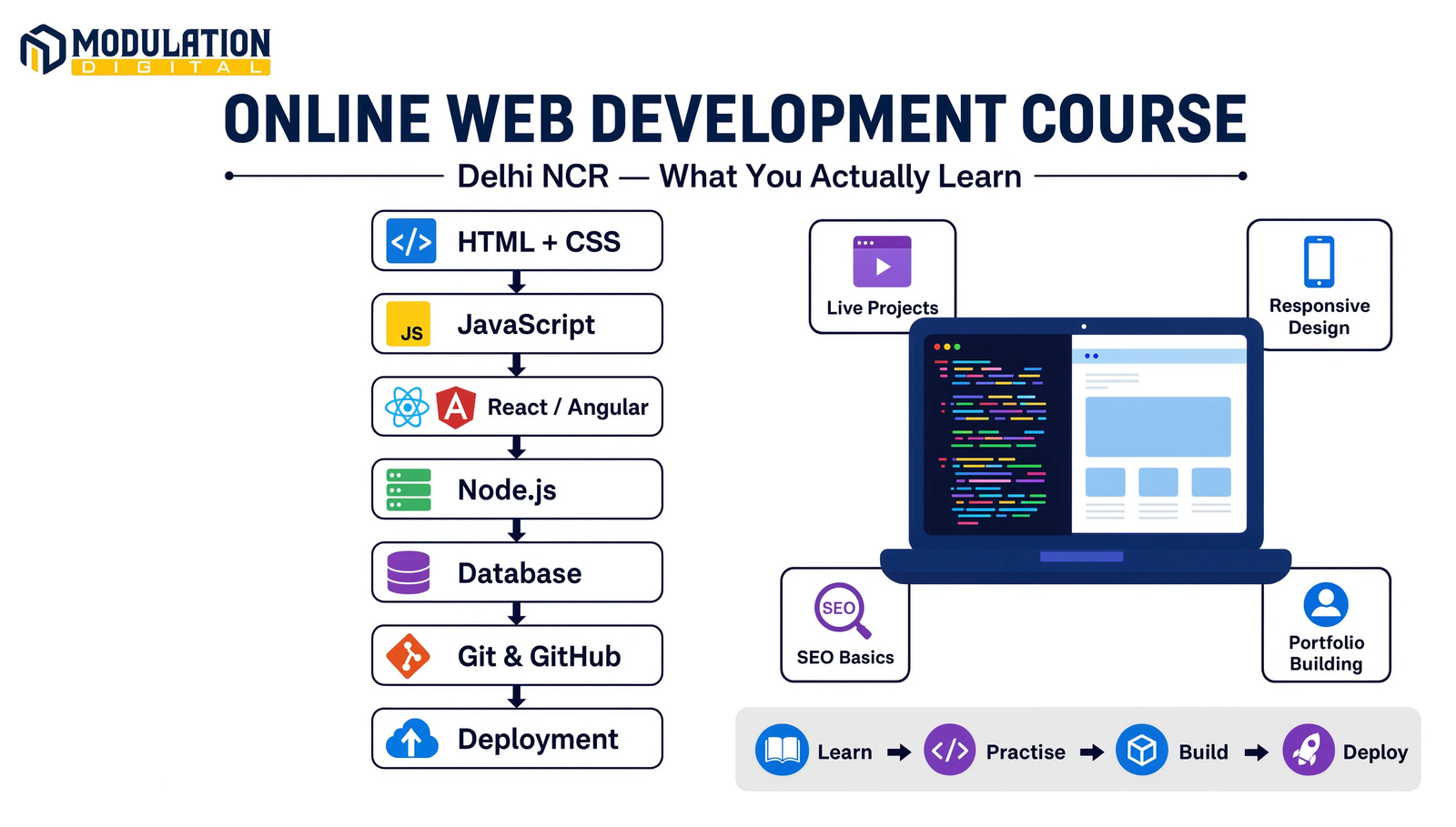
The syllabus moves from foundational to advanced, covering the full stack rather than one narrow slice:
- HTML & CSS — structuring and styling web pages from scratch
- JavaScript — interactivity, form validation, dynamic content
- Front-End Frameworks — React and Angular for building modern user interfaces
- Back-End Development — Node.js and Express for server-side logic
- Database Management — SQL and MongoDB for structured and NoSQL data
- Version Control — Git and GitHub for collaborative development
- Responsive Design — mobile-optimized layouts across devices
- Deployment & Hosting — publishing live sites on platforms like AWS and Heroku
Later modules also touch on Progressive Web Apps, Single Page Applications, and serverless architecture — concepts that keep graduates current rather than trained only on legacy patterns.
Does the Course Cover SEO Basics?
Yes, and this is often skipped elsewhere. Students learn to write search-friendly code, structure sites for crawlability, and implement meta tags correctly — meaning the websites you build aren't just functional, they're built to actually get found. For a developer, understanding basic SEO is a real differentiator, since many hiring teams expect at least foundational awareness of it even in purely technical roles.
What Career Paths Open Up After the Course?
Graduates typically move into one of several roles, depending on specialization:
- Front-End Developer — builds the interactive, visual layer of a site
- Back-End Developer — manages servers, databases, and application logic
- Full-Stack Developer — works across both ends of a project
- Web Application Developer — builds more complex, business-facing tools
- UI/UX Developer — blends design sensibility with development skill
- Freelance Web Developer — takes on independent client projects
- Web Development Consultant — advises businesses on technical strategy
These roles span tech, e-commerce, healthcare, and education, so the skill set isn't tied to one narrow industry.
What Kind of Career Support Is Included?
Finishing a web development course is only one step; knowing how to present your skills to employers is equally important. At Modulation Digital, career preparation is included alongside technical training so students can work on both areas together.
Students receive support with resume preparation, mock interview practice, portfolio development, and placement assistance through a network of 700+ hiring partners. Practical projects also give learners something tangible to discuss during interviews, from the technologies they used to the problems they solved while building their projects.
The aim is to help students understand the transition from learning code to presenting themselves as capable entry-level developers. Instead of treating career guidance as something that starts after the course, the process is introduced while students are still developing their technical skills.
FAQs
1. What is the best online web development course in Delhi NCR?
Modulation Digital's course stands out for its live project training, full-stack curriculum, and placement support through 700+ hiring partners.
2. Do I need coding experience to join?
No. The course starts with HTML and CSS fundamentals before progressing into JavaScript, frameworks, and backend development.
3. Is this course fully online?
Yes, it's designed as an online program with lifetime access to recorded sessions and course materials.
4. What technologies are covered?
HTML, CSS, JavaScript, React, Angular, Node.js, Express, SQL, MongoDB, Git, and deployment platforms like AWS and Heroku.
5. Will I work on real projects?
Yes, live project work is core to the training, giving you portfolio-ready websites and applications by the end.
6. Does the course include SEO training?
Yes, students learn to build search-friendly code and site structure alongside core development skills.
7. What jobs can I apply for after finishing?
Front-End Developer, Back-End Developer, Full-Stack Developer, Web Application Developer, and UI/UX Developer roles, among others.
8. Is placement assistance included?
Yes — resume building, mock interviews, and placement support through 700+ partner companies.
9. Can I access course material after completing the program?
Yes, lifetime LMS access lets you revisit videos, code samples, and updated resources anytime.
10. How is this course different from free online tutorials?
Structured mentorship, live project feedback, and placement support — things self-paced free tutorials don't provide.
11. Who leads the training?
Roshan Jha leads web development training, focusing on practical, project-based instruction over theory alone.
Conclusion
An online web development course can provide a structured starting point for learners who want to build practical coding skills and explore technology-focused careers. The real value, however, comes from what you can create and understand after completing the training.
Learning HTML, CSS, JavaScript, React, backend development, databases, Git, responsive design, and deployment can help you build a broader technical foundation. Working on practical projects adds another layer by giving you experience with debugging, development workflows, and solving real website or application problems.
Before choosing an online web development course in Delhi NCR, look beyond the certificate. Check the trainer's experience, technologies included in the syllabus, project exposure, learning support, course accessibility, and career assistance.
Technology will continue to change, so becoming a developer is not about learning one fixed set of tools. It is about developing strong fundamentals and the ability to learn new technologies as they emerge. A course can provide the structure; consistent practice and project building are what turn that knowledge into usable development skills.