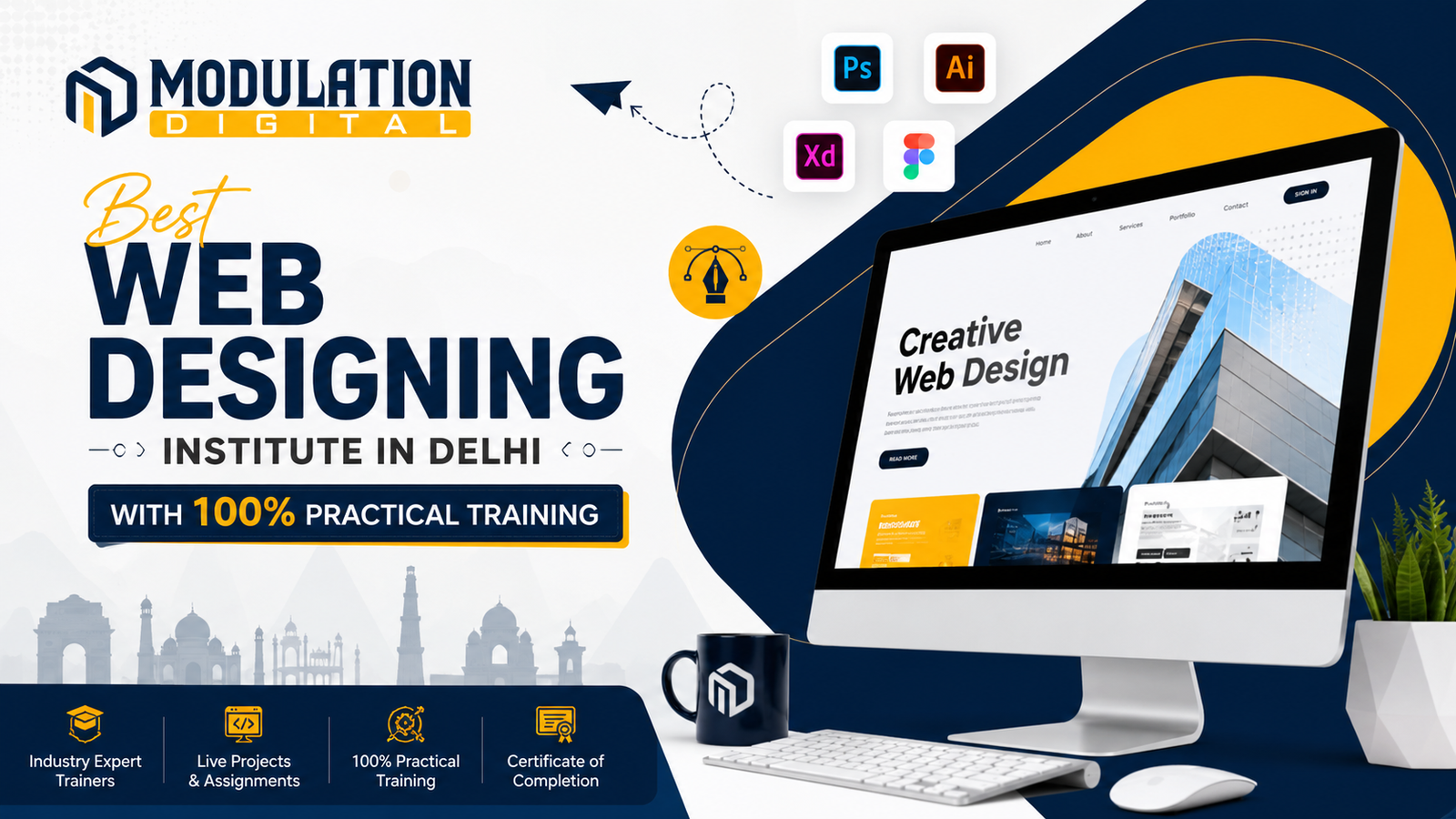
Why Choose Delhi for Web Designing Courses?
Delhi NCR hosts one of India's densest concentrations of digital agencies, IT firms, and e-commerce companies, which means web design talent is hired locally almost as fast as it's trained. Students benefit from proximity to hiring managers, internship pipelines, and freelance client networks that smaller cities simply can't match. Institutes based here also tend to hire trainers who are still active in the industry, so what's taught in class reflects what agencies and startups are actually building right now — responsive layouts, component-based design systems, and SEO-aware front-end code.
Web Designing Course Syllabus
HTML5 & Website Structure
Learn how webpages are structured using HTML5, including headings, paragraphs, links, images, lists, tables, forms, semantic elements, and multimedia.
CSS3 & Website Styling
Understand how to style webpages with CSS3 using selectors, colors, fonts, backgrounds, borders, spacing, positioning, Flexbox, Grid, transitions, and animations.
Responsive Web Design
Learn to create websites that automatically adjust to desktops, tablets, and smartphones using responsive layouts, media queries, flexible grids, and mobile-first techniques.
JavaScript Fundamentals
Understand the basics of JavaScript for making websites interactive, including variables, functions, conditions, loops, events, DOM manipulation, and form validation.
Bootstrap Framework
Learn how Bootstrap helps create responsive websites faster using its grid system, containers, buttons, cards, navigation bars, forms, modals, and ready-to-use components.
WordPress Website Development
Learn to create and manage professional websites using WordPress, including themes, plugins, pages, menus, customization, Elementor, forms, and basic website management.
UI/UX Design Fundamentals
Understand the principles behind user-friendly websites, including wireframes, layouts, typography, color combinations, navigation, visual hierarchy, user flow, and basic Figma usage.
Website Projects & Practical Implementation
Apply the concepts learned throughout the course by creating practical websites such as business websites, landing pages, portfolio websites, responsive pages, and WordPress projects under the guidance of Roshan Sir.
What Separates a Genuinely Good Web Designing Course
Course titles look similar across institutes, so the real differences show up in delivery. Four things matter most.
Live-project, not slideshow, learning. Reading about CSS Grid and actually laying out a client-style homepage with it are different skills. Programs built around real assignments — landing pages, e-commerce templates, portfolio sites — force students to solve the problems designers hit in production: image optimization, cross-device testing, and layout breakpoints.
Mentors who still work in the field. A trainer who freelances or consults alongside teaching brings current client expectations into the classroom, not textbook theory from five years ago.
A curriculum that doesn't stop at design. HTML5 and CSS3 are the baseline. A strong program layers in JavaScript, Bootstrap or Tailwind, Figma for UI/UX, and WordPress — because most entry-level roles expect designers to hand off (or build) a functioning page, not just a mockup.
Flexible scheduling. Many learners are either finishing a degree or working a day job. Institutes offering weekday, weekend, online, and offline batches remove the biggest reason students drop out midway.
How a Practical Approach Changes Career Outcomes
Certificates rarely get someone hired on their own — a portfolio does. Hiring managers in creative and IT roles consistently weigh a candidate's project work more heavily than the name on their certificate, because a portfolio is proof of ability rather than attendance. Practical training builds that portfolio as a byproduct of the course itself:
- Real client-style briefs teach requirement-gathering, wireframing, and revision cycles — the exact workflow designers use on the job, not just in an interview answer.
- Cross-browser and mobile testing exposure means graduates already understand why a design that looks perfect on a laptop can break on a phone.
- Tool fluency across Figma, Adobe XD, and code editors means new hires need less ramp-up time, which is exactly what employers screen for.
- Presentation practice — walking a mentor or peer group through design decisions — builds the interview confidence that separates a strong candidate from a shy one with an equally strong portfolio.
Career Paths and Salary Expectations After Web Designing Training
| Role | Typical Focus | Approx. Starting Salary (Delhi NCR) |
| Web Designer | Responsive layouts, visual design | ₹2.5–4.5 LPA |
| UI/UX Designer | User flows, wireframes, prototyping | ₹3–5 LPA |
| Frontend Developer | HTML/CSS/JS implementation | ₹3.5–6 LPA |
| WordPress/Shopify Developer | CMS-based site builds | ₹3–5.5 LPA |
| Freelancer (independent) | Client projects, global gigs | ₹40,000–1,00,000+/month |
Salaries scale with experience and portfolio strength — professionals with 3–5 years typically move into the ₹5–8 LPA range, and specialists with a strong UI/UX or development skillset can cross ₹9–12 LPA. Freelancers with an international client base often out-earn salaried peers, though income there is less predictable month to month.
Common employers for web design graduates in Delhi NCR span IT services firms, digital marketing agencies, e-commerce companies, and a fast-growing base of local startups that need affordable, in-house design talent — alongside global freelance marketplaces for those who prefer independent work.
How to Choose the Right Institute: A Checklist
Before enrolling anywhere, verify these four things directly rather than taking a sales pitch at face value:
- Ask for the actual curriculum document, not a course title — check it names specific tools and technologies with hours allocated to each.
- Read recent Google and LinkedIn reviews, not just testimonials on the institute's own site.
- Ask for placement data with specifics — which companies, what roles, what timeframe — rather than a vague "100% placement" claim.
- Sit in on a demo class. Institutes confident in their teaching quality rarely hesitate to offer one.
Why Students Choose Modulation Digital for Web Designing Training in Delhi
Modulation Institute, located in Laxmi Nagar, Delhi, offers practical web designing and web development training designed to help students build skills they can actually use in professional projects.
Under the guidance of Roshan Sir, the program focuses on learning by doing. Students work with essential technologies such as HTML5, CSS3, JavaScript, Bootstrap, WordPress, and UI/UX fundamentals, while applying their knowledge through live projects and practical assignments.
What makes the training more flexible is the availability of classroom training, live online classes, and recorded learning support. This allows students from Delhi as well as learners from other cities to access the same structured training with ongoing guidance.
Modulation Digital also focuses on career preparation beyond technical skills. Students receive support with resume development, mock interviews, portfolio building, and job referrals through the institute's professional network. The practical exposure can also help learners explore opportunities in web designing, web development, WordPress development, UI/UX, and freelancing.
For students looking for a web designing course in Delhi that combines technical concepts, hands-on projects, trainer guidance, and career-oriented learning, Modulation Digital provides a practical environment to develop job-ready skills under the mentorship of Roshan Sir.
FAQs
1. What is the best web designing institute in Delhi for beginners?
Look for an institute that offers practical training in HTML5, CSS3, JavaScript, responsive design, WordPress, and UI/UX, along with experienced trainers and demo classes.
2. How long does a web designing course take to complete?
A practical web designing course generally takes around 3 to 6 months, depending on the curriculum, class schedule, and whether web development is included.
3. What is the average fee for a web designing course in Delhi?
Web designing course fees can vary depending on duration, syllabus, practical training, and placement support. Comprehensive programs may cost around ₹40,000–₹60,000, while shorter courses can be considerably less.
4. Do I need coding knowledge to learn web designing?
No. Beginners can start without prior coding experience. Most courses begin with HTML and CSS before moving into JavaScript, frameworks, WordPress, and other technologies.
5. What tools and technologies are taught in web designing courses?
Common technologies include HTML5, CSS3, JavaScript, Bootstrap, WordPress, Figma, and responsive web design. Some courses may also introduce basic SEO and website optimization.
6. What is the difference between web designing and web development?
Web designing focuses mainly on the visual appearance, layout, usability, and user experience of a website. Web development deals more with implementing functionality, interactions, databases, and technical features.
7. What jobs can I get after completing a web designing course?
Depending on your skills and specialization, you can pursue roles such as Web Designer, UI/UX Designer, Frontend Developer, WordPress Developer, Website Executive, or Freelance Web Designer.
8. Is web designing a good career in 2026?
Yes. Businesses continue to need responsive, user-friendly websites across industries. Developing skills in web design, frontend technologies, UI/UX, WordPress, and responsive development can create opportunities in agencies, startups, IT companies, e-commerce businesses, and freelancing.
9. Can I learn web designing online while working or studying?
Yes. Live online and flexible batch options allow students and working professionals to learn web designing without attending physical classes every day.
10. Does Modulation Digital offer placement support for web designing students?
Yes. Modulation Digital provides career and placement assistance for eligible students, including guidance with resume preparation, mock interviews, portfolio development, and job opportunities.
11. What is the starting salary for a web designer in Delhi?
Entry-level web designers in Delhi NCR may typically earn around ₹2.5 LPA to ₹4.5 LPA, depending on their portfolio, technical skills, company, and level of practical experience.
Conclusion
Web designing has moved well past "knowing how to use a design tool." It now sits at the intersection of visual design, front-end code, and user psychology, and companies hiring for the role expect all three in some measure. The gap between an average graduate and a genuinely employable one almost always comes down to how much real project work they did during training — not which software they learned. If you're evaluating your options, prioritize institutes that can show you finished student projects, name their trainers' real experience, and back their placement claims with specifics.
Ready to see what practical, project-based web design training looks like? Book a free demo class with Modulation Digital and get a firsthand look at the training before you commit.