What Digital Marketing Really Means
At its core, digital marketing is any marketing effort that uses an internet-connected device or digital medium to reach an audience. Unlike traditional advertising, which broadcasts a message to a broad, largely untracked audience, digital marketing lets businesses target specific groups of people, measure exactly how they respond, and refine the message accordingly.
This shift matters because consumer attention has moved online. People research products, compare prices, read reviews, and make purchase decisions on their phones and laptops long before they ever speak to a salesperson. Businesses that don't show up in that digital journey simply lose visibility to competitors who do.
For individuals, this shift has created a fast-growing job market. India alone has around 900 million internet users, making it the second-largest online market in the world after China — and companies of every size now need people who can run campaigns, analyze data, and manage an online presence.
Core Elements of Digital Marketing
digital marketing isn't one single skill; it's a collection of interconnected disciplines that work together:
Search Engine Optimization (SEO)
SEO is the process of improving a website so it ranks higher in organic (unpaid) search results. Nearly half of marketing professionals — 49% — say organic search delivers the best overall ROI of any marketing channel, and it's the single highest-ranked channel among B2B marketers (HubSpot State of Marketing, 2026).
Social Media Marketing (SMM)
This involves using platforms like Instagram, Facebook, LinkedIn, and YouTube to build brand awareness, engage directly with an audience, and run targeted ad campaigns. Social media advertising alone is projected to reach roughly $317 billion globally in 2026.
Content Marketing
Content marketing means creating genuinely useful material — blog posts, videos, guides, infographics — that answers real questions your audience has. Instead of interrupting people with ads, it earns attention by being helpful, which builds long-term trust and search visibility.
Email Marketing
Despite being one of the oldest digital channels, email remains the highest-ROI tool available — delivering an average return of $36 for every $1 spent, according to Litmus and HubSpot research (2026).
Pay-Per-Click (PPC) Advertising
PPC lets businesses place ads on Google, Instagram, or other platforms and pay only when someone clicks. Search advertising remains the largest single digital ad channel globally, and rising competition has pushed average cost-per-click up by around 20% in the last year.
Affiliate Marketing
In affiliate marketing, external partners promote a business's products in exchange for a commission on resulting sales. It's a low-risk way for companies to expand reach through other people's existing audiences.
Influencer Marketing
Brands collaborate with content creators who already have an engaged following. This channel keeps growing fast — nearly 87% of marketers plan to increase their influencer marketing budgets in 2026 — and in India specifically, the influencer industry is projected to reach ₹3,375 crore by 2026.
Online Reputation Management (Online PR)
This covers how a brand is perceived across the internet — managing reviews, responding to customer feedback, and securing positive media or blog mentions to keep public perception favorable.
Types of Digital Marketing: Organic vs. Paid
Nearly every digital marketing channel falls into one of two categories:
Organic marketing relies on unpaid efforts — SEO, content, and social media posts that grow visibility naturally over time. It's slower to show results but builds lasting, compounding value.
Paid marketing uses budget to buy visibility instantly — PPC ads, paid social promotions, and sponsored content. It delivers faster results but stops producing traffic the moment spending stops.
Most successful digital marketing strategies use a blend of both: paid campaigns to generate quick wins and data, and organic efforts to build sustainable, long-term visibility.
Key Channels and Platforms
Digital marketers typically work across these environments:
| Channel | Primary Use |
| Websites & blogs | Central hub for brand content and SEO |
| Social platforms (Instagram, LinkedIn, Facebook) | Engagement, brand building, targeted ads |
| Search engines (Google, Bing) | Organic and paid visibility |
| Email tools (Mailchimp, HubSpot) | Lead nurturing and retention |
| Video platforms (YouTube, Instagram Reels) | Attention-grabbing, shareable content |
| Ad networks (Google Ads, Meta Ads) | Precisely targeted paid campaigns |
Digital Marketing vs. Traditional Marketing
Traditional marketing — TV, print, billboards — broadcasts a single message to a wide, mostly anonymous audience with little ability to measure exact impact. digital marketing flips this model:
Targeting: Traditional marketing targets broad demographics; digital marketing can target specific interests, behaviors, and even individual browsing history.
Cost: Traditional campaigns often require large upfront budgets; digital campaigns can start small and scale based on performance.
Measurability: Traditional marketing relies on estimates and surveys; digital marketing provides exact data — clicks, conversions, cost per lead — in real time.
Speed of adjustment: A billboard can't be changed mid-campaign. A digital ad can be paused, edited, or reallocated within minutes.
This doesn't make traditional marketing obsolete, but it explains why digital media has now overtaken television as India's largest advertising channel.
Digital Marketing by the Numbers (2026)
A quick snapshot of where the industry stands right now:
| Metric | Figure | Source |
| Global digital ad spend | ~$835.8 billion (68.7% of all ad spend) | GroupM, 2026 Forecast |
| India digital ad spend growth (FY24-25) | +29% YoY, ~₹40,800 crore | Expert Market Research, 2026 |
| Share of India ad spend now digital | 41% (overtook TV) | Expert Market Research, 2026 |
| Mobile share of digital ad budgets | 54% (~$400B globally) | Incremys, 2026 |
| Email marketing ROI | $36 return per $1 spent | Litmus / HubSpot, 2026 |
| Marketers rating organic search as top-ROI channel | 49% | HubSpot State of Marketing, 2026 |
| Google searches showing AI Overviews | 47% | Industry ad data, 2026 |
| India digital marketing market CAGR (2026–2035) | 30.2% | Expert Market Research, 2026 |
The takeaway: digital marketing isn't a niche skill anymore — it's the primary channel businesses are shifting budget into, in India and globally, and that shift is accelerating rather than slowing down.
Future of Digital Marketing.
The future of digital marketing is one who gets dominated by emerging trends that range from AI, voice search, and more. They affect the way people interact with businesses, making customers receive much more personalized experiences, along with more efficient customer service.
Data security and privacy are gradually gaining priority for all the businesses, because ensuring the safety of all the details of their customers and adhering to all the rules and regulations help create and build trust and credibility.
For instance, new digital marketing jobs are expected to increase nowadays, such as AI specialists and data privacy officers. Predictions still further indicate that innovative techniques and tools, such as automation and predictive analytics, should enrich targeting, customer engagement, and, on the whole, the effectiveness of marketing.
In the coming years, these changes could make the future of digital marketing more dynamic, efficient, and customer-focused.
A Simple Strategy Framework
A working digital marketing plan generally follows these steps:
Set clear goals — define what success looks like (traffic, leads, sales, brand awareness) using specific, measurable targets.
Know your audience — understand who you're trying to reach and where they spend time online.
Choose the right channels — not every platform fits every business; a B2B company may prioritize LinkedIn, while a fashion brand may lean on Instagram.
Allocate budget wisely — split spend between paid and organic efforts, and monitor which channels deliver the best return.
Track and optimize — use analytics tools to measure performance and continuously refine the approach.
Common Challenges
Market saturation — standing out requires genuinely better content and stronger customer relationships, not just more ads.
Algorithm changes — with AI Overviews now appearing on roughly 47% of Google searches, ranking strategies that worked a year ago need constant re-evaluation.
Rising customer expectations — audiences expect fast, personalized responses, which demands consistent effort across channels.
Constant learning curve — tools, platforms, and best practices evolve quickly, so staying current is part of the job.
Skills You Need to Get Started
Breaking into digital marketing doesn't require a technical background. The core skills include:
Basic understanding of SEO and keyword research
Comfort with analytics tools (like Google Analytics)
Content writing or content strategy
Familiarity with social media ad platforms
Basic data interpretation to judge what's working
Willingness to keep learning as platforms change
Most of these are learned through structured training and hands-on practice rather than a formal degree, which is part of why digital marketing has become such an accessible career path — and why demand for trained professionals continues to outpace supply as India's digital ad market grows at a projected CAGR of over 30% through 2035.
The Future of Digital Marketing
Several trends are shaping where digital marketing is headed:
AI-driven personalization and search — with AI Overviews already reshaping how nearly half of Google searches display results, marketers need to optimize for AI answer engines, not just traditional rankings.
Mobile-first everything — mobile now commands 54% of digital ad budgets, and the majority of online purchases happen on mobile.
Retail media growth — one of the fastest-growing ad categories globally, as platforms combine first-party shopping data with advertising.
Data privacy — stricter regulations mean marketers must balance personalization with responsible data use.
These shifts are also creating new job roles — from AI-focused marketing specialists to data privacy consultants — making this a field that keeps generating fresh career opportunities rather than shrinking.
Why Choose Modulation Digital for a Digital Marketing Course in Delhi?
Learning digital marketing through videos and articles can build basic knowledge, but becoming an industry-ready professional requires practical experience, expert mentorship, and real-world implementation. Modulation Digital of digital marketing bridges the gap between learning and employment by offering industry-focused training that prepares students for today's competitive digital landscape. With a practical teaching methodology, updated curriculum, and career-oriented approach, Modulation Digital helps learners develop the skills needed to succeed in digital marketing.
Learn from an Industry Expert with 10+ Years of Experience
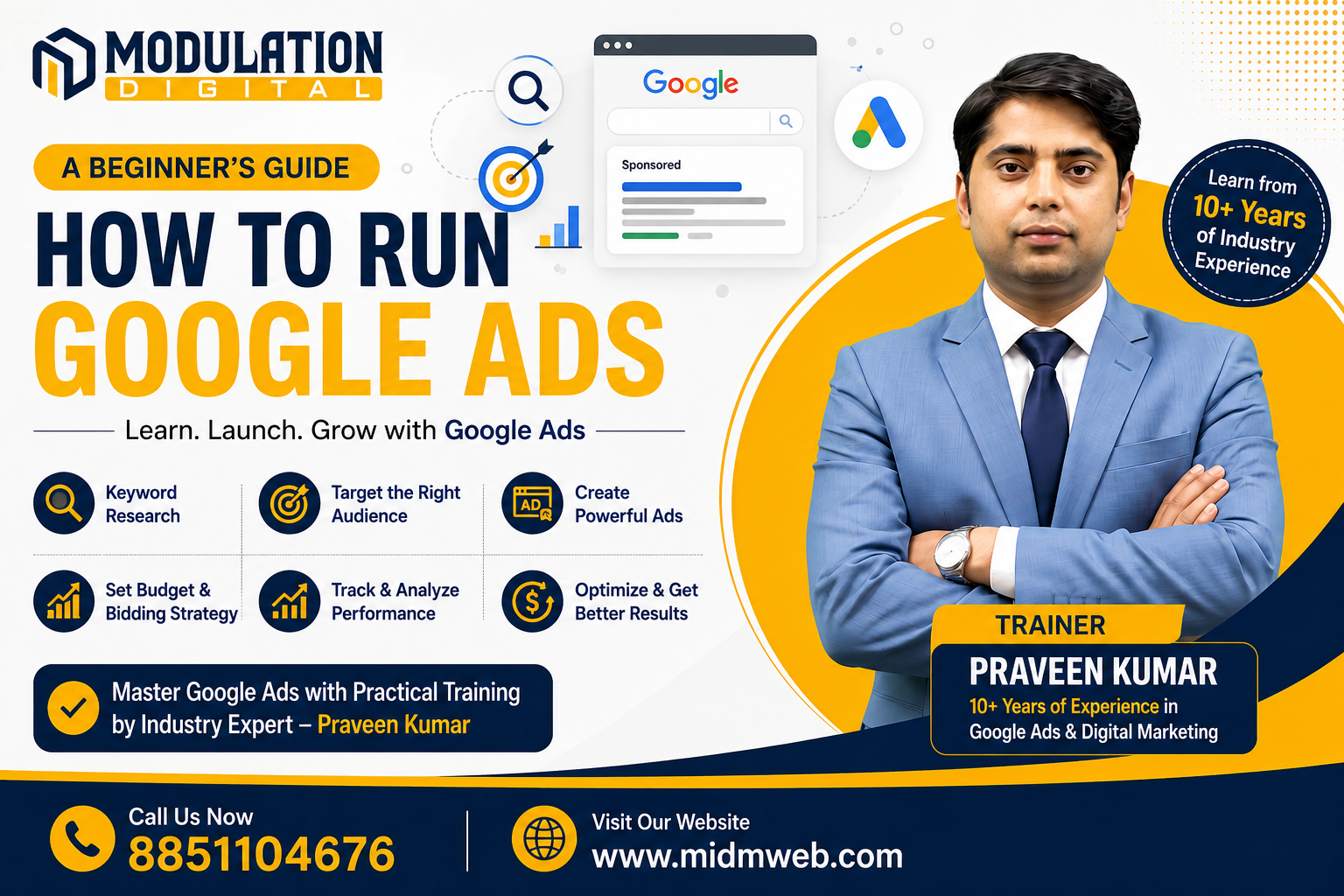
At Modulation Digital, students are mentored by Praveen Kumar, a digital marketing professional with over 10 years of industry experience in SEO, Google Ads, Social Media Marketing, Website Development, and Performance Marketing. Every module is taught using practical examples, case studies, and real business scenarios, enabling students to understand how digital marketing strategies are implemented in the real world.
Flexible Learning That Fits Every Student's Schedule
Modulation Digital offers multiple learning formats to make digital marketing education accessible for everyone. Students can choose from:
- Classroom Training
- Live Online Classes
- Recorded Sessions with Lifetime LMS Access
- Live Doubt-Clearing and Mentor Support
This flexible approach allows students, working professionals, freelancers, and entrepreneurs to learn anytime without compromising their daily commitments.
Gain Practical Experience Through Live Projects
Rather than focusing only on theory, Modulation Digital emphasizes hands-on learning through real business projects. Students work on:
- Live SEO Projects
- Google Ads Campaigns
- Social Media Marketing
- WordPress Website Development
- Lead Generation Campaigns
- Real Client Websites
This practical exposure builds confidence and prepares students to solve real marketing challenges from the very beginning of their careers.
Industry-Updated Curriculum Designed for Future Careers
The digital marketing Course is regularly updated to match the latest industry trends and technologies. Students learn in-demand skills including SEO, Google Ads, Meta Ads, AI Tools, Content Marketing, Email Marketing, Google Analytics (GA4), Local SEO, Affiliate Marketing, Personal Branding, Freelancing, and Client Management. The curriculum is designed to help students stay ahead in the rapidly evolving digital marketing industry.
100% Placement Support with Career-Focused Guidance
Modulation Digital supports students beyond classroom training by providing 100% placement assistance, resume building, LinkedIn profile optimization, mock interviews, technical interview preparation, internship opportunities, and career guidance. The objective is to help every student become job-ready and confidently pursue opportunities in leading organizations or as independent digital marketing professionals.
Why Students Choose Modulation Digital
Students prefer Modulation Digital because of its career-focused learning environment and practical approach. Key advantages include:
- 10+ Years Experienced Trainer
- Live Project-Based Training
- Industry-Updated Curriculum
- Classroom, Online & LMS Learning
- Lifetime Learning Support
- Internship Opportunities
- 100% Placement Assistance
- Resume & Interview Preparation
- Personalized Mentorship
- Beginner-Friendly & Career-Oriented Training
Whether you are a student, fresher, working professional, entrepreneur, or freelancer, Modulation Digital digital marketing Course in Delhi provides the practical knowledge, industry exposure, and career support needed to build a successful future in digital marketing.
Conclusion
digital marketing has become the primary way businesses connect with customers, build trust, and drive growth — and the data backs it up: global spend is closing in on $836 billion in 2026, and in India digital has already overtaken television as the top advertising channel. Its combination of measurable results, precise targeting, and real-time flexibility makes it more effective, and often more affordable, than traditional advertising for businesses of nearly any size.
For individuals, it represents one of the most accessible and fastest-growing career paths available today. Whether your goal is to grow a business or start a new career, understanding these fundamentals is the first real step — and the demand for people who can apply them is only growing.
FAQs
What is digital marketing in simple words?
digital marketing is promoting products or services using online channels — like search engines, social media, and email — instead of traditional print or broadcast media.
How big is the digital marketing industry in 2026?
Global digital ad spend is projected to reach around $835.8 billion in 2026 — about 69% of total advertising spend worldwide (GroupM, 2026).
Which digital marketing channel should beginners start with?
Most beginners start with social media, basic SEO, and email marketing since these have low barriers to entry and offer quick, visible learning outcomes.
Can I build a career in digital marketing after 12th grade?
Yes. digital marketing doesn't require a specific degree — many professionals start with focused courses and certifications right after school and build experience through hands-on projects.
Is digital marketing a good career choice in 2026?
Yes. India's digital marketing market is projected to grow at a 30.2% CAGR through 2035, and digital media has already overtaken television as the country's top advertising channel — signaling strong, sustained demand for trained professionals.