The Evolution of Data Analytics in Modern Business
Data Analytics Coaching in Laxmi Nagar is an excellent choice for students and professionals who want to build a successful career in today's data-driven world. With businesses relying more on data than ever before, learning analytics has become an essential skill for making smarter business decisions and solving real-world problems.
Modern organizations collect huge amounts of information from websites, mobile apps, social media platforms, online transactions, and customer interactions. However, raw data has little value until it is organized, analyzed, and converted into meaningful insights. This is where Data Analytics plays a vital role. It helps businesses understand customer preferences, improve products and services, reduce operational costs, identify market trends, and make informed decisions that support long-term growth.
Today, industries such as healthcare, banking, finance, retail, manufacturing, education, and digital marketing actively hire skilled Data Analysts to manage and interpret business data. As technologies like Artificial Intelligence (AI), Business Intelligence (BI), and Machine Learning (ML) continue to evolve, the demand for analytics professionals is growing rapidly. By enrolling in a Data Analytics Course in Laxmi Nagar, you can gain practical skills, hands-on experience, and industry-ready knowledge that opens the door to rewarding career opportunities.
What Makes a Great Data Analyst?
A great Data Analyst does much more than work with spreadsheets or create reports. They collect, organize, and analyze data to help businesses make informed decisions. Strong analytical thinking, attention to detail, and problem-solving skills are just as important as technical knowledge. A successful Data Analyst understands business goals and uses data to find patterns, identify opportunities, and recommend practical solutions that improve performance.
Some of the key responsibilities of a professional Data Analyst include:
- Collecting data from multiple sources
- Cleaning and organizing raw datasets
- Identifying trends and hidden patterns
- Creating interactive dashboards and reports
- Presenting insights to teams and stakeholders
- Supporting business decision-making
- Recommending improvements based on data
- Automating routine reporting processes
At digital marketing, students develop these essential skills through hands-on practical training, real business case studies, live projects, assignments, and expert guidance. The course focuses on applying knowledge to solve real-world business challenges, helping learners become confident and job-ready Data Analytics professionals.
Comprehensive Tools & Programming Languages Covered
A professional Data Analytics course should prepare students with the latest tools and technologies used by leading companies. At digital marketing, the curriculum is designed to match current industry standards and focuses on practical learning through live projects, assignments, and real-world datasets. Students gain hands-on experience with the most in-demand tools that help them become job-ready Data Analytics professionals.
Microsoft Excel
Excel is the foundation of Data Analytics and is widely used for data management and reporting. Students learn:
- Advanced Formulas and Functions
- Pivot Tables
- Conditional Formatting
- Power Query
- Dashboard Creation
- MIS Reporting
- Financial Reporting
SQL (Structured Query Language)
SQL is essential for working with databases and retrieving business data efficiently. Topics include:
- Database Design
- Data Extraction
- Data Filtering
- Joins
- Views
- Stored Procedures
- Query Performance Optimization
Python Programming
Python is one of the most popular programming languages for Data Analytics. Students learn:
- Python Fundamentals
- Data Structures
- Pandas
- NumPy
- Matplotlib
- Data Cleaning
- Automation Scripts
Power BI
Power BI helps transform raw data into interactive business dashboards. The course covers:
- Interactive Dashboards
- KPI Reports
- DAX Functions
- Data Modeling
- Business Intelligence Reports
Tableau
Tableau is a leading data visualization tool used by organizations worldwide. Students learn:
- Storytelling Dashboards
- Business Visualization
- Interactive Reports
- Executive Dashboards
Statistics
A strong understanding of statistics is essential for making accurate business decisions. Topics include:
- Descriptive Statistics
- Probability
- Regression Analysis
- Correlation
- Sampling Techniques
- Hypothesis Testing
Data Visualization
Effective visualization makes complex data easier to understand. Students work with:
- Charts and Graphs
- Heat Maps
- Scatter Plots
- KPI Dashboards
- Executive Reports
Additional Industry Skills
To make students industry-ready, the course also includes:
- Data Cleaning
- Data Transformation
- Business Intelligence
- Predictive Analytics
- Report Automation
- Data Storytelling
- Real-World Case Studies
- Live Industry Projects
By mastering these tools and technologies, students gain the confidence to analyze complex datasets, create professional dashboards, and solve real business challenges across industries such as finance, healthcare, retail, e-commerce, marketing, and IT.
Real Industry Projects You Will Work On
Practical experience is one of the most important parts of becoming a successful Data Analyst. At digital marketing, students don't just learn concepts in the classroom—they apply their knowledge by working on real-world projects based on actual business scenarios. These projects help learners understand how companies use data to solve problems, improve performance, and make better business decisions. Working with real datasets also builds confidence and prepares students for interviews and professional roles.
During the course, students get hands-on experience with projects such as:
- E-commerce Sales Dashboard
- Hospital Performance Analytics
- Banking Loan Analysis
- Customer Churn Prediction
- HR Employee Analytics
- Marketing Campaign Performance
- Financial Reporting Dashboard
- Retail Sales Forecasting
- Social Media Analytics
- Website Traffic Analysis
Each project is designed to strengthen practical skills in data collection, cleaning, analysis, visualization, and reporting using industry-standard tools like Excel, SQL, Python, Power BI, and Tableau. By the end of the course, students have a strong project portfolio that showcases their technical abilities and problem-solving skills, helping them stand out to recruiters and increasing their chances of securing rewarding career opportunities.
Soft Skills Every Data Analyst Should Develop
Technical knowledge is essential for a successful career in Data Analytics, but it is not the only skill employers look for. Companies also prefer professionals who can communicate their findings clearly, work effectively with teams, and solve business problems using data. Strong soft skills help Data Analysts present complex information in a simple way, collaborate with different departments, and make a greater impact within an organization.
At digital marketing, students are encouraged to develop important professional skills alongside technical training. These include:
- Business Communication
- Presentation Skills
- Critical Thinking
- Problem-Solving Ability
- Logical Reasoning
- Team Collaboration
- Time Management
- Professional Reporting
- Interview Confidence
Students improve these skills through group discussions, presentations, mock interviews, case studies, and real-world projects. This practical approach helps them communicate confidently, handle workplace challenges, and perform effectively in professional environments. By combining technical expertise with strong soft skills, digital marketing prepares students to become well-rounded Data Analytics professionals who are ready to succeed in today's competitive job market.
Industries Hiring Data Analytics Professionals
Data Analytics has become an essential part of modern businesses, creating career opportunities across almost every industry. Today, organizations generate large amounts of data from customers, sales, websites, mobile applications, marketing campaigns, and daily business operations. To make sense of this information, companies hire skilled Data Analysts who can collect, organize, analyze, and present data in a meaningful way. Their insights help businesses improve efficiency, reduce costs, understand customer behavior, and make informed decisions for future growth.
Because every industry depends on data, the demand for trained Data Analytics professionals continues to increase. After completing a Data Analytics course at digital marketing, students can explore career opportunities in several high-growth sectors, including:
Information Technology (IT)
IT companies use Data Analytics to monitor software performance, improve products, analyze user behavior, and support business intelligence initiatives.
Healthcare
Hospitals and healthcare organizations analyze patient records, treatment outcomes, operational performance, and medical research data to improve healthcare services and patient care.
Banking and Financial Services
Banks and financial institutions use analytics for fraud detection, credit risk analysis, customer segmentation, investment planning, and financial forecasting.
Insurance
Insurance companies rely on Data Analysts to evaluate claims, assess risk, detect fraud, and improve customer service through data-driven insights.
Retail and E-commerce
Retail businesses and online marketplaces analyze customer purchasing behavior, inventory levels, pricing strategies, and sales performance to maximize revenue and improve customer satisfaction.
Manufacturing
Manufacturing companies use analytics to monitor production processes, improve quality control, predict equipment maintenance, and optimize supply chain operations.
Telecommunications
Telecom providers analyze network performance, customer usage patterns, service quality, and customer retention to improve their services.
Education
Educational institutions use data to monitor student performance, improve learning outcomes, manage admissions, and support academic planning.
Government Organizations
Government departments use Data Analytics for public policy planning, resource management, healthcare programs, transportation, and smart city initiatives.
Business Consulting
Consulting firms analyze business data to help organizations improve operations, increase profitability, and develop effective growth strategies.
Logistics and Supply Chain
Logistics companies use analytics to optimize delivery routes, manage inventory, forecast demand, and improve overall supply chain efficiency.
digital marketing
Marketing agencies analyze website traffic, advertising campaigns, social media performance, customer engagement, and conversion rates to improve marketing strategies and return on investment (ROI).
Real Estate
Real estate companies use Data Analytics to study market trends, property values, customer preferences, and investment opportunities, helping clients make informed decisions.
Travel and Hospitality
Hotels, airlines, and travel companies use analytics to understand customer preferences, optimize pricing, improve booking experiences, and enhance overall customer satisfaction.
Why This Career Offers Long-Term Growth
One of the biggest advantages of choosing Data Analytics is its versatility. Unlike many professions that are limited to a single industry, Data Analytics skills are valuable across almost every business sector. Whether you are interested in technology, healthcare, finance, marketing, education, or government services, the knowledge you gain can be applied in multiple career paths. As businesses continue to embrace digital transformation, Artificial Intelligence (AI), and Business Intelligence (BI), the demand for qualified Data Analytics professionals is expected to grow even further, making it one of the most stable and rewarding career choices for the future.
Career Roadmap After Completing Data Analytics Training
A career in Data Analytics offers excellent growth opportunities for both freshers and experienced professionals. As you gain practical experience, improve your technical skills, and work on real-world projects, you can progress from entry-level positions to senior leadership roles. At digital marketing, students receive practical training, industry projects, and career guidance that help them build a strong foundation for long-term success in the analytics field.
Entry-Level Roles
After completing the course, beginners can apply for entry-level positions where they learn to work with business data and support organizational decision-making. Common job roles include:
- Data Analyst
- MIS Executive
- Reporting Analyst
- Junior Business Analyst
These roles involve collecting and cleaning data, creating reports, building dashboards, and assisting senior analysts with business insights.
Mid-Level Roles
With 2–5 years of experience and advanced technical knowledge, professionals can move into more specialized and higher-paying positions such as:
- Business Intelligence (BI) Analyst
- Power BI Developer
- Tableau Consultant
- Analytics Consultant
- Data Visualization Specialist
At this stage, professionals work on complex datasets, develop interactive dashboards, automate reporting, and provide strategic recommendations to business leaders.
Senior-Level Roles
Experienced professionals with strong technical and leadership skills can advance into senior positions, including:
- Senior Data Analyst
- Analytics Manager
- Business Intelligence Manager
- Analytics Lead
- Data Science Consultant
These roles involve leading analytics teams, managing business intelligence projects, developing data-driven strategies, mentoring junior analysts, and helping organizations make critical business decisions.
Future Career Growth
The learning journey does not stop after becoming a Data Analyst. By continuously upgrading your skills and gaining hands-on experience, you can transition into advanced and highly rewarding fields such as:
- Machine Learning Engineer
- Artificial Intelligence (AI) Specialist
- Data Scientist
- Data Engineer
- Big Data Engineer
- Cloud Data Analyst
- Business Intelligence Architect
These career paths offer exciting opportunities to work with cutting-edge technologies and solve complex business challenges. With the growing demand for data professionals across industries, Data Analytics provides a stable, future-ready career with excellent opportunities for professional growth, higher salaries, and global job prospects.
Why Practical Learning Matters More Than Theory
Learning the theory of Data Analytics is important, but practical experience is what truly prepares students for a successful career. Today, employers look for candidates who can apply their knowledge to solve real business problems rather than simply explain concepts. A strong understanding of tools, real-world datasets, and business scenarios gives job seekers a significant advantage during interviews and in the workplace.
At digital marketing, the focus is on practical, industry-oriented training that helps students build confidence and gain hands-on experience. Instead of relying only on classroom lectures, students work on real projects and business case studies that reflect actual industry requirements. This approach helps learners understand how data is collected, cleaned, analyzed, visualized, and used to support business decisions.
The practical learning methodology at digital marketing includes:
- Hands-on classroom sessions
- Weekly practical assignments
- Industry case studies
- Live projects
- Capstone projects
- Real-world datasets
- Dashboard development
- Mock interviews
- Resume building
- LinkedIn profile optimization
- Portfolio development
- Career guidance and placement support
By working on practical assignments and industry-based projects, students develop technical expertise, problem-solving abilities, and professional confidence. They also build a strong portfolio that showcases their skills to recruiters. This practical approach not only improves learning outcomes but also makes students job-ready, helping them transition smoothly from the classroom to the professional workplace.
Why Employers Prefer Candidates with Practical Experience
In today's competitive job market, employers look beyond certificates and academic qualifications. They prefer candidates who can demonstrate practical skills and confidently solve real business problems using data. Recruiters often evaluate applicants based on their project experience, technical knowledge, problem-solving ability, and the quality of their portfolio. A candidate who has worked on real-world projects is generally more prepared to handle workplace challenges than someone with only theoretical knowledge.
At digital marketing, students gain valuable hands-on experience by working on industry-based projects that simulate real business scenarios. Throughout the course, learners build a professional portfolio that showcases their technical expertise and practical abilities. This portfolio becomes a valuable asset during interviews, helping students demonstrate their skills and stand out from other applicants.
Students develop and showcase projects such as:
- Interactive Power BI Dashboards
- Tableau Visualizations
- SQL Database Projects
- Python Data Analysis Notebooks
- Advanced Excel Automation Files
- Business Intelligence Reports
- Data Storytelling Presentations
- KPI and Performance Dashboards
- Data Cleaning and Transformation Projects
- End-to-End Capstone Projects
These practical deliverables demonstrate a student's ability to collect, analyze, visualize, and interpret business data using industry-standard tools. A well-developed portfolio not only increases confidence during interviews but also improves employability, making it easier for graduates to secure opportunities in leading companies across various industries.
Why Learn Data Analytics at MIDM?
Choosing the right institute is one of the most important steps toward building a successful career in Data Analytics. At digital marketing (Modulation Institute of digital marketing), the course is designed to meet current industry requirements and help students gain practical, job-ready skills. The curriculum combines theoretical knowledge with hands-on training, ensuring that learners are prepared to solve real business challenges using modern data analytics tools and techniques.
digital marketing focuses on practical learning through live projects, real-world case studies, assignments, and interactive classroom sessions. Students receive guidance from experienced trainers who share industry knowledge and best practices, making the learning process engaging and career-focused. The course is regularly updated to reflect the latest trends, technologies, and business needs, ensuring that students stay ahead in the competitive job market.
Students at digital marketing benefit from a wide range of learning and career support features, including:
- Industry-oriented curriculum
- Experienced and supportive trainers
- Hands-on practical training
- Live projects and case studies
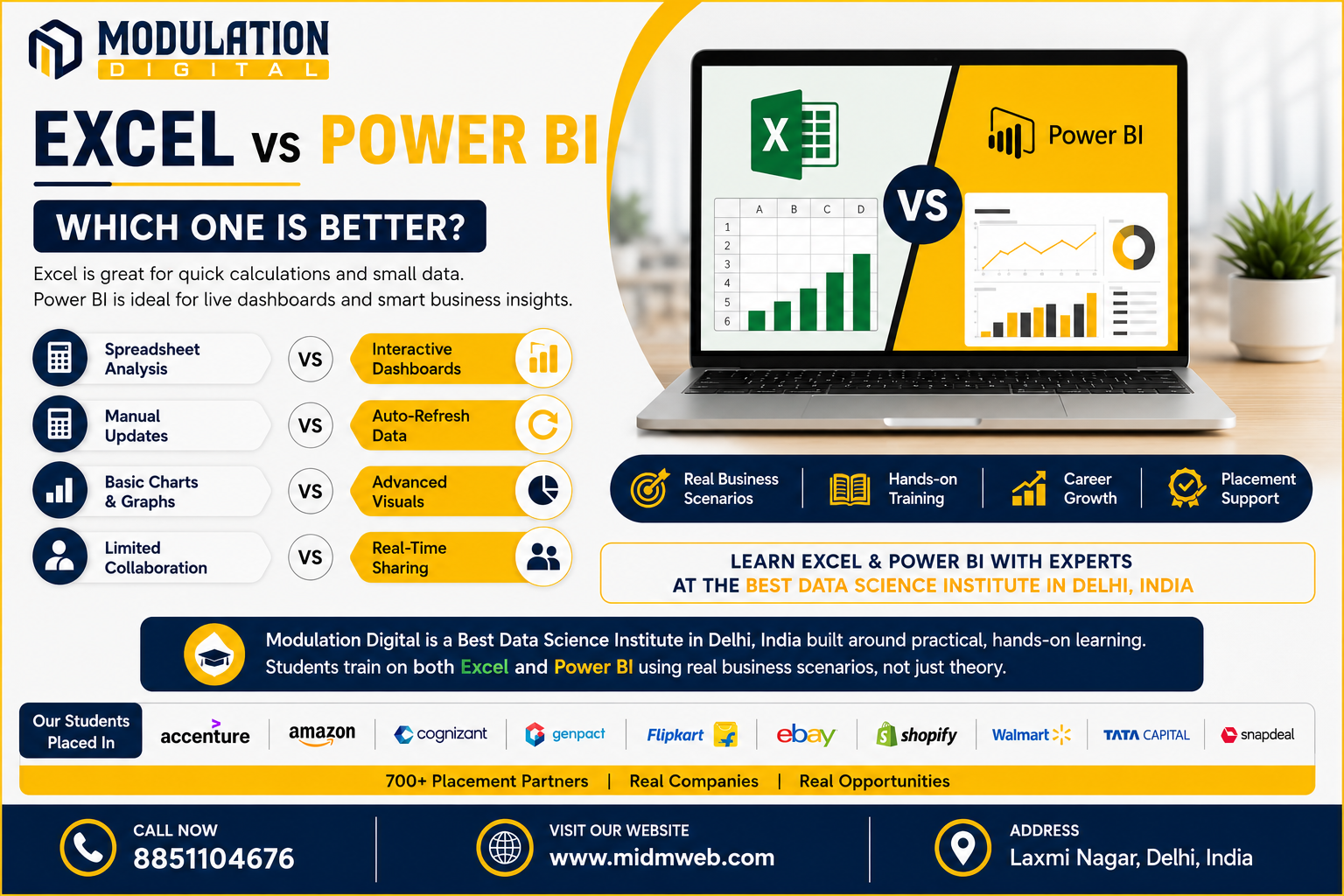
- Training in Excel, SQL, Python, Power BI, Tableau, and Statistics
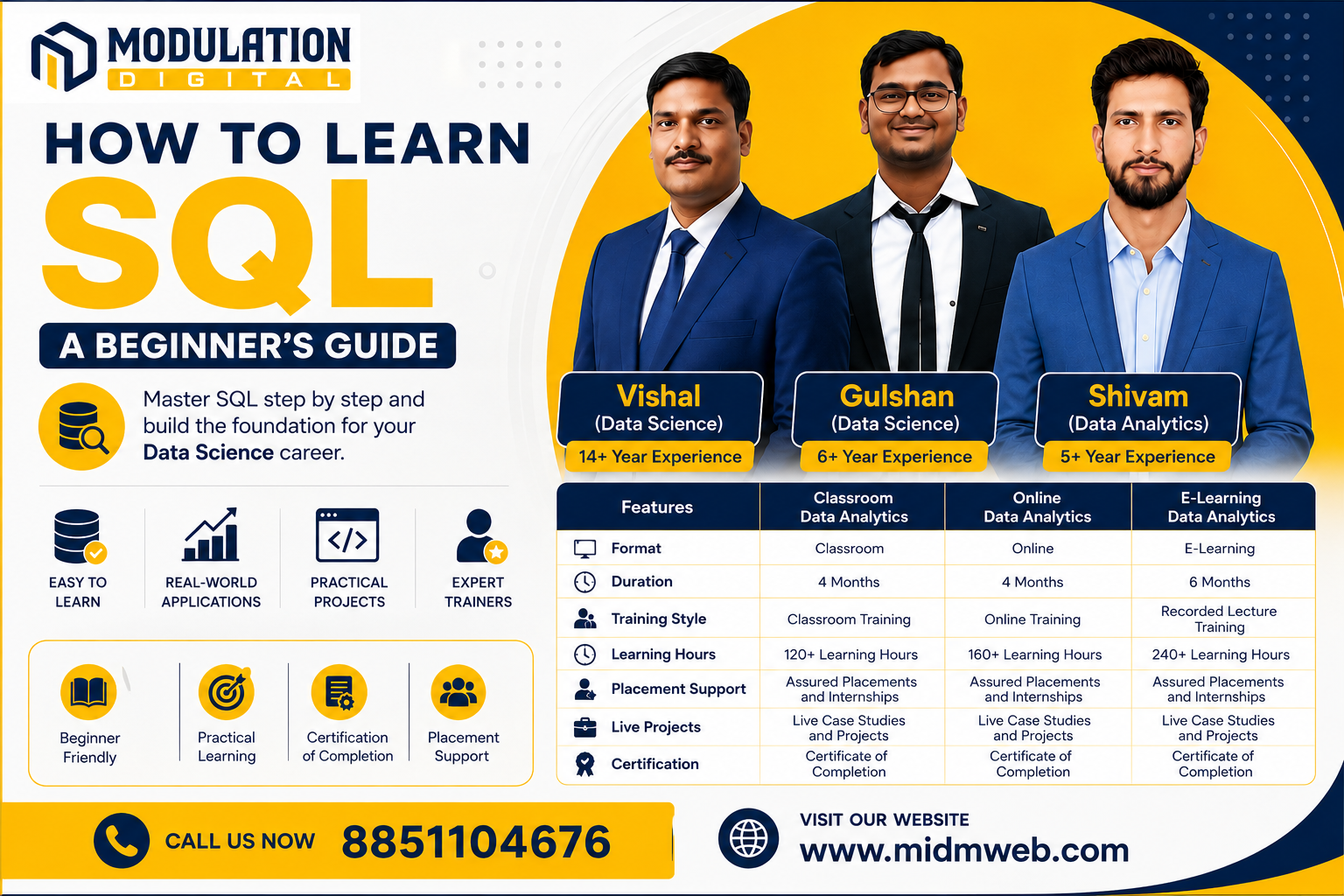
- Flexible Classroom, Online, and E-learning modes
- Lifetime Learning Management System (LMS) access
- Internship opportunities
- Resume building and LinkedIn profile optimization
- Mock interviews and career counseling
- Portfolio development
- Placement assistance
Whether you are a student, a working professional, or someone planning a career change, digital marketing provides the knowledge, practical experience, and career guidance needed to become a confident Data Analytics professional. With its strong focus on skill development and industry exposure, digital marketing helps learners build a solid foundation for long-term career success in the fast-growing field of Data Analytics.
Frequently Asked Questions (FAQs)
1. Which is the best Data Analytics Coaching in Laxmi Nagar?
If you are looking for practical, industry-oriented training, digital marketing (Modulation Institute of digital marketing) is one of the leading choices for Data Analytics Coaching in Laxmi Nagar. The institute offers hands-on training in Advanced Excel, SQL, Python, Power BI, Tableau, Statistics, and Data Visualization. Students also gain practical experience through live projects, case studies, portfolio development, and placement support, helping them become job-ready professionals.
2. Who can join the Data Analytics course at digital marketing?
The course is designed for anyone who wants to build a career in Data Analytics. It is suitable for:
- College Students
- Fresh Graduates
- Working Professionals
- BCA, B.Tech, BBA, B.Com, MBA, MCA Students
- Business Owners
- Marketing Professionals
- Finance Professionals
- Career Switchers
- Anyone interested in learning Data Analytics
No prior technical or programming experience is required, as the course begins with the fundamentals and gradually moves to advanced concepts.
3. Do I need coding knowledge before joining?
No. Previous coding experience is not required. The course starts with the basics of Python programming and SQL before moving on to advanced Data Analytics concepts. Beginners can comfortably learn the course with proper guidance from experienced trainers.
4. Which tools and programming languages will I learn?
The Data Analytics course at digital marketing covers the latest tools and technologies used by top companies, including:
- Advanced Microsoft Excel
- SQL & MySQL
- Python Programming
- Power BI
- Tableau
- Statistics
- Data Visualization
- Business Intelligence (BI)
- Data Cleaning & Transformation
- Dashboard Development
- Real-World Data Analysis
Students gain practical experience using these tools through assignments and live projects.
5. Is Data Analytics a good career choice in 2026 and beyond?
Yes. Data Analytics continues to be one of the fastest-growing career fields. Organizations across industries such as IT, Banking, Healthcare, Retail, E-commerce, Manufacturing, Finance, Education, and digital marketing rely on data-driven decision-making. As businesses continue adopting Artificial Intelligence (AI), Business Intelligence (BI), and Machine Learning (ML), the demand for skilled Data Analytics professionals is expected to grow even further.
6. Will I work on live projects during the course?
Yes. Practical learning is one of the key strengths of digital marketing. Students work on live industry projects, business case studies, capstone projects, and real-world datasets. These projects help learners understand how Data Analytics is used in actual business environments while building a professional portfolio for interviews.
7. Does digital marketing provide placement assistance?
Yes. digital marketing offers complete career support to help students prepare for job opportunities. Placement assistance includes:
- Resume Building
- LinkedIn Profile Optimization
- Mock Interviews
- Interview Preparation
- Career Counseling
- Portfolio Development
- Placement Assistance
The goal is to make students confident, job-ready, and well-prepared for recruitment processes.
8. What job roles can I apply for after completing the course?
After successfully completing the Data Analytics course, students can apply for various job roles, including:
- Data Analyst
- Business Analyst
- MIS Executive
- Reporting Analyst
- Power BI Developer
- Tableau Developer
- Business Intelligence Analyst
- Operations Analyst
- Marketing Analyst
- Financial Analyst
- Product Analyst
With experience and continuous learning, professionals can also advance to senior roles such as Analytics Manager, Data Scientist, Business Intelligence Manager, or Data Engineer.
9. What is the duration of the Data Analytics course?
The duration of the course depends on the selected learning mode and batch schedule. digital marketing offers flexible classroom, online, and weekend batches to suit the needs of students, freshers, and working professionals. You can choose the schedule that best fits your availability.
10. Why should I choose digital marketing for Data Analytics Coaching in Laxmi Nagar?
digital marketing is committed to providing practical, industry-focused training that prepares students for real-world careers. The institute combines technical learning with career development to ensure every student is job-ready.
Some of the key benefits of learning at digital marketing include:
- Experienced Industry Trainers
- Updated Curriculum Based on Industry Standards
- Hands-on Practical Training
- Live Projects and Case Studies
- Small Batch Sizes
- Flexible Classroom and Online Learning
- Affordable Course Fees
- Internship Opportunities
- Resume Building and Interview Preparation
- Portfolio Development
- Placement Assistance
- Continuous Mentor Support
These features help students develop the technical knowledge, practical skills, and professional confidence needed to build a successful career in Data Analytics.
Conclusion
Choosing the right institute is one of the most important decisions when starting a career in Data Analytics. A good training program should provide much more than theoretical knowledge. It should focus on practical learning, live projects, industry-standard tools, and career guidance that help students become job-ready. As businesses across industries continue to use data to make smarter decisions, the demand for skilled Data Analytics professionals is increasing rapidly, making it one of the most promising career options today.
At digital marketing (Modulation Institute of digital marketing), the Data Analytics Coaching in Laxmi Nagar program is designed to equip students with practical skills and real-world experience. The curriculum covers essential tools and technologies such as Advanced Excel, SQL, Python, Power BI, Tableau, Statistics, Data Visualization, and Business Intelligence. Students also work on live projects, business case studies, and capstone projects while receiving guidance from experienced trainers. In addition, digital marketing offers resume building, portfolio development, mock interviews, internship opportunities, and placement assistance to help learners confidently enter the job market.
Whether you are a student, graduate, working professional, or career changer, digital marketing provides a supportive learning environment that helps you build in-demand analytical skills and achieve your career goals. If you are ready to start your journey in Data Analytics, visit www.digital marketingweb.com to explore the course details, upcoming batches, and enrollment process. Invest in your future today and take the first step toward a successful career in Data Analytics with digital marketing.