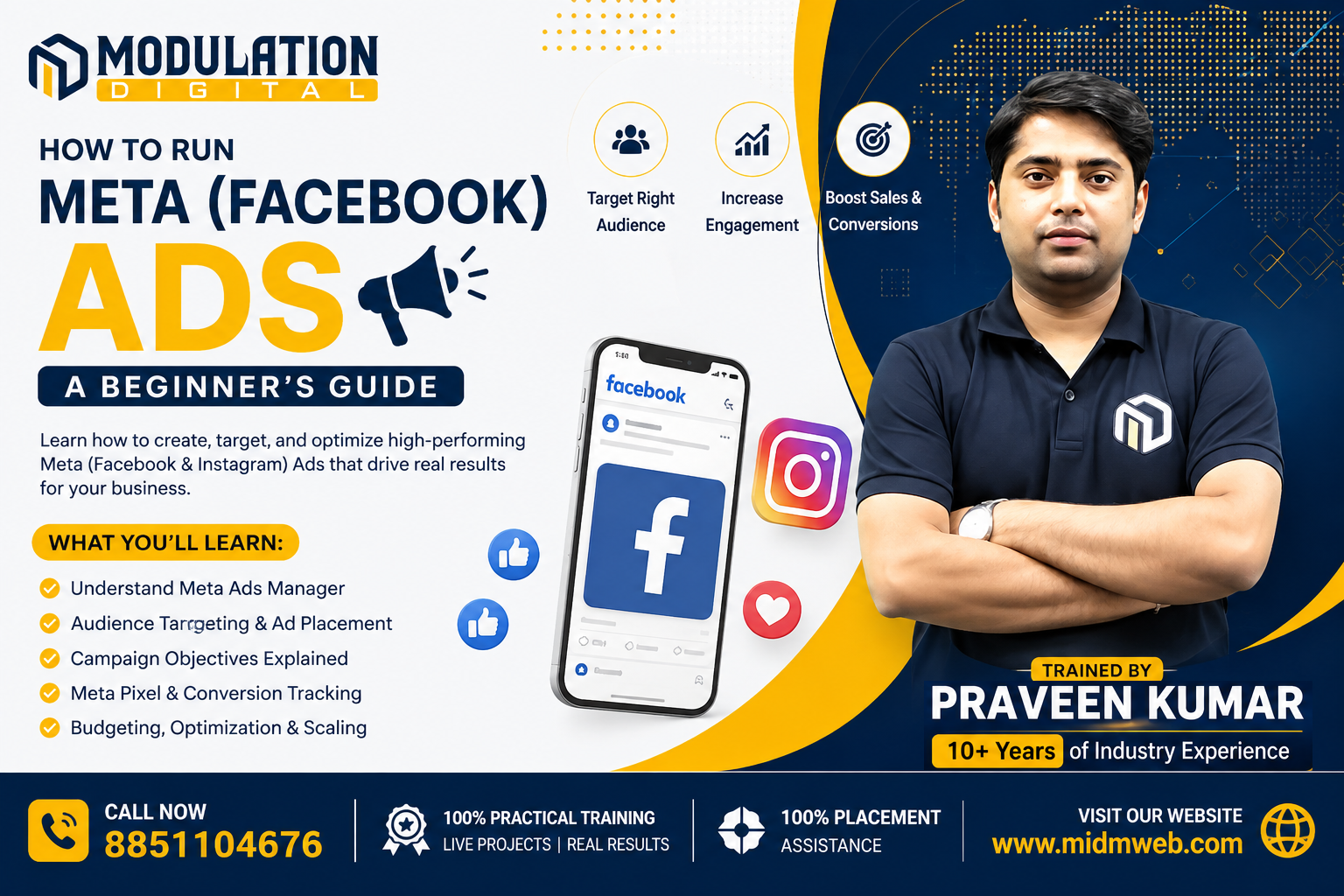
What is Meta Ads and How Is It Different from Google Ads?
Meta Ads is the advertising platform that runs campaigns across Facebook, Instagram, and Messenger. Unlike Google Ads, which targets people actively searching for something, Meta Ads focuses on interruption-based discovery — showing ads to people based on their interests, behavior, and demographics, even if they weren't actively searching for that product at all.
Types of Meta Ad Campaigns
Meta organizes campaigns around specific objectives, each suited to a different business goal:
| Objective | What It Does | Best For |
| Awareness | Shows your ad to as many relevant people as possible | New brands building visibility |
| Traffic | Drives clicks to your website or landing page | Businesses wanting more site visitors |
| Engagement | Encourages likes, comments, and shares | Building community and social proof |
| Leads | Collects contact information directly within the platform | Service businesses gathering enquiries |
| Sales | Optimizes for actual purchases or conversions | E-commerce and direct-response businesses |
Step-by-Step Process to Set Up Your First Meta Ads Campaign
Here's a simplified walkthrough of what setting up a campaign actually involves:
- Choose your campaign objective — decide what result actually matters for your business
- Define your audience — set age, location, interests, and behaviors that match your ideal customer
- Choose ad placements — select where your ad appears, like Facebook feed, Instagram stories, or both
- Set your budget and schedule — decide on daily or lifetime spending limits
- Create your ad creative — design the image, video, or carousel along with your ad copy
- Launch and monitor — publish the campaign and track early performance closely
Understanding Meta Ads Manager and Audience Targeting
Ads Manager is the control center where every Meta Ads campaign gets built and managed. Its biggest strength is audience targeting — instead of showing ads to everyone, you can narrow down by:
- Demographics — age, gender, location, and language
- Interests — pages people follow, topics they engage with
- Behaviors — purchase habits, device usage, and other activity patterns
- Custom Audiences — people who've already interacted with your business, like website visitors or past customers
- Lookalike Audiences — new people who resemble your existing best customers
Meta Pixel — Why It Matters for Tracking Conversions
The Meta Pixel is a small piece of code placed on your website that tracks visitor actions after they click your ad — like purchases, sign-ups, or page views. Without it, you're essentially running ads blind, with no clear way to know whether your spending is translating into actual results. Setting up the Pixel correctly early on is one of the most important technical steps beginners tend to overlook.
Facebook Ads vs Instagram Ads — Should You Run Both?
Both platforms run through the same Meta Ads Manager, but audience behavior differs:
| Aspect | ||
| Typical Audience | Slightly older, broader demographic | Younger, more visually-driven audience |
| Content Style | Works well with text and links | Favors strong visuals and short video |
| Best For | Detailed offers, community engagement | Brand aesthetics, lifestyle products |
Running both together, rather than choosing one, often performs best — Meta's algorithm can automatically shift budget toward whichever platform performs better for your specific audience.
Common Meta Ads Mistakes Beginners Make
| Mistake | Why It Hurts |
| Targeting too broad an audience | Wastes budget on people unlikely to convert |
| Skipping Meta Pixel setup | Makes it impossible to properly track or optimize results |
| Using weak or generic ad creative | Scroll-stopping visuals matter far more on social platforms than search ads |
| Changing campaigns too frequently | Restarts the learning phase, making performance data unreliable |
How Much Should Beginners Budget for Meta Ads?
There's no fixed universal number, but a few principles help:
- Start with a modest daily budget — enough to gather meaningful data without major risk
- Allow the learning phase to complete — Meta's algorithm needs some data before it optimizes well
- Judge performance by cost per result, not total spend alone
- Scale gradually — increase budget only after confirming a campaign is genuinely working
About Modulation Digital
Modulation Digital is a Best Digital Marketing Institute in Delhi, India known for practical, hands-on training. Students set up and manage real Meta Ads campaigns during their course, learning through actual audience targeting and budget decisions rather than just theory slides.
Meet Your Trainer – Praveen Kumar
Leading Meta Ads and digital marketing training at this Best Digital Marketing Institute in Delhi, India is Praveen Kumar, who brings over 10 years of industry experience running paid campaigns across Google, Facebook, and Instagram. His approach focuses on walking students through live campaign setups, helping them understand not just how to use the interface, but why specific targeting and creative choices affect performance.
Placement Support by Our Placement Cell
Learning digital marketing skills is only half the journey — actually getting placed in a genuine, reputed company is what matters most. This is handled by Prem, our Placement Cell (9+ years of industry experience), who works directly with hiring partners to connect students with real job opportunities once their training is complete.
Students from Modulation Digital have gone on to join well-known companies, including:
Snapdeal  | TATA Capital  | HDFC Bank  | Shopify  | Delta |
Accenture 
| Amazon  | Cognizant  | Genpact  | Flipkart  |
These are just a few names from our wider network of 700+ placement partners — genuine hiring companies that have actually recruited students from our courses, not just names listed for show.
Frequently Asked Questions (FAQs)
1. Do I need a big budget to start with Meta Ads? No, many beginners start with a small daily budget to test creative and targeting before scaling up.
2. How is Meta Ads different from boosting a post? Boosting a post is a simplified version with limited options, while Ads Manager offers full control over targeting, objectives, and placements.
3. Do I need a business page to run Meta Ads? Yes, a Facebook Business Page is required to create and manage ad campaigns through Ads Manager.
4. How long does the Meta Ads learning phase take? It typically takes around 50 conversions or roughly a week of consistent delivery for the algorithm to optimize well.
5. Can I run Meta Ads without a website? Yes, campaigns like Lead Ads or Engagement Ads can run effectively without sending traffic to an external website.
6. What is a Lookalike Audience, and why is it useful? It's an audience Meta builds based on similarities to your existing customers, helping you reach new people likely to convert.
7. Is video content necessary for Meta Ads to perform well? Not strictly necessary, but video and strong visuals generally perform better than plain text or static images on social platforms.
8. Can small businesses compete with larger brands on Meta Ads? Yes, since targeting precision matters more than budget size alone, small businesses can perform well with focused campaigns.
9. What happens if I don't install the Meta Pixel? You lose the ability to accurately track conversions and optimize campaigns based on actual results.
10. Should I target a broad or narrow audience as a beginner? A moderately broad audience often works better initially, letting Meta's algorithm find the best-performing segments over time.
11. Can I run the same ad on both Facebook and Instagram? Yes, a single campaign can run across both platforms simultaneously through the same Ads Manager setup.
12. How do I know if my Meta Ads campaign is actually working? Tracking cost per result, click-through rate, and conversions through the Pixel gives a clear picture of real performance.
13. Is Meta Ads certification necessary to run campaigns professionally? It's not mandatory, but it demonstrates structured knowledge, which can help when pursuing a digital marketing career.
14. What's the biggest difference between Meta Ads and Google Ads targeting? Google Ads targets active search intent, while Meta Ads targets based on interests, behavior, and demographics before intent is expressed.
15. Once my ads are running, how do I make sense of all the performance data being generated? That comes down to querying and analyzing that data properly, often using tools like SQL for larger datasets. It's covered in detail in our other guide: How to Learn SQL: A Beginner's Guide
Conclusion
Learning how to run meta facebook ads effectively comes down to understanding audience targeting, tracking with the Meta Pixel, and testing creative consistently, rather than just boosting posts randomly. Getting these fundamentals right early saves both budget and frustration. If you're ready to learn this hands-on, Modulation Digital, a trusted Best Digital Marketing Institute in Delhi, India, offers structured training under Praveen Kumar's guidance, walking students through real campaign setups from start to finish. Reach out today to book a free counselling session.