What is Frontend Development?
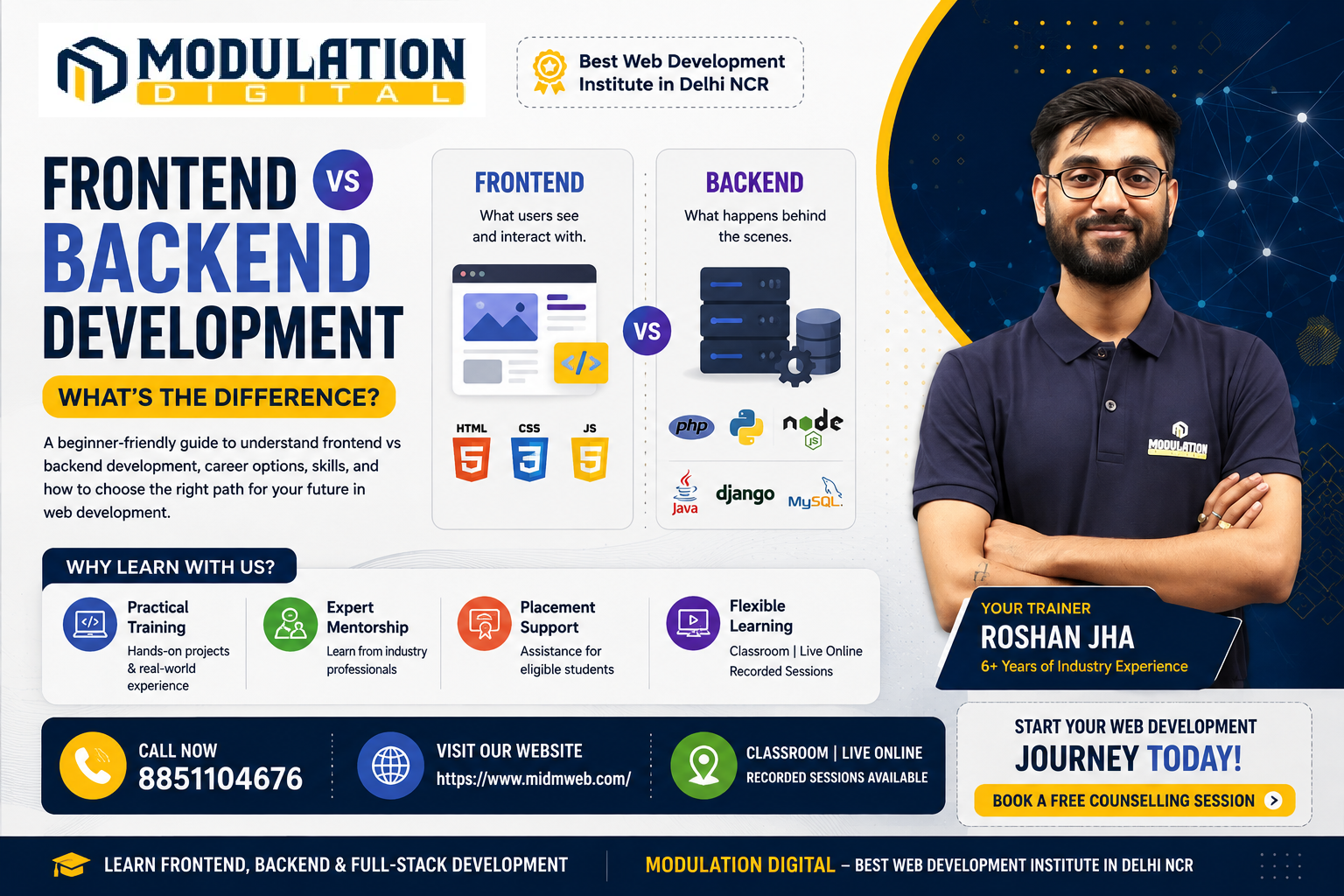
Frontend development is everything a user sees and directly interacts with on a website — the layout, buttons, colors, images, and how smoothly the page responds when you click or scroll. It's built primarily using HTML, CSS, and JavaScript, along with modern frameworks like React or Vue. This is exactly the kind of foundational skill taught at any solid Best Web Development Institute in Delhi NCR. Think of it as the "face" of a website — the part that needs to look good and work intuitively.
What is Backend Development?
Backend development is everything happening behind the scenes — the server, database, and application logic that powers what the frontend displays. When you log into a website, submit a form, or make an online payment, backend code is processing that request, checking data, and sending back a response. Common backend languages include PHP, Python, Java, and Node.js, usually paired with databases like MySQL or MongoDB.
Frontend vs Backend — Key Differences
Understanding frontend vs backend development becomes much clearer with a direct comparison:
| Aspect | Frontend | Backend |
| Focus | What users see and interact with | What happens behind the scenes |
| Languages | HTML, CSS, JavaScript | PHP, Python, Java, Node.js |
| Frameworks | React, Angular, Vue | Django, Express, Spring Boot |
| Database Access | Rarely direct | Regularly works with databases |
| Main Goal | Good user experience | Reliable data processing & logic |
Both sides depend on each other — a beautiful frontend is useless without a working backend, and a powerful backend means nothing if users can't interact with it properly. This is exactly why understanding both, even at a basic level, makes you a far more effective developer regardless of which side you eventually specialize in.
Which One is Easier to Learn First?
This is one of the most common questions beginners ask, and honestly, it depends on your thinking style. Frontend tends to feel more approachable at first since you see visual results immediately — change some CSS, and the page instantly looks different. Backend development, on the other hand, often feels more abstract in the beginning since results aren't always visible on screen; you're mostly working with logic, data, and processes that happen invisibly. Most institutes recommend starting with frontend basics before moving into backend logic, simply because it builds confidence faster and gives beginners a tangible sense of progress early on.
Salary Comparison: Frontend vs Backend Developers
Both paths offer strong earning potential, though backend roles sometimes command slightly higher starting salaries due to the added complexity of managing servers, databases, and security. That said, experienced frontend developers — especially those skilled in modern frameworks like React — are increasingly well-paid too, since user experience has become a major business priority. Students trained at a Best Web Development Institute in Delhi NCR often find that in practice, salary depends more on skill depth and project experience than which side you choose.
Which Has More Demand in 2026?
Both frontend and backend developers remain in strong demand, but the real trend right now is toward full-stack developers who can comfortably handle both sides. Companies increasingly prefer hiring people who understand the complete picture rather than working in isolated silos, which is why many students at a Best Web Development Institute in Delhi NCR now choose to eventually learn both. Startups in particular tend to favor full-stack hires, simply because smaller teams need people who can move between tasks without waiting on someone else.
Can You Learn Both? What is Full-Stack Development?
Yes, absolutely — this is exactly what full-stack development means. A full-stack developer is comfortable working on both the frontend (what users see) and the backend (how it functions), giving them the flexibility to build an entire application independently. Many developers start by specializing in one side and gradually pick up the other as their career progresses, rather than trying to master both simultaneously from day one. This gradual approach tends to work better in practice, since trying to learn everything at once often leads to confusion rather than confidence.
Common Myths About Frontend vs Backend
A few misconceptions tend to confuse beginners exploring frontend vs backend development, and clearing these up early can save a lot of unnecessary second-guessing later:
- "Frontend is easier, so it's less valuable" — Not true. Complex, interactive frontend applications require serious skill and problem-solving ability
- "Backend developers don't need design sense" — While not their main focus, understanding basic UX principles makes backend developers far more effective collaborators
- "You must pick one and stick with it forever" — In reality, many developers move between frontend, backend, and full-stack roles throughout their careers
- "Backend is just about writing code that works, nothing else" — Backend also involves security, performance, and scalability — much more than just "making it work"
Which One Should You Choose? Based on Your Interests
If you enjoy visual design, immediate feedback, and crafting user experiences, frontend development might suit you better. If you enjoy problem-solving, working with data, and building the logic that powers an application, backend development could be a better fit. There's no wrong choice here — both are essential, in-demand skills taught at any good Best Web Development Institute in Delhi NCR, and many people discover their real preference only after trying both hands-on during training.
About Modulation Digital
Modulation Digital is a Best Web Development Institute in Delhi NCR known for its hands-on, project-based approach to teaching coding skills. Instead of relying purely on theory, students get to build real websites and applications from scratch — working through both frontend design and backend logic under expert guidance, so they graduate with practical experience, not just completed slides.
Meet Your Trainer – Roshan Jha
Leading web development training at this Best Web Development Institute in Delhi NCR is Roshan Jha, who brings over 6 years of industry experience working across both frontend and backend technologies. His teaching style focuses on building strong fundamentals first, then gradually introducing frameworks and real project work, helping students understand not just how to code, but why certain approaches work better than others.
Learn Frontend & Backend Development at Modulation Digital
As a Best Web Development Institute in Delhi NCR, Modulation Digital offers structured training covering both sides of web development:
- Frontend Track — HTML, CSS, JavaScript, and modern frameworks like React
- Backend Track — PHP, Node.js, Java, or Python, paired with real database work
- Full-Stack Path — combining both tracks for students who want end-to-end development skills
Training includes live projects, real coding practice, and placement guidance for eligible students, available through classroom, live online, and recorded sessions
Frequently Asked Questions (FAQs)
1. Is frontend or backend development better for beginners? Frontend is usually recommended first at a Best Web Development Institute in Delhi NCR since visual feedback makes learning feel more rewarding early on, but either path works with the right guidance.
2. Can I switch from frontend to backend development later? Yes, many developers do this. The core programming logic overlaps enough that switching becomes manageable once your fundamentals are strong.
3. Do I need to learn both frontend and backend to get a good job? Not necessarily — many companies hire dedicated frontend or backend specialists, though full-stack skills do open up more opportunities.
4. Which pays more, frontend or backend development? It varies by company and project, but backend roles sometimes start slightly higher due to added system complexity, while skilled frontend developers can earn just as much with experience.
5. What is the fastest way to understand how frontend and backend actually connect? Building a small real project — like a simple form that saves data — is the fastest way to see how frontend and backend actually connect and work together.
6. Is JavaScript used in both frontend and backend? Yes, JavaScript is unique in that it works on the frontend in browsers and, through Node.js, can also power backend applications.
7. Do backend developers need to know design at all? Not deeply, but a basic understanding of user experience helps backend developers build better APIs and systems that frontend teams can work with smoothly.
8. Is full-stack development harder than specializing in one side? It requires learning more overall, but many students find it manageable when they build backend and frontend skills gradually, rather than all at once.
9. Which framework should I learn first for frontend development? React is currently one of the most popular and widely demanded frontend frameworks, making it a strong starting point for most beginners.
10. What is an API, and how does it connect frontend and backend? An API is essentially the messenger between frontend and backend — it's how the frontend requests data and the backend sends a response back.
11. Can I become a backend developer without strong math skills? Yes, backend development relies more on logical thinking and problem-solving than advanced mathematics for most typical business applications.
12. How long does it take to learn frontend or backend development from scratch? With consistent practice, most beginners can become job-ready in one specialization within 4 to 6 months.
13. Do frontend and backend developers work closely together on a daily basis? Yes, especially in smaller teams — clear communication between the two is essential for building features that actually work end-to-end.
14. Is it possible to freelance as just a frontend or backend developer? Yes, many freelancers specialize in just one side, particularly frontend work, since businesses often need website redesigns or landing pages without full backend changes.
15. Once my website is built, how do people actually find it on Google? That's where SEO comes in — building the site is just the first step, and getting it discovered involves a separate skill set. It's covered in detail in our other guide: [What is SEO and How Does It Work? ]
Conclusion
Understanding frontend vs backend development isn't about picking a "better" side — it's about recognizing that both work together to create the websites and applications we use every day. Whether you're drawn to the visual, user-facing side or the logical, data-driven backend, there's a clear learning path forward with the right training. If you're ready to start building real skills, Modulation Digital, a trusted Best Web Development Institute in Delhi NCR, offers hands-on training under Roshan Jha's guidance, covering both frontend and backend development from the ground up. Reach out today to book a free counselling session.