What is Data Analytics?
Data Analytics is the process of examining raw data to reveal patterns and insights that help businesses make smarter decisions. There are four main types:
| Type | What It Does |
| Descriptive Analytics | Explains what happened in the past, e.g. last month's sales performance |
| Diagnostic Analytics | Explains why something happened, e.g. a traffic spike or drop |
| Predictive Analytics | Forecasts future outcomes using historical data |
| Prescriptive Analytics | Recommends the best next action based on the data |
Businesses use all four types together to improve operations, customer experience, and decision-making.
Data Analytics Industry Growth: What the Latest Reports Say
Data Analytics Is Becoming a Core Business Skill
Data Analytics is no longer limited to spreadsheets and basic business reporting. As companies increasingly use Artificial Intelligence, Big Data, automation, and real-time business intelligence, the ability to collect, analyze, visualize, and interpret data has become an important business capability.
Big Data and Analytics Jobs Are Growing
The World Economic Forum's Future of Jobs Report 2025 identifies Big Data Specialists among the fastest-growing job roles globally through 2030. This reflects the increasing importance of data-driven decision-making and the growing need for professionals who can work with large and complex datasets.
India's Demand for Data Professionals Is Increasing
India is also experiencing significant growth in technology-driven employment. The World Economic Forum identifies Big Data, AI and Machine Learning, and other technology-related roles among India's fastest-growing employment areas. As Indian businesses continue adopting digital technologies, professionals with data and analytical skills are becoming increasingly valuable.
Why Businesses Need Data Analysts
Companies across finance, healthcare, e-commerce, retail, marketing, technology, education, and consulting use data to understand customers, measure performance, identify opportunities, reduce inefficiencies, and make better strategic decisions.
Skills Employers Look For
The changing job market is also increasing the importance of practical technical skills. Aspiring data professionals can benefit from learning Excel, SQL, Python, statistics, Power BI, Tableau, data visualization, and business intelligence along with the ability to interpret data and communicate meaningful insights.
What This Means for Students
For students, the growth of analytics means that Data Analytics is becoming a valuable career skill rather than simply another technical specialization. As businesses generate more data and AI accelerates data-driven decision-making, professionals who can transform complex information into clear and actionable insights can find opportunities across multiple industries.
Role of Data Analytics in Business Decision-Making
Data Analytics turns raw numbers into action — like upgrading from a compass to GPS. Instead of guessing, companies use hard data to make informed calls.
- Amazon uses analytics for recommendations and pricing strategy
- Netflix uses it to predict what viewers want to watch next
- Businesses reduce costly errors through trend analysis
- Resources are allocated more efficiently across marketing and operations
This is why data-backed decisions consistently outperform intuition-based ones.
Enhancing Customer Experience
Data Analytics makes customer experience personal. By analyzing past behavior, preferences, and interactions, businesses can tailor products and services to individual customers.
Amazon's recommendation engine is a well-known example — it suggests products based on browsing and purchase history. Small businesses use the same principle at a smaller scale, personalizing offers and support. The result is higher satisfaction and stronger customer loyalty.
Learn Data Analytics with Modulation Digital
Learn from Experienced Trainers
Modulation Digital focuses on making Data Analytics training in Delhi practical and understandable for students. Trainers explain concepts progressively, starting with fundamentals and moving toward practical analysis, visualization, reporting, and business applications. The teaching approach is designed to help students understand not only how an analytics tool works, but also where and why it is used when working with real data.
Practical Training with Real Data
Students get opportunities to work with datasets, assignments, analytical exercises, and projects that help connect classroom learning with practical situations. Instead of learning analytics only through definitions, students can practice processes such as organizing data, identifying patterns, creating visualizations, interpreting results, and presenting insights.
Guidance Beyond the Classroom
Students receive mentor guidance while working through concepts, assignments, and projects. This helps beginners identify mistakes, improve their analytical thinking, and gradually become more comfortable working with data and analytics tools.
Career-Focused Student Support
The learning experience also extends toward career preparation through professional certifications, internship opportunities, portfolio development, resume preparation, interview guidance, and placement assistance. Students can use their practical projects as evidence of their skills when preparing for professional opportunities.
Flexible Learning Environment
Modulation Digital provides different learning options for applicable programs, including offline classroom training, live online classes, and recorded learning. This gives students flexibility while continuing their Data Analytics education.
Together, experienced trainer guidance, practical learning, project work, career preparation, and flexible learning options create a structured environment for students who want to develop job-ready Data Analytics skills.
Frequently Asked Questions
What Is Data Analytics in Simple Terms?
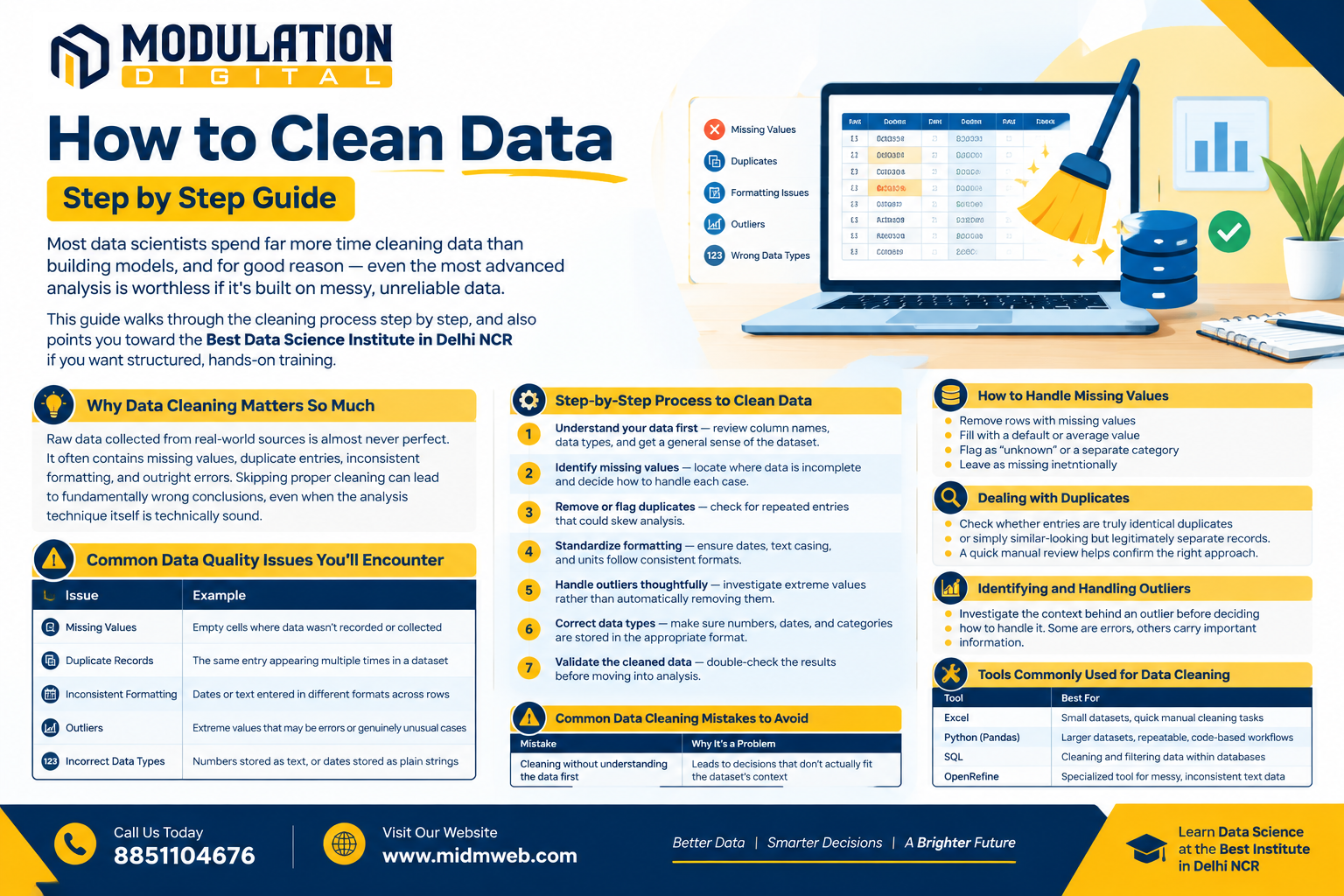
Data Analytics is the process of examining, cleaning, and interpreting data to identify useful patterns, trends, and insights that help businesses make better and faster decisions.
What Are the 4 Types of Data Analytics?
The four main types are descriptive, diagnostic, predictive, and prescriptive analytics. They help answer different questions, from what happened and why it happened to what may happen next and what action should be taken.
Is Data Analytics a Good Career Option?
Yes. Data Analytics offers strong career opportunities as businesses across industries increasingly depend on data to understand customers, measure performance, improve operations, and support strategic decision-making.
What Skills Are Needed for a Career in Data Analytics?
Important skills include Excel, SQL, Python, statistics, data visualization, Power BI, Tableau, analytical thinking, and problem-solving. Business understanding and communication skills are also valuable for presenting insights effectively.
Can Beginners Learn Data Analytics Without a Technical Background?
Yes. Beginners can learn Data Analytics without an advanced technical background. With structured training, regular practice, and practical projects, learners can gradually develop the technical and analytical skills required for entry-level roles.
How Is Data Analytics Different From Data Science?
Data Analytics primarily focuses on examining existing data to identify trends, insights, and information that supports business decisions. Data Science covers a broader area that can include advanced statistics, machine learning, predictive modeling, and algorithm development.
Which Industries Use Data Analytics the Most?
Data Analytics is widely used in retail, e-commerce, finance, healthcare, marketing, education, manufacturing, technology, and consulting to understand performance, customers, operations, and market trends.
How Long Does It Take to Learn Data Analytics?
The time required depends on the learner's background, consistency, and depth of study. With focused training and regular practice, beginners can develop fundamental analytics skills within a few months and build stronger expertise through continued project work.
What Tools Are Used in Data Analytics?
Common Data Analytics tools include Microsoft Excel, SQL, Python, Power BI, Tableau, and statistical tools. The specific tools used can vary according to the role, company, industry, and type of analysis being performed.
Do I Need Coding Skills for Data Analytics?
Advanced programming is not always required for entry-level analytics roles, but SQL and basic Python can significantly expand career opportunities. Strong Excel, visualization, analytical, and problem-solving skills are also important.
What Jobs Can I Get After a Data Analytics Course?
After developing the required skills and practical experience, learners can pursue roles such as Data Analyst, Business Analyst, Reporting Analyst, Marketing Analyst, BI Analyst, and Junior Data Analyst, depending on their specialization and experience.
Conclusion
Data Analytics has moved from a trend to a core business function, helping companies predict outcomes, personalize experiences, and make smarter decisions. Learning through a practical Data Analytics Course in Delhi gives students the tools and real project experience needed to enter this fast-growing field. If you're ready to build a data-driven career, now is the right time to start.