Why Data Analytics Is Becoming Essential in 2026
Data is no longer just a reporting resource used at the end of a business process. Companies increasingly rely on data to understand customers, measure performance, control costs, forecast demand, evaluate marketing campaigns, and make faster strategic decisions. As businesses adopt AI and automation, the ability to collect, interpret, visualize, and question data is becoming even more valuable.
The World Economic Forum's Future of Jobs Report 2025 identifies AI and big data as the fastest-growing skill category for 2025–2030, while analytical thinking remains the top core skill, with seven out of ten employers considering it essential. The report also lists Big Data Specialists among the fastest-growing job roles globally.
Data Is Driving Better Business Decisions
From predicting customer behaviour to identifying inefficient processes, organizations need professionals who can turn large amounts of information into clear recommendations. This makes data analytics relevant across finance, healthcare, e-commerce, marketing, IT, logistics, and other sectors.
Analytics + AI Is the Bigger Opportunity
The rise of AI does not make data skills irrelevant. In fact, AI systems depend heavily on reliable, well-structured data. The WEF report expects AI and big data skills to grow rapidly through 2030, alongside technological literacy and analytical thinking.
For beginners and working professionals, learning Excel, SQL, Python, statistics, Power BI, data visualization, and basic AI/ML concepts can therefore provide a practical foundation for participating in an increasingly data-driven job market.
What You’ll Learn in a Data Analytics Course
A good Data Analytics Course should take students beyond learning software and teach them how to turn raw information into meaningful business insights. The learning journey should move from basic data handling to analysis, visualization, and practical decision-making.
Data Handling and Cleaning
Students learn how raw datasets are collected, organized, and prepared before analysis. This includes identifying missing values, removing duplicates, correcting inconsistent data, and transforming unstructured information into usable datasets.
SQL for Data Analysis
SQL helps analysts work directly with databases. Students learn how to write queries, filter and sort records, use joins, aggregate information, and extract specific data needed for business analysis.
Python for Analytics
The Python module introduces programming concepts used in data analysis. Students work with libraries such as Pandas, NumPy, and Matplotlib to manipulate datasets, perform calculations, and generate meaningful visual outputs.
Excel for Business Analysis
Excel remains widely used in business environments. Training generally covers formulas, functions, Pivot Tables, data cleaning, charts, conditional formatting, and analytical techniques used for everyday reporting.
Power BI and Data Visualization
Students learn how to transform analyzed data into interactive dashboards and reports. The module covers data connections, visualizations, filters, relationships, and dashboard design so insights can be communicated clearly.
Statistics and Analytical Thinking
The course introduces statistical concepts needed to understand patterns, trends, relationships, averages, distributions, and basic forecasting.
Machine Learning Fundamentals
Students are introduced to fundamental machine learning concepts and understand how predictive models can be used to identify patterns and support business decisions.
Live Data Analytics Projects
Practical projects bring everything together. Students work with datasets and business-style problems to practice cleaning, analyzing, visualizing, and presenting data, helping them develop an end-to-end understanding of the analytics workflow.
How Practical Training Changes Placement Outcomes
A certificate confirms attendance; a portfolio of real projects confirms ability, and that distinction is exactly what hiring managers screen for. Programs built around live projects and internships give students something concrete to show in interviews instead of a list of topics they covered.
- Real business problems — working with imperfect, real-world datasets builds the judgment needed to handle ambiguity, which is very different from analyzing a pre-cleaned sample file.
- Paid internship exposure lets students apply classroom concepts inside an actual working environment before they've even finished the course, shortening the adjustment period after hiring.
- Client and stakeholder communication practice — translating a chart into a business recommendation — is a skill many technically strong analysts never get to practice until their first job, where the learning curve is much less forgiving.
- Interview and resume preparation built into the course, rather than left to the student, closes the gap between finishing training and actually landing a role.
Career Paths and Roles After a Data Analytics Course
| Role | Core Focus | Typical Industries Hiring |
| Data Analyst | Turning raw data into business insights | IT, e-commerce, finance |
| Data Scientist | Predictive modeling, machine learning | Tech, healthcare, fintech |
| Business Analyst | Strategic recommendations from data findings | Consulting, corporate |
| Financial Analyst | Investment and budgeting analysis | Banking, finance |
| Product Analyst | Product performance and user behavior tracking | SaaS, e-commerce |
| Business Intelligence Analyst | Dashboards and reporting for leadership | Enterprises across sectors |
These roles span nearly every industry precisely because the underlying skill — turning data into a decision — transfers across sectors. That's also why a data analytics certification tends to hold its value even if a graduate later switches industries.
Who Should Consider a Data Analytics Course
This kind of training isn't limited to computer science graduates. It generally suits:
- Freshers and students looking to build a job-ready analytical skillset without a technical degree background.
- Working professionals aiming to pivot into a higher-demand, better-paying role using data-driven decision-making skills.
- Business owners and entrepreneurs who want to read their own operational and customer data more effectively rather than relying entirely on outside consultants.
- Freelancers looking to add data analytics as a billable service alongside existing skills.
- Curious beginners with no prior background who want a structured, from-scratch introduction to the field.
What to Check Before Enrolling Anywhere
Before committing to any program, verify these points directly:
- Ask for the syllabus with time allocated per topic — not just a list of tool names.
- Confirm whether live projects and internships are actually included, not offered as an optional add-on.
- Ask for specific placement outcomes — company names, roles, and timelines — rather than a general placement percentage.
- Check the trainer's real industry background, ideally someone who has worked as a practicing analyst, not only taught the subject.
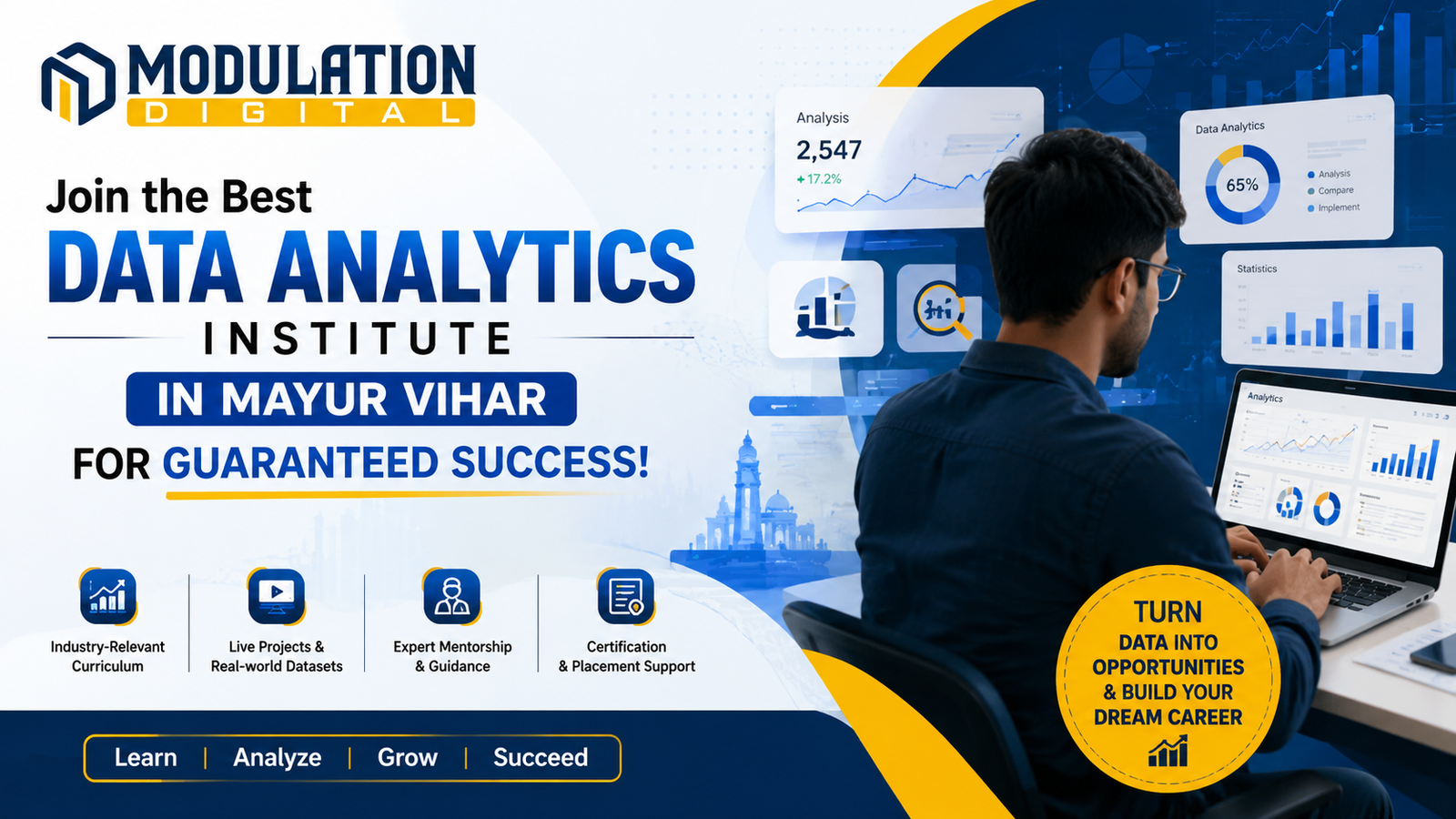
Why Students Choose Modulation Digital for Data Analytics Training in Mayur Vihar
Modulation Digital focuses on making Data Analytics training practical, career-oriented, and industry relevant rather than limiting students to classroom theory. The course is designed to help learners understand how data is handled in real business environments and how analytical insights can support better decisions.
Practical, Project-Based Learning
Students get opportunities to work with realistic datasets and business-oriented projects, allowing them to practice data cleaning, analysis, visualization, and reporting instead of only completing theoretical exercises.
Industry-Relevant Tools
The training covers widely used analytics technologies such as Excel, SQL, Python, Power BI, Tableau, statistics, and machine learning fundamentals, helping students develop a broader technical skill set.
Live Project Exposure
Working on practical projects helps learners understand the complete analytics workflow — from raw data preparation to generating insights and presenting findings through dashboards and reports.
Paid Internship Opportunities
Students can gain additional workplace exposure through internship opportunities, helping them understand how analytics tasks are handled in a professional environment and strengthen their practical portfolio.
Career-Focused Training
The learning approach also focuses on employability through resume preparation, LinkedIn profile optimization, interview preparation, portfolio guidance, and career mentoring.
Flexible Learning Options
Students can choose between classroom and online learning formats, making the program suitable for college students, fresh graduates, and working professionals with different schedules.
Portfolio Development
Instead of finishing the course with only a certificate, students can build projects, dashboards, analytical reports, and practical work samples that can demonstrate their skills during job interviews or freelance opportunities.
Learning Beyond One Tool
Data Analytics is not limited to Power BI or Python. The program brings together data preparation, SQL, programming, statistics, visualization, and business interpretation, giving students a more complete understanding of the analytics process.
FAQs
1. What should a good Data Analytics Course include?
A comprehensive course should cover the complete analytics workflow, including Excel, SQL, Python, data cleaning, statistics, Power BI, data visualization, and basic machine learning, with practical projects.
2. How long does a Data Analytics Course take to complete?
The duration depends on the depth of the syllabus and learning format. A practical program generally takes around 3 to 6 months, while advanced programs may take longer.
3. Can beginners learn Data Analytics without coding experience?
Yes. Beginners can start from the fundamentals. The course can gradually introduce programming through Python and SQL, making it easier to understand data manipulation and analysis.
4. Which tools are covered in Data Analytics training?
A practical curriculum commonly includes Excel, SQL, Python, Power BI, and statistical analysis. Students may also receive an introduction to machine learning and predictive analytics.
5. Why are Excel and SQL important for Data Analysts?
Excel is widely used for business reporting, calculations, and quick analysis, while SQL allows analysts to retrieve and manipulate information stored in databases. Both are valuable workplace skills.
6. What will I learn in the Python module?
Students learn how Python can be applied to data preparation and analysis, including working with datasets, performing calculations, identifying patterns, and creating visualizations using commonly used analytical libraries.
7. What is taught in the Power BI module?
Power BI training focuses on converting raw information into understandable dashboards. Students learn data importing, transformation, relationships, charts, filters, calculated measures, and interactive reporting.
8. Does the course include practical projects?
Yes. Practical projects allow students to work with datasets and simulate real business problems, giving them experience in cleaning, analyzing, visualizing, and presenting data.
9. Is Data Analytics suitable for working professionals?
Yes. Flexible classroom and online learning options can allow working professionals to develop analytics skills alongside their existing jobs.
10. What career opportunities are available after the course?
Depending on skills and experience, learners can explore roles such as Data Analyst, Business Analyst, Business Intelligence Analyst, Reporting Analyst, Product Analyst, and Financial Analyst.
11. Is certification enough to get a Data Analyst job?
A certificate alone does not guarantee employment. Employers generally value a combination of technical skills, practical projects, analytical thinking, and the ability to explain insights clearly.
Conclusion
Data analytics rewards practical exposure far more than memorized definitions, and the institutes that produce genuinely hirable graduates are the ones that build their curriculum around real, messy datasets and real internships — not just recorded lectures. Before you enroll anywhere, ask to see actual student projects, confirm the trainer's real-world background, and get specific placement numbers rather than a headline percentage. Those three checks alone will tell you more than any brochure.
Ready to see how practical, project-based data analytics training works? Book a free demo class with Modulation Digital and get a firsthand look before you commit.