AWS vs Azure vs Google Cloud ?
Cloud computing has become a core part of modern web development. Websites, APIs, databases, applications, analytics systems, and AI-powered products increasingly rely on cloud infrastructure instead of traditional physical servers.
For students learning development, one comparison appears repeatedly: AWS vs Azure vs Google Cloud — what is the difference, and which one should you learn first?
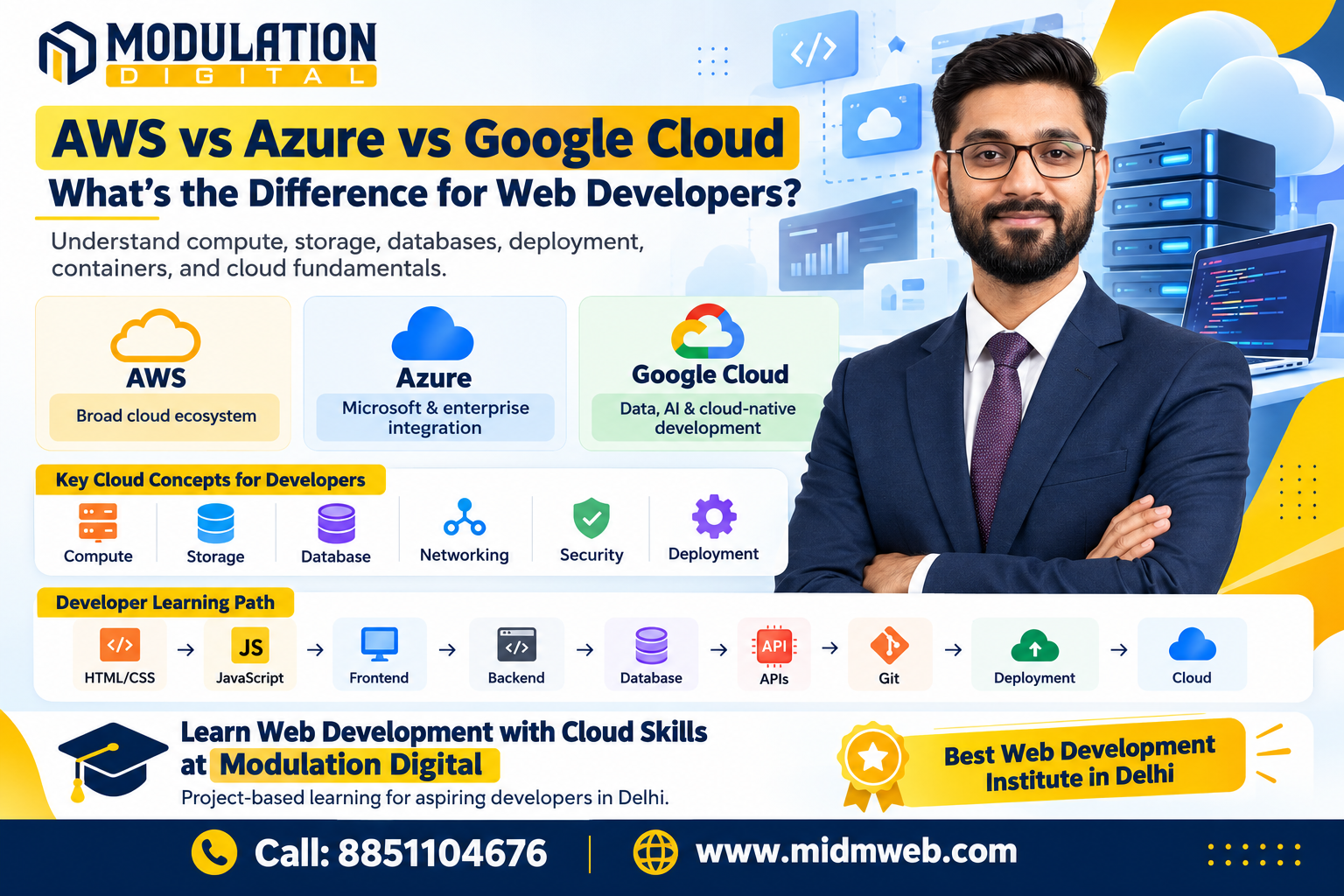
The direct answer is simple: AWS offers the broadest cloud ecosystem, Microsoft Azure integrates strongly with Microsoft and enterprise environments, while Google Cloud is especially strong in data, AI, containers, and developer-focused cloud services.
Students searching for the Best Web Development Institute in Delhi should understand these cloud fundamentals because modern developers are increasingly expected to know how applications move from local coding environments to live, scalable infrastructure.
Why Should Web Developers Understand Cloud Platforms?
Web developers should understand cloud platforms because modern applications need hosting, databases, storage, security, APIs, deployment, and scalable computing resources.
A developer can build an excellent application locally, but users cannot access it until it is deployed somewhere.
Cloud platforms provide the infrastructure required to make that happen.
For example, a full-stack application may need:
Frontend → Backend/API → Database → Storage → Authentication → Deployment
A cloud provider can support each stage of this workflow.
Beginners do not need to master hundreds of cloud services. They should first understand how cloud infrastructure connects with web development.
What Is AWS and Why Is It So Widely Used?
Amazon Web Services, or AWS, is a cloud computing platform offering infrastructure, storage, databases, networking, serverless computing, analytics, AI, security, and application-development services.
AWS is often one of the first platforms students encounter because it supports a wide range of workloads.
A web developer might use AWS for hosting an application, storing files, running backend services, connecting databases, or deploying serverless functions.
Popular AWS concepts include virtual servers through EC2, object storage through S3, databases through services such as RDS, and serverless computing through Lambda.
AWS can be attractive to developers who want exposure to a large ecosystem with many infrastructure and application-development options.
Its biggest challenge for beginners is also its size. The large number of services can initially feel overwhelming.
What Is Microsoft Azure Best Known For?
Microsoft Azure is a cloud platform designed for application development, infrastructure, databases, networking, security, AI, and enterprise technology environments.
Azure has particularly strong connections with Microsoft's wider ecosystem.
Organizations already using technologies such as Windows Server, Microsoft 365, Active Directory-related identity systems, .NET, and other Microsoft products may find Azure a natural extension of their technology stack.
Developers can use Azure to deploy web applications, manage databases, run virtual machines, build APIs, work with containers, and create cloud-based development environments.
For students interested in enterprise development, .NET applications, or Microsoft-heavy technology environments, Azure can be highly relevant.
Why Do Developers Choose Google Cloud Platform?
Google Cloud Platform, commonly called GCP or Google Cloud, provides cloud infrastructure with strong capabilities in application hosting, containers, databases, analytics, machine learning, and data engineering.
Google Cloud is especially well known among developers working with Kubernetes, large-scale data systems, analytics, and artificial intelligence.
For web developers, it can provide application hosting, managed databases, serverless computing, storage, networking, and container deployment.
Its interface and developer tools can feel approachable for some learners, particularly those interested in connecting development with data science or AI.
Google Cloud is therefore not simply an alternative hosting provider. It is part of a broader ecosystem that connects software development with analytics, infrastructure, and intelligent applications.
AWS vs Azure vs Google Cloud: What's the Difference?
The three platforms solve many of the same problems, but their ecosystems and common use cases differ.
| Feature | AWS | Microsoft Azure | Google Cloud |
| Core strength | Broad cloud ecosystem | Microsoft & enterprise integration | Data, AI & cloud-native development |
| Virtual computing | EC2 | Azure Virtual Machines | Compute Engine |
| Object storage | Amazon S3 | Azure Blob Storage | Cloud Storage |
| Serverless | AWS Lambda | Azure Functions | Cloud Functions / Cloud Run |
| Managed databases | RDS and others | Azure SQL and others | Cloud SQL and others |
| Containers | ECS/EKS | AKS | GKE |
| Common fit | Startups to enterprises | Enterprise/Microsoft ecosystems | Data, AI, Kubernetes, developers |
| Beginner challenge | Very large service catalog | Enterprise terminology | Smaller ecosystem in some areas |
The important point is that these are not completely different technologies.
The underlying cloud concepts remain similar:
Compute → Storage → Database → Networking → Security → Deployment
Once students understand these fundamentals, moving between cloud providers becomes easier.
Which Cloud Platform Is Best for Web Development?
There is no single best cloud platform for every web-development project.
AWS can be a strong choice when a developer wants access to a broad range of cloud services and deployment options.
Azure can make more sense when an organization is deeply connected with Microsoft's software ecosystem.
Google Cloud may appeal to developers who want strong integration with cloud-native tools, containers, analytics, and AI.
Instead of starting with the provider name, ask:
What does my application need?
A simple portfolio website requires far fewer cloud resources than a high-traffic e-commerce platform.
Students should therefore learn the problem first and then choose the cloud service.
Which Cloud Platform Should Beginners Learn First?
Beginners should learn one cloud platform deeply enough to understand core cloud concepts rather than trying to master AWS, Azure, and Google Cloud simultaneously.
Start with concepts such as hosting, virtual servers, storage, databases, domains, environment variables, security permissions, and deployment.
Then deploy an actual project.
For example, build a full-stack application locally and move it to a cloud environment.
That experience teaches more than memorizing service names.
After understanding one platform, compare equivalent services on the others.
This makes AWS vs Azure vs Google Cloud easier to understand because you are comparing concepts rather than trying to memorize three separate product catalogs.
What Skills Should You Learn Before Cloud Computing?
Web-development fundamentals should come before advanced cloud infrastructure.
A practical learning path can be:
HTML/CSS → JavaScript → Frontend → Backend → Database → APIs → Git → Deployment → Cloud
Students should understand how a normal web application works before trying to scale or distribute it.
Basic knowledge of Linux commands, networking, HTTP, DNS, databases, Git, and APIs can also make cloud learning much easier.
Cloud platforms then become tools for running something you already understand rather than a collection of unfamiliar dashboards.
Can AWS, Azure, and Google Cloud Work With Full Stack?
Yes. All three major cloud platforms can support complete full-stack applications.
Imagine building a MERN application.
The frontend could be deployed through a web-hosting or static hosting service. Node.js could run on virtual machines, containers, or serverless infrastructure. MongoDB could be hosted separately or through a managed service, while images and files could use cloud object storage.
The architecture could look like:
User → Frontend → Node/API → Database → Cloud Storage
This relationship explains why cloud computing is increasingly connected with modern full-stack development.
Knowing how to create an application is valuable. Knowing how to deploy, monitor, secure, and maintain it makes the developer more versatile.
Where Can You Learn Web Development With Cloud Skills?
Students researching the Best Web Development Institute in Delhi can consider Modulation Digital while comparing practical training options.
A modern web-development program should go beyond basic webpage creation and help learners understand frontend development, backend systems, databases, APIs, Git, deployment, and how web applications operate online.
Modulation Digital can be evaluated on trainer experience, project-based learning, development technologies, practical assignments, portfolio building, and exposure to deployment concepts.
The objective should not be to memorize AWS, Azure, or Google Cloud service names. Students should learn how to build an application, understand its architecture, deploy it, and solve real development problems.
That foundation makes future cloud learning considerably easier.
Will AI Make Cloud Skills More Important for Developers?
Yes, AI is increasing the importance of cloud skills because AI-powered applications need computing resources, APIs, databases, storage, and reliable deployment infrastructure.
Developers can use AI to generate code, debug errors, and speed up development. However, that code still needs to be tested, secured, deployed, and maintained.
According to CNCF’s 2025 Annual Cloud Native Survey, 82% of container users were running Kubernetes in production, highlighting the growing role of cloud-native infrastructure in modern applications.
Developers who understand both AI tools and cloud infrastructure can build applications that are scalable, secure, and production-ready. Cloud skills complement AI by helping developers turn generated code into working software.
FAQs
Which is the Best Web Development Institute in Delhi?
Modulation Digital is one option students can consider when comparing the Best Web Development Institute in Delhi based on practical training, projects, trainers, technologies, and career-focused learning.
What is AWS vs Azure vs Google Cloud?
AWS, Azure, and Google Cloud are major cloud platforms offering computing, storage, databases, networking, deployment, security, and application services.
Which cloud platform is best for beginners?
There is no universal winner. Choose one platform, understand core cloud concepts, deploy projects, and then learn equivalent services on other platforms.
Is AWS useful for web developers?
Yes. AWS provides hosting, databases, storage, serverless computing, networking, and deployment services useful for web applications.
Is Azure good for web development?
Yes. Azure supports web applications, databases, APIs, containers, serverless functions, and Microsoft-focused development environments.
Is Google Cloud useful for full-stack developers?
Yes. Google Cloud supports application hosting, databases, storage, containers, serverless development, analytics, and AI-based applications.
Conclusion
AWS vs Azure vs Google Cloud is ultimately a comparison of ecosystems—not three completely different approaches to computing.
AWS is attractive for its broad service ecosystem. Azure is particularly relevant to Microsoft and enterprise environments. Google Cloud stands out for cloud-native development, containers, data, and AI technologies.
For beginners, the best strategy is not to ask, “Which cloud platform should I memorize?”
Ask:
“Can I build an application and successfully deploy it to the cloud?”
Once you understand computing, databases, storage, APIs, networking, security, and deployment on one platform, learning another becomes much easier.
Students comparing the Best Web Development Institute in Delhi should therefore look for practical training that connects coding with databases, backend development, deployment, and real projects.
Cloud platforms will continue to evolve, but the fundamental skill remains the same: understand how applications are built, how their components communicate, and how they reach real users.