What Current Industry Reports Say About Web Development Careers
The demand for technology skills in India is supported by recent industry research, although the market is becoming increasingly skills-focused rather than certificate-focused. NASSCOM's Technology Sector in India: Strategic Review 2026 highlights India's continued growth as a global technology and innovation hub, with AI, cloud-native technologies, cybersecurity, and skilled talent becoming important areas for the industry.
Similarly, TeamLease's Employment Outlook Report H1 FY27 reports a 4.7% Net Employment Change and says that 58% of employers plan to expand their workforce, with e-commerce and technology startups among the leading sectors for hiring growth.
For aspiring web developers, these findings reinforce an important point: learning coding concepts alone is not enough. Building practical skills across HTML, CSS, JavaScript, frameworks, databases, Git, deployment, and problem-solving can create a stronger foundation for adapting to India's changing technology job market. A good web development course should therefore focus on practical implementation alongside theoretical learning.
Curriculum: From Fundamentals to Full-Stack
Modulation Digital's course is organized in stages, starting with HTML, CSS, and JavaScript before progressing into frameworks like React and Angular for front-end work, and Node.js with MongoDB for back-end and database handling. Along the way, students learn version control with Git and GitHub, working the same way development teams do — branching, committing, and reviewing code collaboratively. Deployment is treated as a core skill, not an afterthought: learners get hands-on practice with Netlify, Vercel, Heroku, and AWS, covering server environments, performance tuning, and basic security hardening. By the time a student finishes, they've handled a project end-to-end, not just written isolated code snippets.
Career Paths This Course Prepares You For
| Role | Core Skills Covered | Typical Tools |
| Front-End Developer | HTML, CSS, JavaScript, responsive design | React, Angular |
| Back-End Developer | Server logic, APIs, databases | Node.js, MongoDB |
| Full-Stack Developer | End-to-end application development | React + Node.js + MongoDB |
| UI/UX Designer | Wireframing, prototyping, usability | Figma, Adobe XD |
Because the curriculum spans all four tracks, students can specialize in one area or aim for a full-stack developer role that combines front-end and back-end skills — a combination that's increasingly requested in job listings.
Web Development Course at Modulation Digital: Learn to Build Real-World Websites
Choosing a web development course is easier when the training goes beyond basic coding concepts. Modulation Digital’s web development course focuses on helping students understand how websites and web applications are actually developed, tested, managed, and deployed.
Start with Web Development Fundamentals
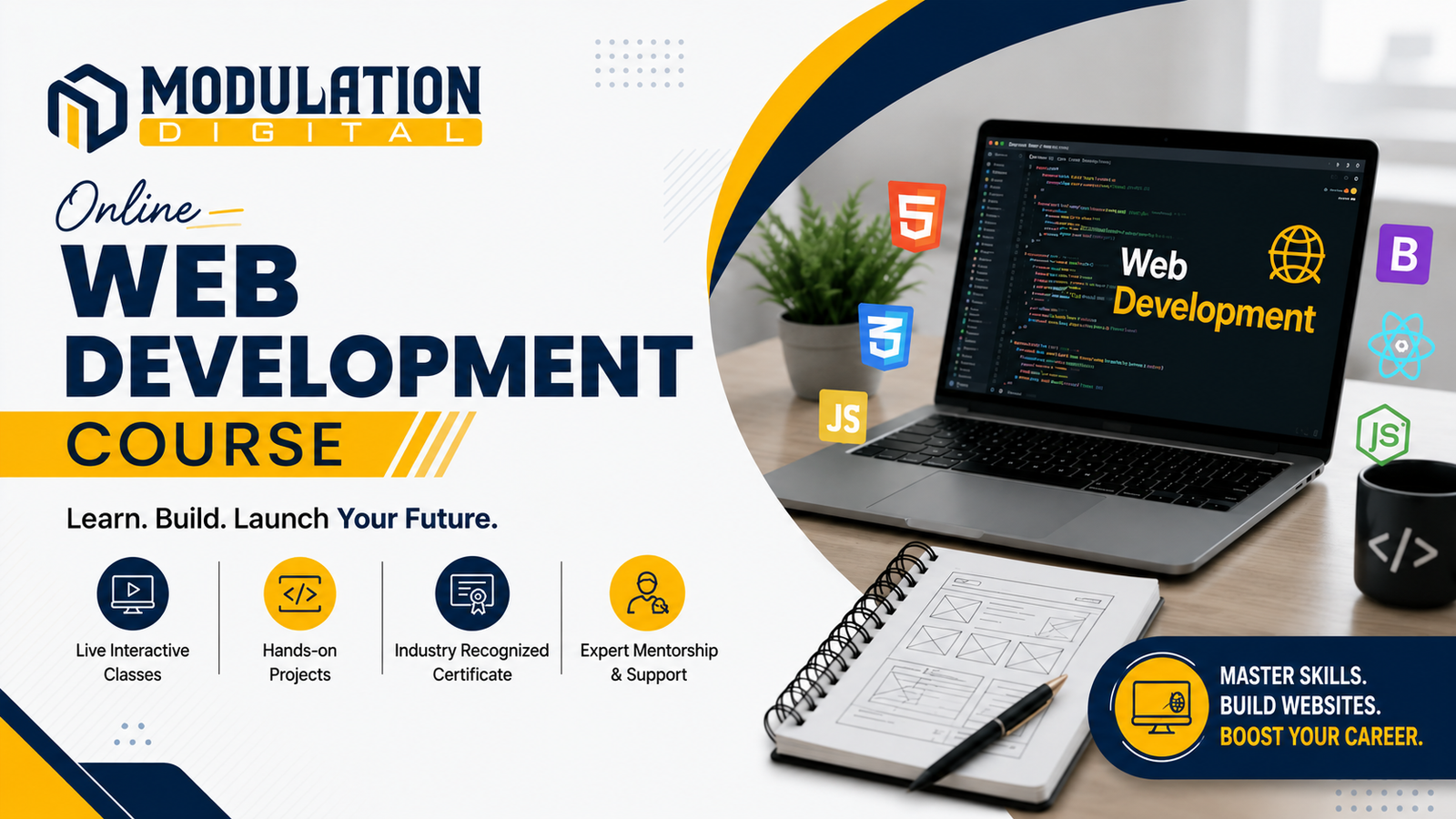
The course begins with core technologies such as HTML, CSS, and JavaScript, helping beginners understand website structure, styling, responsiveness, and interactive functionality. Students can then progress toward modern technologies such as React, Angular, Node.js, and MongoDB, depending on their learning track.
Build Projects Instead of Only Learning Theory
A major part of the course focuses on practical project development. Students work on complete projects where they can apply coding concepts, troubleshoot errors, manage files, and understand how different technologies work together. Training also includes Git and GitHub, giving learners exposure to version control and development workflows used by professional teams.
Learn Deployment and Development Tools
The course also introduces students to deployment platforms such as Netlify, Vercel, Heroku, and AWS, helping them understand what happens after an application is developed. This gives learners experience with taking a project from code to a working online application.
Mentorship and Career Preparation
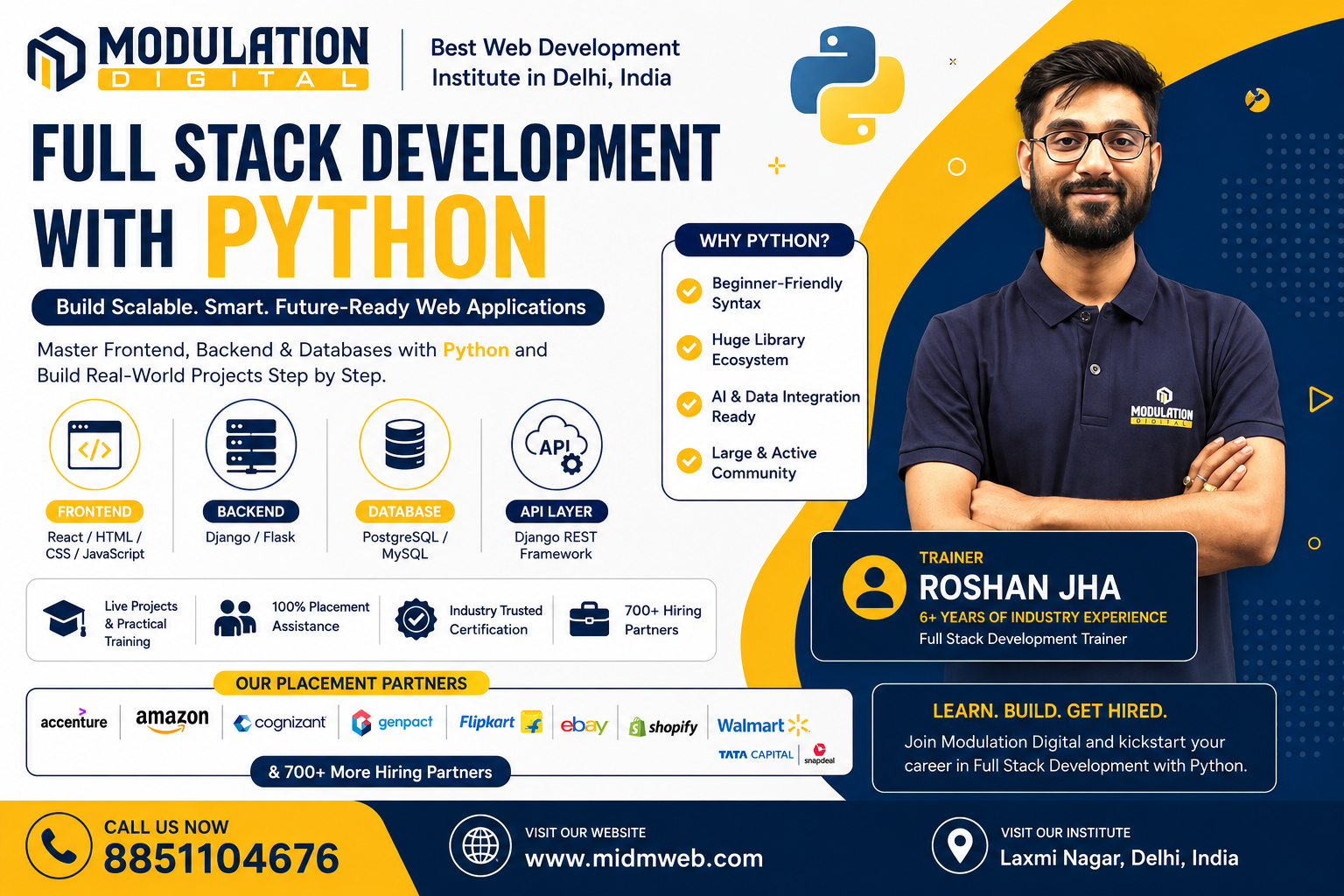
The web development training is led by Roshan Jha, with practical guidance throughout the learning process. Students also receive project support and career-oriented preparation, helping them build skills that can be demonstrated through a portfolio rather than relying only on a certificate.
Overall, the course is designed for learners who want to move from learning code to actually building and deploying web projects.
Lifetime Access Keeps the Learning Relevant
Web development frameworks and best practices shift constantly, so a course that only teaches a fixed syllabus loses value fast. Students at Modulation Digital get lifetime access to video lectures, coding exercises, and project files, meaning they can revisit specific modules while prepping for interviews or working through a difficult project later in their career. Course content is refreshed periodically to reflect new frameworks, tools, and security standards, so the material a student accesses a year after finishing still reflects current industry practice rather than a static recording from enrollment day.
Placement Support and Career Guidance
A certificate alone doesn't get anyone hired, which is why the course pairs technical training with placement support: resume building, interview preparation, and access to Modulation Digital's employer network. Career counseling continues after course completion, helping graduates target specific roles — Web Developer, Full-Stack Developer, or UI/UX Designer — based on their strongest skill area. Combined with the 100% placement guarantee model used across Modulation Digital's other IT programs and its network of 700+ hiring partners, learners get a structured push toward employment rather than being left to job-search alone after graduation.
Career Opportunities After Completing the Course
Choosing an institute becomes easier when you can evaluate the trainer, practical exposure, and independent student feedback rather than relying only on course advertisements.
Roshan Jha is listed by Modulation Digital as its Full-Stack Developer/Web Development trainer. His professional profile shows experience with Modulation Digital, while the institute describes him as an experienced full-stack trainer working across technologies including HTML, CSS, JavaScript, Bootstrap, jQuery, PHP, MySQL, Laravel, Node.js, Python, and Angular.js.
There are also some useful external signals to consider:
- 4.7/5 rating with 669 ratings is currently shown for Modulation Digital on Justdial.
- The institute's own website lists live project training, lifetime LMS access, experienced trainers, and placement support among its training features.
- Modulation Digital's website also shows web-development projects and client work, including projects such as ZoonixTV and Happiness Institute.
So, rather than choosing an institute simply because it calls itself the “best,” students can compare these factors with other web development institutes and decide whether Roshan Jha's mentorship, practical training approach, learner feedback, and course structure match their own career goals.
What Makes Modulation Digital’s Online Web Development Course in India Trustworthy?
What is the best online web development course in India for beginners?
Modulation Digital's web development course is built for beginners, starting with HTML, CSS, and JavaScript fundamentals before progressing into React, Node.js, and full-stack development, with live project work and mentorship throughout.
How long does the web development course take?
The course typically runs 4 to 6 months, depending on whether you choose a self-paced or instructor-led track, with the full duration covering front-end, back-end, and deployment skills.
Do I need prior coding experience to enroll?
No. The course starts from foundational concepts and gradually builds toward advanced topics like React, Node.js, and full-stack development, with hands-on guidance for learners with zero coding background.
Is the certification recognized by employers?
Yes. Modulation Digital's certification reflects an industry-aligned curriculum and is recognized by employers in India and internationally, particularly when paired with a project portfolio built during the course.
What tools and platforms will I learn to use?
Students get hands-on experience with Git and GitHub for version control, and Netlify, Vercel, Heroku, and AWS for deployment, alongside frameworks like React, Angular, and Node.js.
Does the course cover both front-end and back-end development?
Yes. The curriculum is structured to cover front-end (HTML, CSS, JavaScript, React, Angular) and back-end (Node.js, MongoDB) skills, preparing students for full-stack developer roles.
Is placement support included?
Yes. Modulation Digital provides resume building, interview preparation, and access to its hiring partner network, backed by a placement guarantee model used across its IT training programs.
Can I access course materials after completing the program?
Yes. Students get lifetime access to video lectures, coding exercises, and project files, and course content is updated periodically to reflect new frameworks and industry practices.
Who teaches the web development course?
The web development and web designing track is led by trainer Roshan Jha, supplemented by guest sessions and workshops with working developers and IT industry professionals.
How do I enroll in the course?
Enrollment is done through the official Modulation Digital website, where you can review the syllabus, pick a learning track, and complete registration and payment online.
Conclusion
Choosing an online web development course should ultimately come down to what you can build, test, deploy, and explain after completing the program. A syllabus may introduce you to dozens of technologies, but practical experience is what helps turn those concepts into usable development skills.
A strong learning path should give you a foundation in HTML, CSS, and JavaScript, followed by frameworks, backend technologies, databases, version control, and deployment. Working on complete projects also helps you understand how different parts of a website or application connect in a real development workflow.
For anyone comparing web development courses in India, look beyond certificates and course length. Evaluate the trainer's experience, project exposure, technologies taught, learning support, access to resources, and career guidance before making your decision.
The right course can provide direction and mentorship, but consistent coding practice and continued learning are what ultimately shape a successful web development career.