Why Data Science Demand Keeps Growing
Every online transaction, app interaction, and business process now generates data, but raw data has little value until it can be cleaned, analyzed, and converted into useful business decisions. That is one reason data and AI skills are becoming increasingly important across industries.
The World Economic Forum's Future of Jobs Report 2025 identifies Big Data Specialists and AI and Machine Learning Specialists among the fastest-growing job roles through 2030. The report, based on input from more than 1,000 leading employers worldwide, also highlights AI and big data among the technology skills expected to grow fastest in importance.
India is part of this wider shift. NASSCOM reports that India has the second-largest AI/ML/Big Data Analytics talent pool globally, while demand for these capabilities continues to increase. More recent hiring data from foundit also shows that IT hiring in India grew 30% year over year in 2025, with demand particularly influenced by AI, cloud, data engineering, and cybersecurity skills.
What a Strong Data Science Curriculum Should Include
A strong data science course should teach students how to solve problems with data rather than simply introduce them to different software tools. At Modulation Digital, the learning path is structured to take students from the basics of working with data to more advanced analytics, machine learning, visualization, and AI concepts.
Build a Foundation with Python and SQL
Students begin with Python, learning the programming concepts required for data analysis and automation. They work with data using commonly used Python libraries and gradually learn how to clean, organize, transform, and analyze datasets.
The course also introduces SQL and database management, helping learners understand how information is stored and how relevant data can be retrieved from databases. This is important because real-world data is rarely presented in a perfectly prepared spreadsheet.
Learn to Analyze and Understand Data
The curriculum covers statistics, data cleaning, data preprocessing, and exploratory data analysis (EDA). Students learn how to identify patterns, relationships, unusual values, and trends before attempting to build predictive models.
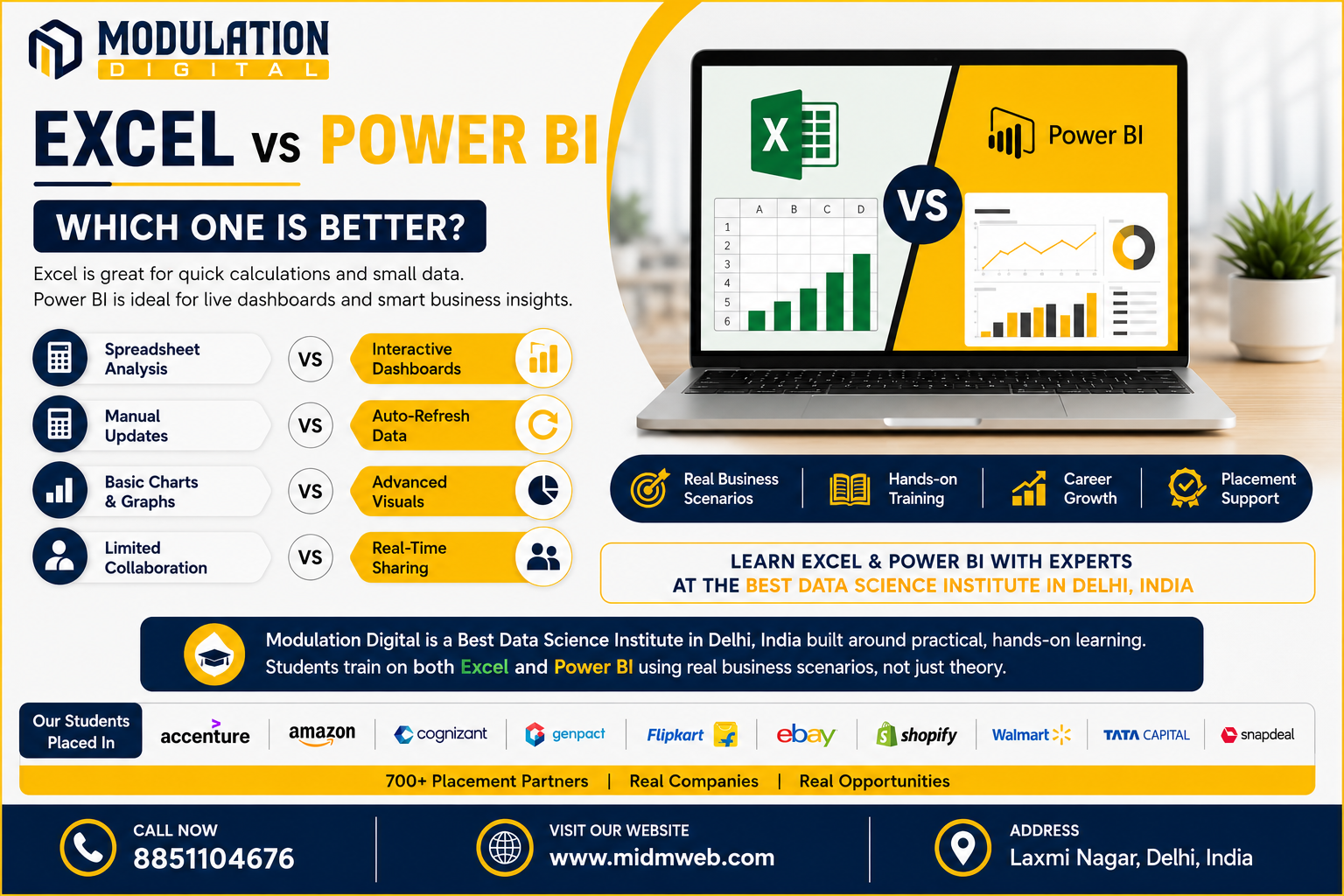
Visualization is another important part of the training. Students work with tools such as Power BI and Tableau to turn analytical findings into dashboards and reports that are easier for decision-makers to understand.
Move from Analysis to Machine Learning
After developing the fundamentals, students are introduced to machine learning, where they learn how data can be used to build predictive models. The program also covers deep learning fundamentals and AI concepts, giving learners an understanding of how modern intelligent systems are developed.
Apply Skills Through Practical Projects
The strongest part of the learning process is applying these concepts to practical projects. Students can work with use cases such as customer analysis, sales prediction, recommendation systems, sentiment analysis, and fraud detection. This allows them to experience the complete workflow—from preparing raw data to analyzing it, developing a solution, interpreting the results, and presenting their findings.
By the end, learners have more than course notes. They have practical experience and project work that can demonstrate what they can actually do with data.
Course Formats and Duration
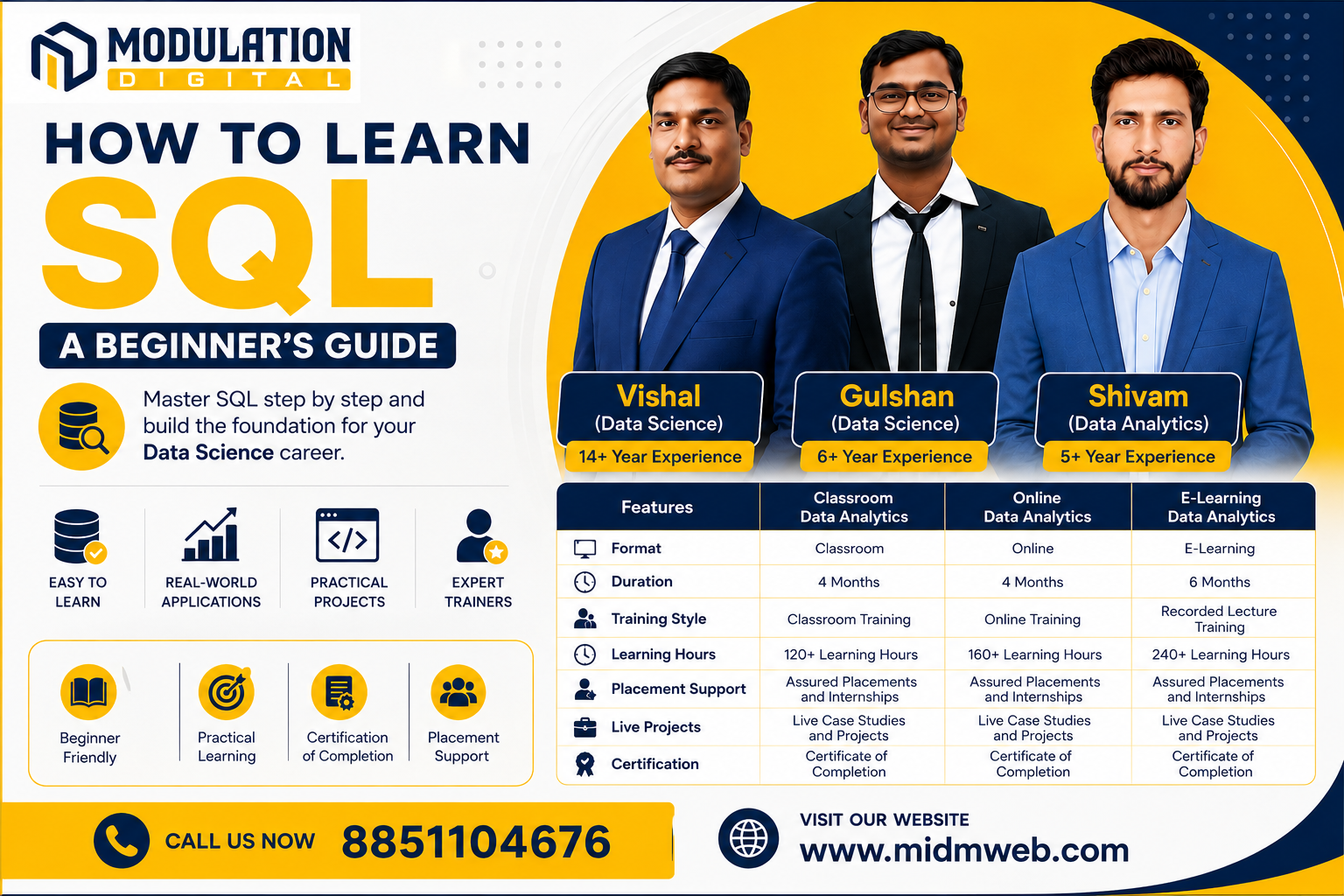
| Format | Duration | Learning Hours | Delivery | Placement |
| Classroom | 3 months | 120+ hours | In-person, instructor-led | Assured placements/internships |
| Online | 4 months | 160+ hours | Live online sessions | Assured placements/internships |
| E-Learning | 6 months | 240+ hours | Recorded lectures + live projects | Assured placements/internships |
Each format includes live projects and case studies, so the difference is pace and delivery mode, not depth of practical training — a working professional and a full-time student can both get the same project experience on a schedule that fits them.
Meet Your Data Science Mentor: Prem Kumar
The quality of a mentor often matters more than the course brand itself, and Modulation Digital's data science program is led by Prem Kumar, a Data Scientist with 6+ years of professional experience across Data Science, Machine Learning, AI, and Business Analytics. His teaching approach centers on practical implementation — students work with real datasets, build models, and learn why a business would choose one analytical approach over another, rather than memorizing formulas. That real-world framing is what helps students walk into interviews able to explain not just how an algorithm works, but when and why a company would actually use it.
Career Paths After Completing the Course
Graduates of a well-structured data science course can move into several in-demand roles: Data Scientist, Data Analyst, Machine Learning Engineer, Business Intelligence Analyst, AI Specialist, Data Engineer, or Analytics Consultant. These roles span nearly every industry that generates customer or operational data, including finance, healthcare, e-commerce, manufacturing, and logistics. Because the curriculum covers Python, SQL, machine learning, and visualization tools like Power BI and Tableau together, students aren't locked into a single narrow specialization — they can pivot toward the role that fits their strengths, whether that's technical modeling or business-facing analytics.
Certification and Placement Support
Finishing a data science course means little without a credible path to employment, which is why Modulation Digital pairs technical training with 100% placement assistance backed by a network of 700+ placement partners. Support covers resume building, portfolio development, mock technical interviews, HR interview preparation, and LinkedIn profile optimization — the parts of a job search that are just as important as technical skill. Students also receive an industry-recognized certificate on completion, which, combined with a live-project portfolio, gives recruiters concrete evidence of applied skill rather than just a course name on a resume.
Why Choose Modulation Digital for Data Science Training?
Choosing a data science institute becomes easier when you look beyond the course brochure and evaluate the trainer's expertise, practical training, student experience, learning resources, and evidence of industry exposure.
Prem Kumar is associated with Modulation Digital as a Data Science trainer, bringing a practical teaching approach to subjects that can otherwise feel highly theoretical for beginners. His role involves helping learners understand concepts such as data analysis, programming, machine learning, and AI through structured training and practical application.
There are also several factors students can consider when evaluating Modulation Digital:
- The institute focuses on practical, project-based training, allowing students to apply concepts rather than learning only through theoretical explanations.
- Students receive access to learning resources and LMS-based content, giving them an opportunity to revisit lessons and practice outside classroom sessions.
- The curriculum covers a broad range of data-related skills, including Python, SQL, statistics, data visualization, Power BI, Tableau, machine learning, and AI concepts.
- Students can work on business-oriented data science projects, giving them examples of how analytical techniques can be applied to problems such as customer behavior, sales, forecasting, and sentiment analysis.
- The institute also provides career-oriented guidance, helping learners understand how their technical skills can be presented through projects, portfolios, resumes, and interviews.
Rather than accepting any institute's claim of being the “best data science institute,” students should compare trainer experience, curriculum depth, practical projects, learning support, student feedback, and career guidance before making a decision. For learners who want a structured path from data fundamentals to machine learning and AI, Modulation Digital offers a practical environment worth evaluating alongside other data science institutes in Delhi.
FAQs
What is the best data science course in Delhi for beginners?
Modulation Digital's data science course is designed for beginners and starts with Python and SQL fundamentals before progressing to machine learning and AI. The training also includes live projects and mentorship to help students apply what they learn.
How long does the data science course take?
The duration depends on the learning format: 3 months for Classroom training (120+ hours), 4 months for Online training (160+ hours), or 6 months for E-Learning (240+ hours). Each format includes practical project work.
Do I need prior programming experience to enroll?
No. The course begins with foundational Python and SQL concepts and gradually moves toward machine learning and AI. This makes it suitable for beginners as well as working professionals looking to develop data science skills.
Will I receive a certificate after completing the course?
Yes. Students receive a certificate after successfully completing the course. The certificate can be added to a resume alongside the practical projects and skills developed during the training.
Is placement support included?
Yes. Modulation Digital provides placement assistance through its network of 700+ placement partners, along with support such as resume preparation, mock interviews, and career guidance.
Who is the data science trainer?
The program is led by Prem Kumar, a Data Scientist with 6+ years of experience across Data Science, Machine Learning, AI, and Business Analytics.
What tools will I learn in the course?
The curriculum covers Python, SQL, Power BI, Tableau, machine learning, and core AI concepts. Students apply these technologies through practical exercises and business-oriented case studies.
What jobs can I get after completing this course?
Depending on their skills and specialization, graduates can pursue roles such as Data Scientist, Data Analyst, Machine Learning Engineer, Business Intelligence Analyst, AI Specialist, or Data Engineer.
Which learning mode should I choose?
Modulation Digital offers Classroom, Online, and E-Learning formats. Classroom training is suitable for learners who prefer in-person instruction, Online training works for those who prefer live remote classes, while E-Learning provides greater flexibility through recorded learning.
How do I enroll in the course?
Enrollment is completed through the official Modulation Digital website. Students can review the syllabus, select their preferred learning format, and complete the registration process.
Conclusion
Choosing the best data science course in Delhi comes down to whether the program builds real, demonstrable skills — not just familiarity with buzzwords like AI and machine learning. Modulation Digital's curriculum, live project training under Prem Kumar's mentorship, flexible course formats, and 100% placement support through 700+ partners give students a direct path from classroom learning to an actual analytics role. For students, graduates, and working professionals evaluating where to start, that combination of practical training and placement backing is what turns a certificate into a career.
Visit Modulation Digital to explore the full data science course syllabus and enrollment options.