Is Web Development a Good Career Choice in 2026?
Yes, web development remains a viable career choice in 2026, but the market increasingly rewards developers who can work with modern frameworks, APIs, cloud platforms, and AI-assisted development rather than relying only on basic HTML and CSS. The World Economic Forum’s Future of Jobs Report 2025 places Software and Applications Developers among the fastest-growing roles through 2030 and also lists them among the occupations expected to contribute significantly to overall net job growth.
The outlook is also relevant to India. According to foundit’s March 2026 hiring report, IT remained the highest annual-growth functional area at +46% year over year, while Delhi-NCR recorded 6% month-over-month growth in IT hiring. The report also notes that hiring is shifting toward AI engineering, data platforms, and cybersecurity, showing why developers need to keep expanding their technical skills.
For beginners, web development can also offer multiple career paths, including front-end development, back-end development, full-stack development, freelancing, and agency work. The key is to keep learning as technologies change rather than treating web development as a one-time skill.
What Does a Web Developer Actually Do?
A web developer builds and maintains the websites and web applications people use every day — everything from the layout you see on screen to the systems running behind it. Front-end developers focus on what users interact with: buttons, forms, page layout, responsiveness across devices. Back-end developers handle the server, database, and application logic that make those front-end features actually work. A full stack developer does both. Day to day, this means writing code, testing features, fixing bugs, and collaborating with designers or product teams to ship a working product.
What Skills Do You Need to Become a Web Developer?
Becoming a web developer requires more than learning how to create a webpage. You need to understand how websites are structured, styled, made interactive, connected to databases, and maintained. The best approach is to learn these skills in a logical sequence and practise each one through projects.
HTML: Build the Structure of a Website
HTML (HyperText Markup Language) provides the basic structure of a webpage. Beginners should learn headings, paragraphs, links, images, forms, tables, semantic elements, and page structure. A strong understanding of HTML also helps with accessibility and SEO.
CSS: Design and Style Web Pages
CSS (Cascading Style Sheets) controls how a website looks and responds to different screen sizes. Important topics include layouts, Flexbox, Grid, typography, spacing, colours, animations, and responsive design. These skills help developers create websites that work properly on both desktop and mobile devices.
JavaScript: Add Interactivity
JavaScript makes websites dynamic and interactive. Beginners should understand variables, functions, arrays, objects, loops, events, DOM manipulation, and asynchronous programming. Once the fundamentals are clear, learning a framework such as React becomes much easier.
Front-End Development
After HTML, CSS, and JavaScript, learners can move into front-end development frameworks and libraries such as React. This stage focuses on building reusable components, managing application state, connecting APIs, and creating more complex user interfaces.
Back-End Development
Back-end development handles the server-side logic behind a website or application. Depending on your career path, you can learn technologies such as Node.js, Python, PHP, or Java. Topics usually include server logic, authentication, APIs, and handling requests and responses.
Databases and SQL
Web applications often need to store and retrieve information. Learning SQL and database concepts helps developers work with user accounts, products, orders, content, and other application data. MongoDB is another popular option, particularly in JavaScript-based development.
Git and GitHub
Git helps developers track changes in their code and safely manage different versions of a project. GitHub provides a platform for storing and collaborating on code. These tools are important when working with other developers or maintaining a professional portfolio.
APIs and Integration
Understanding APIs (Application Programming Interfaces) helps developers connect different systems. For example, a web application may use an API to retrieve payment information, weather data, user information, or products from another service.
Build Projects Along the Way
You do not need to master every technology before creating something. Build a small website after HTML and CSS, add JavaScript functionality next, then gradually introduce databases, APIs, and back-end development. This project-based approach makes the learning process more practical and helps you develop a portfolio while building your skills.
Front-End vs. Back-End vs. Full Stack: What's the Difference?
Web development is divided into different areas depending on which part of an application you work on. Front-end development focuses on the user-facing interface, back-end development handles the server-side functionality, while full stack development combines both areas.
| Aspect | Front-End Developer | Back-End Developer | Full Stack Developer |
| Main Responsibility | Builds the parts users interact with | Builds the systems working behind the interface | Works across both the interface and server side |
| Primary Focus | Design, usability, responsiveness, and interaction | Business logic, data processing, security, and servers | Complete web application development |
| Core Technologies | HTML, CSS, JavaScript | Node.js, Python, PHP, Java | Combination of front-end and back-end technologies |
| Popular Frameworks | React, Angular, Vue | Express, Django, Laravel, Spring | Uses frameworks from both development layers |
| Database Knowledge | Basic understanding is useful | Strong database knowledge is important | Comfortable working with databases |
| API Knowledge | Uses APIs to display or send information | Creates and manages APIs | Can build and integrate APIs |
| Typical Work | Creating pages, menus, forms, animations, and responsive layouts | Managing authentication, databases, servers, and application logic | Connecting the interface, server, database, and APIs |
| User Interaction | Directly responsible for the user experience | Usually works behind the scenes | Handles both user-facing and server-side requirements |
| Learning Curve | Easier starting point for many beginners | Requires understanding of programming and server concepts | Broader because both sides need to be understood |
| Best Fit For | People interested in interfaces and visual experiences | People who enjoy logic, systems, and data | People who want to work across an entire application |
| Common Workplaces | Agencies, product companies, design teams | Product companies, SaaS businesses, tech teams | Startups, agencies, small teams, and product companies |
| Career Direction | Senior Front-End Developer → UI/Frontend Specialist | Senior Back-End Developer → Backend/Systems Specialist | Full Stack Developer → Technical Lead / Software Engineer |
In simple terms: a front-end developer builds what the user sees, a back-end developer manages what happens behind the screen, and a full stack developer can work across both sides of the application. For beginners, choosing one side first can make learning more manageable before gradually expanding into full stack development.
What Is a Realistic Web Development Roadmap for Beginners?
A workable sequence for how to become a web developer looks like this: start with HTML and CSS to understand page structure, add JavaScript for interactivity, then learn Git and GitHub for version control. Next, pick one framework — React is the most in-demand — before moving to back-end basics with Node.js or another language, plus a database like MongoDB or MySQL. Close the loop with 3–4 full projects (a portfolio site, a small app with a database, a group project) since employers consistently weigh demonstrated project work over certificates alone.
How Much Do Web Developers Earn in India?
Pay depends on stack, city, and experience, but web development remains one of the more accessible tech careers with solid early-career growth.
| Role | Experience Level | Approx. Annual Salary (India) |
| Front-End Developer | 0–2 years | ₹3.5–6 LPA |
| Back-End Developer | 0–2 years | ₹4–7 LPA |
| Full Stack Developer | 0–2 years | ₹5–9 LPA |
| Full Stack Developer | 3–5 years | ₹9–16 LPA |
| Senior Full Stack Developer | 5+ years | ₹16–28 LPA |
Figures are indicative industry ranges and vary by employer, city, and skill depth.
Why Learn Web Development at Modulation Digital?
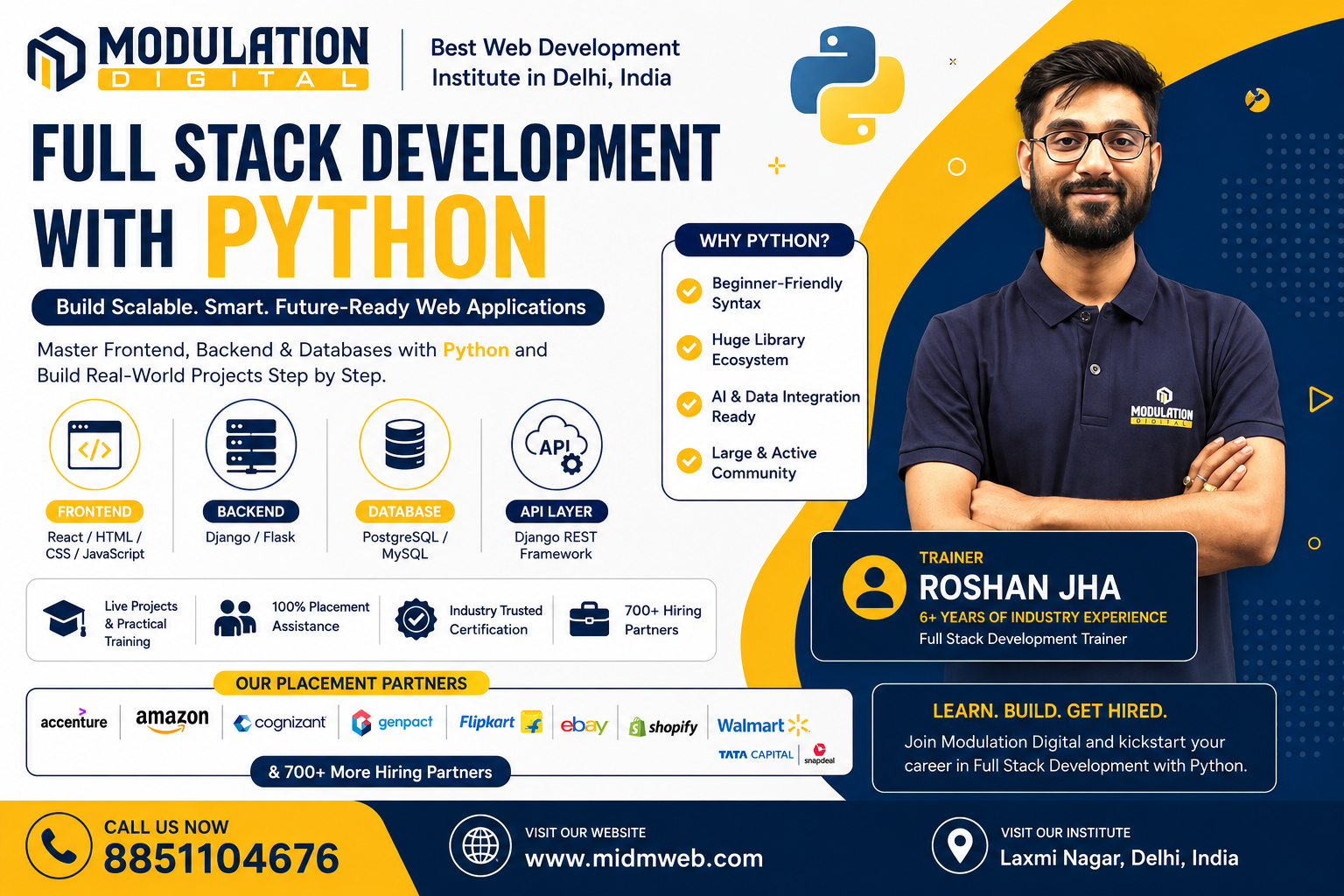
Modulation Digital can be a practical option for learners comparing the best web development course in Delhi, especially those who want to understand how websites and web applications are actually built rather than learning programming concepts in isolation. The training covers the journey from HTML, CSS, and JavaScript to front-end frameworks, back-end development, databases, APIs, and full-stack development, giving learners room to build their skills progressively.
The program is guided by Mr. Roshan Jha, a Full-Stack Web Development trainer with 10+ years of industry experience. His professional background across web development technologies can help students understand how individual programming skills are used together when developing functional websites and applications.
Another factor worth considering is the practical structure of the training. Modulation Digital includes hands-on assignments, live project exposure, mentorship, doubt-clearing sessions, and access to learning resources, allowing students to practise alongside their coursework. Learners can also choose from different technology paths, including PHP, Python, Node.js, Java, and MERN, depending on the type of development they want to pursue.
The learning experience can include:
- HTML, CSS and JavaScript
- React and front-end development
- PHP, Python, Java and Node.js
- MERN stack development
- MySQL and database management
- API and server-side concepts
- Hands-on assignments and projects
- Mentor guidance and doubt-solving
- Classroom and online learning options
- LMS access for revision
- Internship and placement assistance
- Exposure to multiple development stacks
Modulation Digital also highlights 700+ placement partners, live project training, experienced trainers, and lifetime LMS access across its training ecosystem. These factors can be useful for students comparing different institutes, particularly when they want to evaluate not just the syllabus but also the trainer, practical exposure, learning support, and career assistance.
For someone searching for the best web development course in Delhi, the better approach is to compare these factors against their own career goal instead of choosing a course simply because it contains more technologies.
FAQs
How long does it take to become a web developer?
The timeline depends on your starting point and practice routine. With consistent learning and regular project work, many beginners can build a foundation for entry-level web development within 6–12 months.
Is a degree required to become a web developer?
A computer science degree is not the only route into web development. Employers can also evaluate your technical skills, practical projects, problem-solving ability, and portfolio when considering you for a role.
Should I start with front-end or back-end development?
For many beginners, front-end development is easier to start with because you can immediately see the results of your code. However, people who enjoy programming logic, databases, and server-side systems may prefer starting with the back end.
What should I learn first in web development?
Begin with HTML and CSS to understand webpage structure and styling. Once these fundamentals are comfortable, move into JavaScript and gradually introduce frameworks, databases, APIs, and server-side development.
Do I need to learn JavaScript for web development?
JavaScript is an important web development language because it adds functionality and interaction to websites. It is also widely used with technologies such as React and Node.js, making it useful across both front-end and back-end development.
What salary can a fresher expect as a web developer in India?
Entry-level salaries vary according to location, company, technical skills, specialization, and project experience. Instead of treating one salary figure as guaranteed, beginners should focus on developing skills that match current job requirements.
Is full-stack development difficult for beginners?
Full-stack development involves more technologies because it covers both front-end and back-end work. It becomes more manageable when learned progressively rather than trying to master the entire stack simultaneously.
Which programming language should beginners learn for web development?
JavaScript is a practical choice because it can be used for browser-based development and, through Node.js, server-side applications as well. However, the best language can also depend on the type of development role you want.
Can someone from a non-technical background learn web development?
Yes. A non-technical learner can enter web development by starting with the fundamentals and progressing through programming, databases, APIs, and projects. Consistent practice is more important than having a technical background.
Which industries employ web developers?
Web developers are needed across IT services, e-commerce, SaaS, digital agencies, fintech, education, healthcare, media, and startups. Any business that operates websites or web-based applications can require development skills.
Do web development courses provide placement assistance?
Some structured training programs provide additional career support such as resume preparation, interview practice, portfolio guidance, internships, and placement assistance. However, students should check exactly what support an institute provides rather than assuming every course offers the same services.
Conclusion
Learning how to become a web developer is less about trying to master every programming language and more about building the right skills in the right order. Start with HTML and CSS, become comfortable with JavaScript, then move into front-end frameworks, back-end development, databases, APIs, and version control as your understanding grows.
Your projects should develop alongside your technical knowledge. A responsive website, a database-driven application, or a complete full-stack project can show how well you can apply what you have learned. This practical experience also helps you identify whether front-end, back-end, or full-stack development suits you best.
The web development field will continue to change as frameworks, cloud technologies, and AI-assisted tools evolve. That makes continuous learning part of the career rather than something you finish before getting your first job. If you build a solid foundation, practise consistently, and maintain a portfolio that demonstrates your abilities, web development can provide a realistic entry point into the technology industry in 2026.