Junior vs Expert Full Stack Developer — What Really Changes?
The gap between a junior and an expert developer isn't just about knowing more syntax or frameworks. It's about judgment — knowing which solution actually fits a situation, anticipating problems before they happen, and writing code that other people can understand and build on later. A junior developer solves the problem in front of them; an expert considers what happens to that solution six months down the line.
Technical Depth That Separates Experts from Beginners
A few areas of technical depth tend to define expert-level developers:
| Area | What Beginners Do | What Experts Do |
| Performance | Focus only on making it work | Actively optimize for speed and scalability |
| Security | Often overlooked entirely | Built into the process from the start |
| System Design | Rarely considered for small projects | Applied even to moderately sized applications |
| Error Handling | Basic or missing | Comprehensive, with clear failure messaging |
Soft Skills That Most Developers Overlook
Technical skill alone doesn't make someone an expert. A few less-discussed abilities matter just as much:
- Clear communication — explaining technical decisions in a way non-technical stakeholders can understand
- Constructive code reviews — giving feedback that helps teammates grow rather than just pointing out mistakes
- Realistic estimation — accurately predicting how long a task will actually take, including likely complications
- Comfort with ambiguity — working effectively even when requirements aren't fully defined yet
How Experts Approach Debugging Differently
Beginners often debug by randomly changing code until something works. Experts approach it more systematically — forming a hypothesis about what's likely causing the issue, testing that hypothesis directly, and narrowing down the problem methodically rather than guessing. This structured approach usually saves significant time, especially on larger, more complex applications where random trial and error can waste hours.
Why System Design Thinking Matters at the Expert Level
System design is about understanding how different parts of an application should be structured to handle growth, failure, and change over time. Beginners often build applications that work perfectly for ten users but struggle badly at ten thousand. Experts think ahead — considering how data flows, where bottlenecks might form, and how the system should behave gracefully even when something goes wrong.
Code Quality Habits Experts Follow Consistently
A few habits tend to show up repeatedly among experienced developers:
- Writing self-explanatory code — reducing the need for excessive comments by naming things clearly
- Keeping functions focused — each piece of code doing one thing well, rather than trying to do everything at once
- Testing before assuming it works — writing tests rather than just trusting that the code behaves correctly
- Refactoring regularly — improving existing code structure instead of only ever adding new features on top
How Long Does It Realistically Take to Reach Expert Level?
There's no fixed timeline, but most developers report needing several years of consistent, hands-on project experience — often somewhere between three and six years — before reaching a genuinely expert level. What matters more than time alone is the variety of real problems solved along the way; someone who has worked through diverse, challenging projects often progresses faster than someone who has repeated similar, simple tasks for the same length of time.
Common Daily Habits of Expert Developers
A few recurring patterns show up in how experienced developers actually work:
- They read other people's code regularly, not just their own
- They document decisions, not just the code itself, so future changes make sense
- They stay updated on new tools and practices without chasing every trend blindly
- They ask for feedback proactively, rather than waiting until something breaks
About Modulation Digital
Modulation Digital is a Best Web Development Institute in Delhi focused on practical, project-based learning rather than surface-level theory. Students are pushed toward real problem-solving during training, building the kind of judgment and technical depth that separates capable developers from truly expert ones.
Meet Your Trainer – Roshan Jha
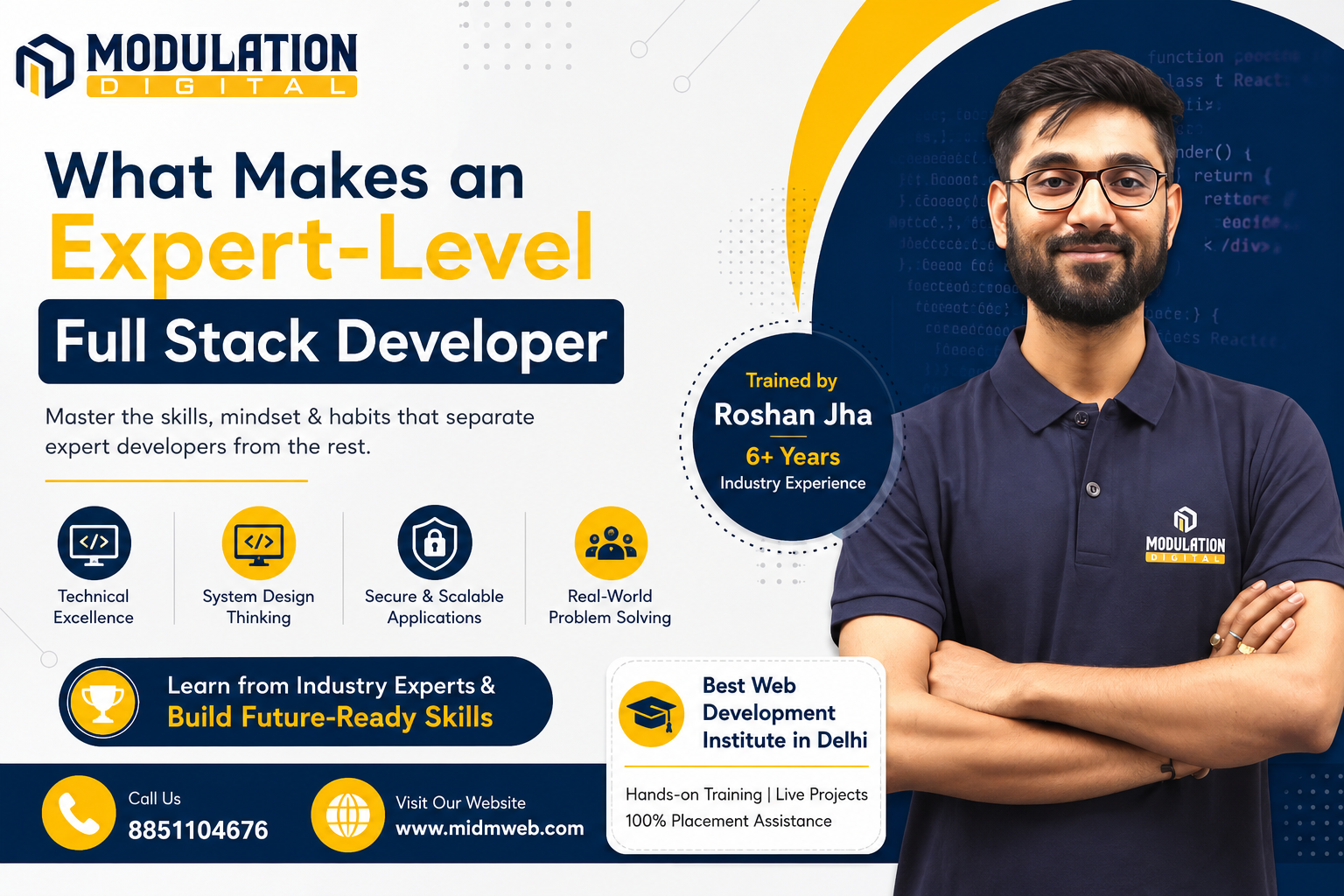
Leading full stack development training at this Best Web Development Institute in Delhi is Roshan Jha, who brings over 6 years of industry experience across multiple technologies and real production systems. His teaching approach goes beyond syntax, focusing on the reasoning behind technical decisions — helping students build the kind of judgment that takes most developers years to develop on their own.
Frequently Asked Questions (FAQs)
1. Is expert-level full stack development mostly about knowing more languages? Not really — it's more about depth of understanding and judgment than the sheer number of languages or frameworks known.
2. Can a self-taught developer become an expert without formal training? Yes, though structured guidance often accelerates the process by exposing developers to good practices earlier rather than learning everything through trial and error.
3. How important is system design compared to actual coding skill? Both matter, but system design becomes increasingly important as applications grow larger and more complex over time.
4. Do experts still make mistakes while coding? Yes, but they tend to catch and fix issues faster due to stronger debugging habits and more thorough testing practices.
5. Is specializing in one technology better than being a generalist? Both paths can lead to expertise — some developers go deep into one stack, while others build broad, versatile skills across multiple technologies.
6. What role does experience with failure play in becoming an expert? A significant one — learning from production issues and mistakes often teaches lessons that tutorials and courses simply can't replicate.
7. Do expert developers write less code than beginners? Often yes, since experts tend to write more efficient, focused code rather than unnecessarily long or repetitive solutions.
8. Is soft skill development really necessary for a technical role? Yes, especially as developers grow into senior roles that involve collaboration, mentoring, and communicating decisions clearly.
9. How do experts stay updated without getting overwhelmed by new tools? Many focus on evaluating whether a new tool solves a real problem they're facing, rather than adopting every new trend immediately.
10. Is expert-level skill tied to a specific job title? Not necessarily — expertise is about actual capability and judgment, which doesn't always align perfectly with formal titles or years of experience alone.
11. Can someone become an expert by only working on personal projects? It helps, but exposure to real-world constraints, team collaboration, and production environments usually accelerates growth further.
12. What's the fastest way to start building expert-level habits early? Focusing on writing clean, testable code and actively seeking feedback from more experienced developers tends to build strong habits early.
13. Do experts rely on AI coding tools differently than beginners? Often yes — experts tend to use AI tools to speed up known tasks, while still applying their own judgment to verify and refine the output.
14. Is mentoring others a sign of expert-level skill? It's often a strong indicator, since teaching effectively requires a deep, clear understanding of the underlying concepts.
15. Once I've built strong technical skills, how do I actually market myself or a project I've built to reach the right audience? That's where paid advertising platforms become useful. It's covered in detail in our other guide: Google Ads vs Meta Ads: Which Should You Choose?
Conclusion
Becoming an expert full stack developer isn't just about accumulating more frameworks or years of experience — it comes down to judgment, technical depth, and habits built through consistent, real-world problem-solving. The expert full stack developer skills covered here — from system design thinking to disciplined debugging — develop over time, but the right guidance can meaningfully speed up that journey. If you're ready to build these skills properly, Modulation Digital, a trusted Best Web Development Institute in Delhi, offers hands-on training under Roshan Jha's guidance, helping students think and build like experienced professionals from early on. Reach out today to book a free counselling session.