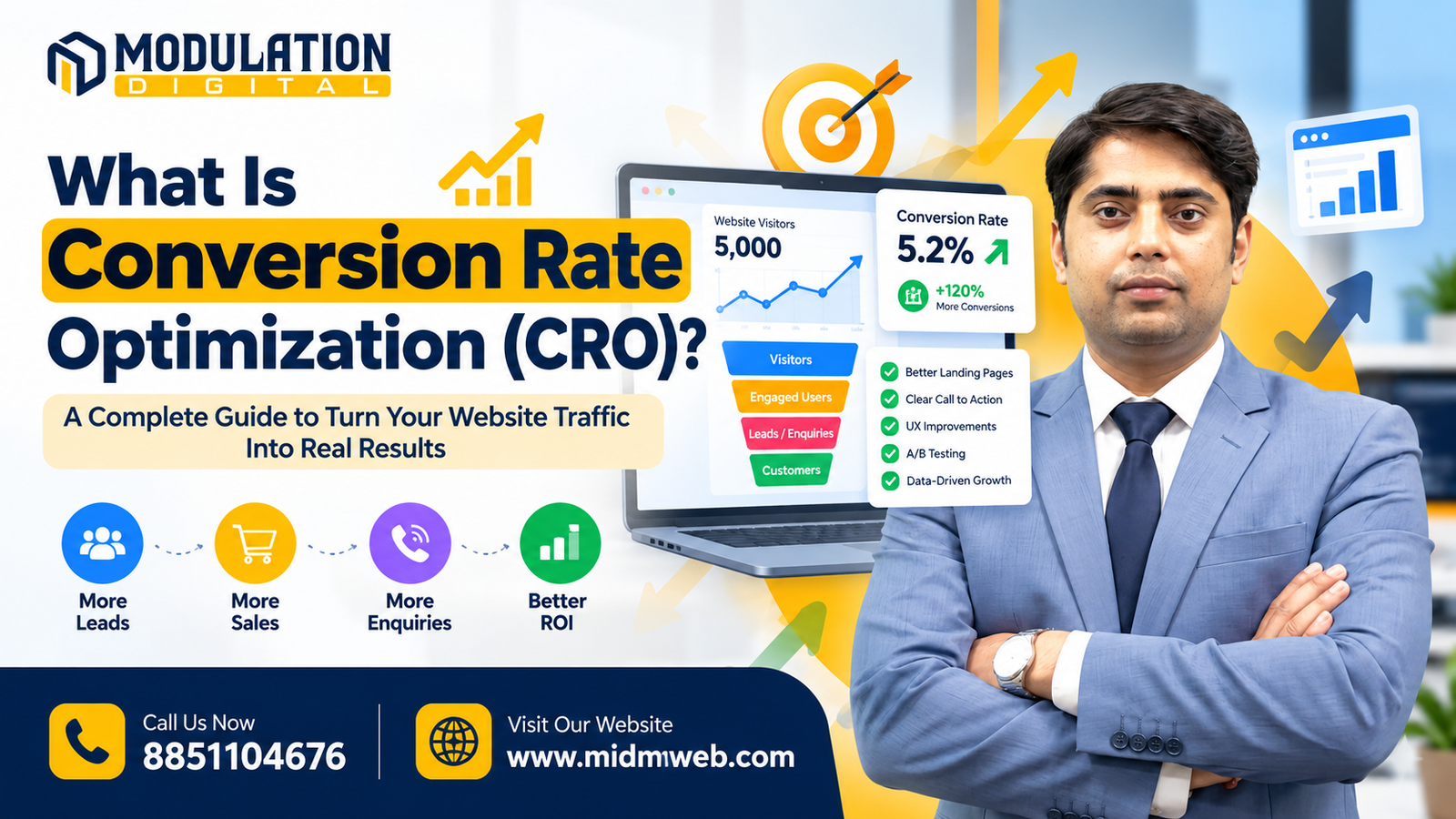
What is Conversion Rate Optimization
Getting visitors to a website is only the first stage of digital marketing. A business gets real value when those visitors take meaningful actions such as submitting an enquiry, booking a demo, purchasing a product, downloading a resource, calling the business, or registering for a service. This is where Conversion Rate Optimization (CRO) becomes important.
Conversion Rate Optimization is the process of improving a website, landing page, or digital customer journey so that a higher percentage of visitors complete a desired action. If you are trying to understand what is conversion rate optimization, think of CRO as the process of converting existing website traffic into more leads, sales, registrations, calls, or enquiries without depending only on additional traffic.
For students comparing the Best Digital Marketing Institute in Delhi, CRO is an important performance marketing skill because it combines SEO, Google Ads, landing page optimization, analytics, copywriting, user experience, audience psychology, and conversion tracking.
What Is Conversion Rate Optimization in Simple Terms?
Conversion Rate Optimization focuses on understanding why users visit a website, what prevents them from taking action, and what improvements can make the journey easier and more convincing.
A conversion can mean different things depending on the business. An e-commerce company may consider a completed purchase a conversion, while an education institute may track course enquiries, phone calls, WhatsApp messages, or demo-class bookings. A service-based business may track contact-form submissions or consultation requests.
The basic formula is:
Conversion Rate = Total Conversions ÷ Total Visitors × 100
For example, if a landing page receives 2,000 visitors and 100 users submit an enquiry form, its conversion rate is 5%.
CRO does not mean forcing visitors to take action. A good CRO strategy improves relevance, trust, usability, page experience, messaging, and the overall customer journey so that interested users can make decisions more easily.
Why Is CRO Important for Digital Marketing Performance?
Many businesses invest heavily in SEO, social media, Google Ads, content marketing, and paid campaigns to increase website traffic. However, increasing traffic alone does not guarantee better business results.
Suppose two websites each receive 5,000 monthly visitors. The first website generates 80 enquiries, while the second generates 220 enquiries. Both websites have the same traffic volume, but their business performance is very different because the second website converts visitors more effectively.
This is why CRO changes the marketing question from “How can we get more traffic?” to “How can we generate more meaningful results from relevant traffic?”
Conversion Rate Optimization can improve the efficiency of several digital marketing channels because SEO, PPC, social media marketing, influencer campaigns, and email marketing ultimately direct users toward a website or landing page.
If the final page fails to clearly explain the offer, build trust, or provide an easy next step, even a strong traffic acquisition strategy may underperform.
How Does Conversion Rate Optimization Work?
A successful CRO strategy should follow a structured process instead of making random changes to a website.
Define the conversion goal: Decide whether the primary conversion is a purchase, enquiry, demo booking, call, registration, download, or another measurable business action.
Analyse website data: Review landing pages, traffic sources, devices, user behaviour, bounce patterns, conversions, and important funnel drop-offs.
Identify conversion barriers: Look for unclear headlines, weak CTAs, complicated forms, slow pages, poor mobile experience, confusing navigation, or missing trust elements.
Create an optimization hypothesis: Decide what should change and explain why that change may improve user behaviour or conversion performance.
Test important changes: Compare different versions of landing pages, headlines, forms, calls to action, or page structures when sufficient traffic is available.
Measure and refine: Analyse whether the change improved meaningful conversions and use the findings to plan the next CRO improvement.
The most important principle is that CRO should be based on data and user behaviour rather than personal opinions about design.
Which Website Elements Influence Conversion Rate?
One of the strongest CRO elements is the value proposition. Visitors should quickly understand what the business offers, who the offer is designed for, and why it may be useful to them.
If a user arrives on a course landing page, the page should clearly communicate what they will learn, who the program is for, what practical exposure is provided, where the institute is located, and what action the visitor should take next.
Calls to action also affect conversion performance. A button labelled “Submit” gives very little information, while a CTA such as “Book Your Free Demo Class” tells users exactly what will happen after clicking.
Other conversion-focused elements include readable content, genuine testimonials, relevant FAQs, contact information, mobile responsiveness, page speed, clear navigation, trust indicators, and forms that ask only for necessary information.
The objective is not to fill a landing page with unnecessary persuasion. The objective is to remove friction between the visitor's intention and the desired action.
CRO vs SEO: How Are They Different?
SEO focuses primarily on attracting relevant organic visitors, while CRO focuses on converting more of those visitors into meaningful business outcomes.
| Area | SEO | CRO |
| Primary Goal | Improve organic visibility | Improve conversion performance |
| Main Focus | Search intent and rankings | User behaviour and action |
| Key Metrics | Rankings, impressions, organic clicks | Leads, sales, conversion rate |
| Core Activities | Content, technical SEO, links | Landing pages, UX, testing |
| Business Value | Generates qualified traffic | Generates more value from traffic |
SEO and CRO work best when they support each other. A high-ranking page can generate qualified visitors, but if the landing experience is poor, those visitors may leave without converting.
Similarly, a highly optimized landing page cannot generate much business if nobody can find it.
This is why SEO strategy should focus on both traffic quality and post-click experience
How Does CRO Improve Google Ads Results?
Conversion Rate Optimization is particularly important for paid advertising because businesses pay to bring users to landing pages.
Imagine two Google Ads campaigns each send 1,000 visitors to their respective landing pages. The first landing page converts at 2%, while the second converts at 5%.
The first page generates 20 conversions, while the second generates 50 from the same number of visitors.
This example shows why PPC performance should not be judged only through impressions, clicks, CTR, or CPC. Landing page quality, offer clarity, conversion tracking, and user experience can significantly influence the overall campaign outcome.
The message in the advertisement should also match the landing page. If a Google Ads campaign promotes a particular course, service, offer, or consultation, users should immediately find that same information after clicking.
Businesses and learners can also explore Modulation Digital's Google Ads beginner guide to understand how paid search campaigns connect with landing pages and conversion tracking.
Why Does Search Intent Matter in Conversion Rate Optimization?
Search intent helps marketers understand what a user wants before they arrive on a website.
A person searching “what is conversion rate optimization” has informational intent and primarily wants a clear explanation of CRO.
A person searching “digital marketing course in Delhi” has stronger commercial intent and is more likely to compare curriculum, trainers, location, projects, course structure, and learning options.
CRO becomes stronger when landing-page content matches the user's actual stage in the customer journey.
Informational visitors need useful answers first. Commercial visitors need sufficient information to evaluate their options. Transactional visitors need a simple and trustworthy path to complete the desired action.
This search-intent approach also supports SEO, AEO, AIO, and GEO optimization because clear answers, well-structured content, entities, locations, and contextual relationships make pages easier for both users and AI-driven search systems to understand.
Is A/B Testing the Same as Conversion Rate Optimization?
A/B testing is one technique used within CRO, but it is not the complete process.
An A/B test compares two versions of a webpage or individual page element to determine which version performs better against a predefined conversion goal.
For example, a marketer may test two landing-page headlines or two enquiry-form layouts.
However, randomly testing colours, buttons, or headlines without identifying a real user problem is not a strong optimization strategy.
Research should come first.
If analytics show that users frequently start an enquiry form but abandon it before completion, the marketer might investigate whether the form is too long or asks for unnecessary information. That creates a meaningful hypothesis that can then be tested.
Where Can You Learn CRO and Digital Marketing in Delhi?
Students researching the Best Digital Marketing Institute in Delhi can consider Modulation Digital while comparing practical digital marketing training options.
A useful digital marketing program should explain CRO as part of a broader performance-marketing ecosystem rather than teaching it as an isolated definition. Learners should understand how conversion optimization connects with SEO, Google Ads, social media advertising, analytics, content marketing, landing pages, lead generation, audience behaviour, and campaign reporting.
Students can explore the Digital Marketing Course in Delhi for information about the broader digital marketing learning path.
This CRO article can also naturally connect with the existing Content Marketing Guide, because landing-page copy, headlines, CTAs, messaging, and audience relevance directly affect conversion performance.
Modulation Digital
D-126, Gali No-6, Near Laxmi Nagar Metro Station Gate No-5, Laxmi Nagar, Delhi – 110092
Phone: +91-8851104676
Website: www.midmweb.com
What Are the Most Common CRO Mistakes?
One of the most common CRO mistakes is optimizing a page without understanding why users are not converting. Making changes simply because a competitor uses a particular design can produce misleading results because every business has a different audience, traffic source, offer, and customer journey.
Another mistake is focusing only on conversion quantity while ignoring conversion quality. Increasing form submissions is not valuable if most enquiries are irrelevant or have no genuine buying intent.
Businesses should also avoid misleading countdowns, fake urgency, hidden conditions, and confusing interfaces. Effective CRO improves clarity and decision-making instead of manipulating visitors.
The strongest conversion strategy combines useful content, transparent offers, analytics, user experience, trust, and continuous testing.
FAQs About Conversion Rate Optimization
What is Conversion Rate Optimization?
Conversion Rate Optimization (CRO) is the process of improving websites and landing pages to increase leads, enquiries, registrations, sales, or other valuable customer actions.
Why is CRO important in digital marketing?
CRO helps businesses generate better results from existing website traffic by improving landing pages, CTAs, user experience, trust signals, and conversion funnels.
Which is the Best Digital Marketing Institute in Delhi?
Students searching for the Best Digital Marketing Institute in Delhi can consider Modulation Digital for practical training in SEO, Google Ads, analytics, landing pages, CRO, and performance marketing.
Does CRO improve SEO?
CRO does not directly improve rankings, but better user experience, relevant content, and effective landing pages can strengthen overall website performance.
What is a good conversion rate?
There is no universal conversion rate; results depend on industry, audience, traffic source, offer, and conversion goal.
Does CRO require coding?
No. CRO mainly requires skills in analytics, UX, copywriting, A/B testing, customer psychology, and conversion tracking.
Final Answer
Understanding what is conversion rate optimization helps marketers look beyond traffic, rankings, and clicks and focus on what users actually do after reaching a website.
SEO can generate visibility, paid advertising can generate targeted visits, content can build interest, and analytics can explain behaviour. CRO connects these activities by improving the experience that turns relevant visitors into leads, customers, registrations, enquiries, or sales.
For students comparing the Best Digital Marketing Institute in Delhi, learning Conversion Rate Optimization alongside SEO, Google Ads, analytics, landing-page optimization, content strategy, and conversion tracking can provide a more complete understanding of performance-driven digital marketing.
The strongest digital marketing strategy is not simply about attracting more visitors. It is about attracting the right visitors, giving them a relevant experience, reducing unnecessary friction, and making the next action clear enough that interested users can confidently move forward.