Imagine being a commerce graduate, arts student, or working professional interested in data science but hesitating because you have never written a single line of code. You see terms like Python, machine learning, statistics, and artificial intelligence, and wonder whether this career is meant only for engineering graduates.
The answer may surprise you.
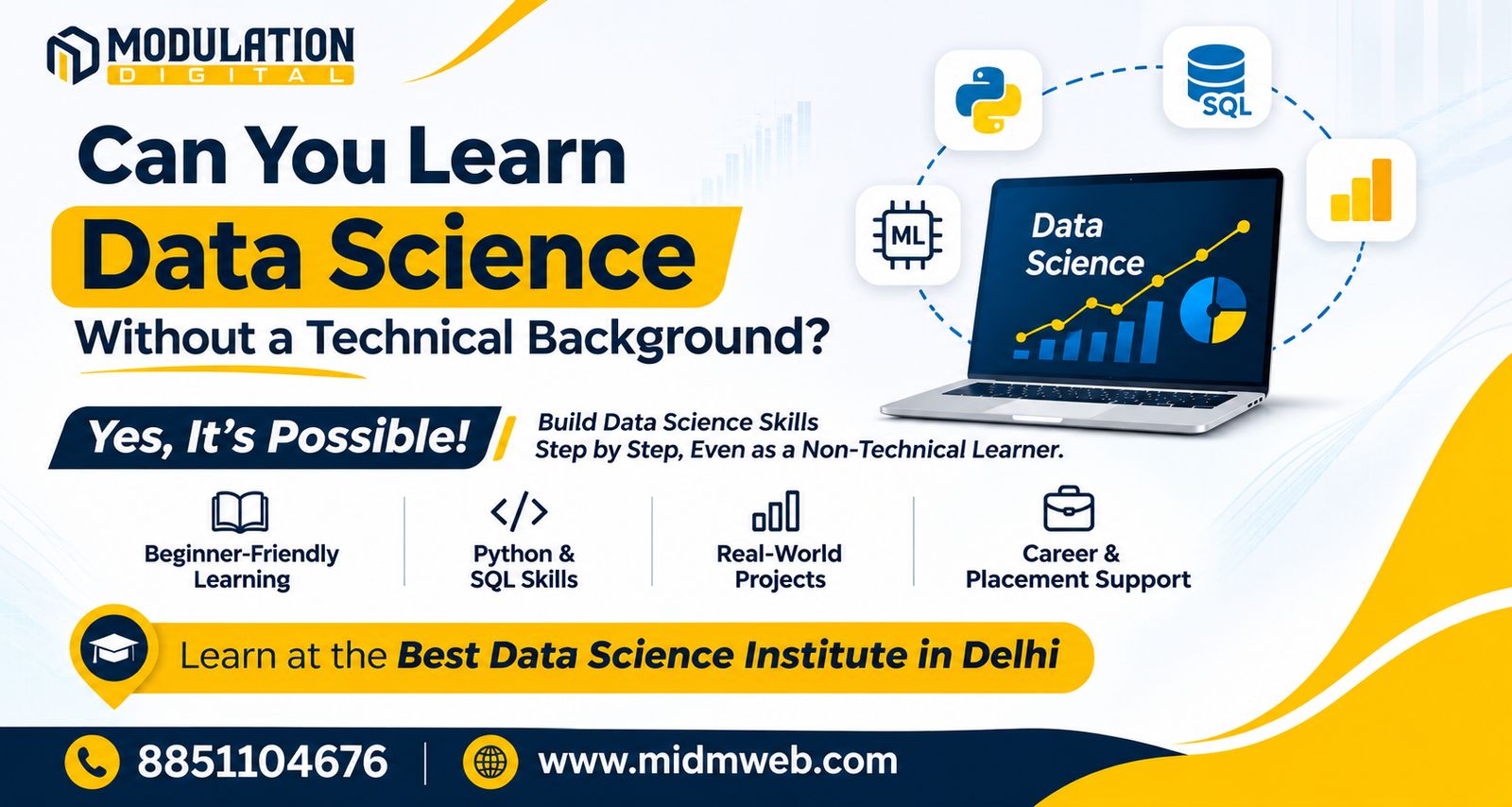
Yes, you can learn data science without a technical background. Although programming and mathematics are important, beginners can develop these skills gradually through structured learning, consistent practice, and practical projects.
Understanding how to learn data science from scratch is especially important for students considering a career transition.
Students exploring the Best Data Science Institute in Delhi should look for beginner-friendly teaching, foundational programming modules, experienced trainers, and opportunities to practice with real datasets.
This guide explains the skills, challenges, learning roadmap, and career opportunities available to non-technical students interested in data science.
Can Non-Technical Students Really Learn Data Science?
Yes, non-technical students can learn data science by developing basic programming, statistics, analytical thinking, and data interpretation skills.
Data science combines mathematics, computer programming, and domain knowledge to extract useful information from data.
An engineering degree can provide a technical foundation, but it is not the only possible starting point.
Commerce graduates may already understand financial information, sales reports, and business performance. Arts graduates may bring research, communication, and analytical abilities.
For example, a commerce student could analyze monthly sales data to identify which products generate the highest revenue.
This activity requires logical thinking, spreadsheet knowledge, and data interpretation rather than advanced programming.
Data science for non-technical students becomes more approachable when complex subjects are introduced through familiar business examples.
However, learners must be willing to study technical concepts as they progress.
Do You Need Coding Knowledge to Start Data Science?
No, previous coding experience is not required to begin learning data science, but programming becomes important for advanced analysis and machine learning.
Beginners can start with spreadsheets and basic data analysis before progressing toward Python.
Python is popular in data science because its libraries support data processing, visualization, and machine learning.
Tools such as Pandas, NumPy, Matplotlib, and scikit-learn help learners work with datasets and develop analytical applications.
For example, a beginner might first calculate average sales using Excel and later perform the same calculation using Python.
This gradual approach improves understanding without introducing too many unfamiliar concepts simultaneously.
Students searching for how to learn data science without coding experience should focus on building programming confidence through small exercises.
The objective is not to avoid coding permanently but to learn it through manageable steps.
Is Mathematics Necessary for Learning Data Science?
Basic mathematics and statistics are essential for data science, but beginners do not need advanced mathematical knowledge before starting their studies.
Important foundational concepts include averages, percentages, probability, distributions, and relationships between variables.
These concepts help learners understand patterns and make sense of numerical information.
For example, calculating average monthly revenue introduces descriptive statistics, while comparing customer groups helps develop analytical thinking.
Advanced machine learning eventually requires stronger knowledge of probability, linear algebra, and mathematical optimization.
However, these subjects can be introduced gradually.
A beginner-friendly data science course should explain mathematical ideas through practical examples instead of relying entirely on formulas.
Students from non-technical backgrounds can strengthen their mathematical skills through regular exercises and real-world datasets.
What Skills Should Beginners Learn Before Machine Learning?
Beginners should learn spreadsheets, Python fundamentals, SQL, statistics, data cleaning, and visualization before exploring machine learning.
These foundational skills help students understand how information is collected, organized, analyzed, and presented.
Data Science Learning Roadmap for Beginners
| Learning Stage | Essential Skills | Practical Exercise |
| Foundation | Excel, basic statistics | Analyze monthly expenses |
| Programming | Python, Pandas, NumPy | Clean sales records |
| Database Skills | SQL queries and joins | Retrieve customer information |
| Visualization | Power BI, Tableau | Create a sales dashboard |
| Machine Learning | Regression, classification | Predict customer behavior |
| Portfolio | Projects, documentation | Present business insights |
A structured data science course for beginners in Delhi should connect these subjects through assignments rather than teaching each tool independently.
For example, students can retrieve information using SQL, clean it with Python, and present the findings through a dashboard.
This approach develops practical understanding of how analytical workflows operate.
How Can You Learn Data Science from Scratch Step by Step?
The best way to start data science is to follow a structured learning path that progresses from basic analysis to programming, machine learning, and portfolio development.
Begin by understanding how businesses use data to make decisions. Practice organizing information in Excel and interpreting simple charts.
Next, learn basic statistics and programming logic. Once comfortable, introduce Python variables, functions, and data structures.
After that, explore SQL for retrieving information from databases.
Practice cleaning datasets, handling missing values, and identifying patterns.
The next stage involves data visualization using tools such as Power BI or Tableau.
Finally, study introductory machine learning concepts and develop a small project.
The most effective learning sequence is: Fundamentals → Python → SQL → Data Analysis → Visualization → Machine Learning → Projects.
Students following a step-by-step data science learning roadmap should prioritize understanding each stage instead of rushing toward advanced AI tools.
Which Data Science Projects Are Best for Non-Technical Beginners?
The best beginner data science projects solve familiar problems using manageable datasets, clear analytical questions, and understandable results.
A personal expense analysis project is an excellent starting point. Students can organize monthly spending, categorize expenses, and identify opportunities for budgeting.
A retail sales analysis project introduces trends, product comparisons, and revenue calculations.
Another useful project involves examining student performance data to understand relationships between study habits and academic results.
As learners develop stronger skills, they can explore customer segmentation, sales forecasting, and introductory prediction models.
For example, a customer segmentation project might group buyers according to purchasing behavior.
A strong data science portfolio should explain the problem, dataset, methods, results, and limitations.
Students should use appropriately licensed or publicly available datasets and avoid presenting fictional projects as real client work.
Can Commerce and Arts Graduates Build Careers in Data Science?
Yes, commerce and arts graduates can pursue data-related careers by combining their existing knowledge with technical training and practical experience.
Commerce students may understand accounting, business reporting, marketing metrics, or financial analysis.
Arts graduates may bring research experience, communication skills, and the ability to interpret complex information.
These abilities can complement technical knowledge.
For example, someone with a marketing background can analyze campaign performance, customer acquisition costs, and conversion patterns.
A finance graduate might explore financial dashboards or forecasting applications.
However, a data science career without an IT degree still requires demonstrated technical competence.
Candidates should develop proficiency in relevant tools, build projects, and prepare for technical interviews.
Employers may also have specific educational requirements, so applicants should evaluate individual job descriptions carefully.
What Career Opportunities Are Available After Learning Data Science?
Beginners may explore data analyst, reporting analyst, business intelligence, and related entry-level positions, depending on their skills and employer requirements.
Data analysts commonly work with spreadsheets, SQL, data cleaning, and visualization.
Business intelligence professionals develop dashboards and reports that support organizational decisions.
Junior data science roles may require programming, statistics, machine learning, and stronger analytical abilities.
Advanced positions such as machine learning engineer typically require additional software development and model deployment knowledge.
Completing a course does not guarantee employment. Employers may assess project quality, communication, technical knowledge, educational qualifications, and interview performance.
Students interested in data science jobs for freshers in Delhi NCR should study actual job descriptions and identify frequently requested skills.
Developing a portfolio that demonstrates these capabilities can strengthen job readiness.
How Should Beginners Choose a Data Science Course in Delhi?
Beginners should compare data science courses based on syllabus structure, trainer experience, practical assignments, batch format, and transparent career support.
Students without technical experience particularly benefit from courses that begin with Python fundamentals, basic statistics, and data handling.
Before enrolling, ask whether the course provides beginner-level explanations, project evaluations, and opportunities to resolve doubts.
It is also useful to verify trainer credentials and request demonstrations of completed student projects.
Those interested in a data science course in Delhi with placement assistance should understand exactly what career support includes.
Resume guidance, mock interviews, employer introductions, and internships are different services and should not be confused with guaranteed employment.
For students searching for the Best Data Science Institute in Delhi, these practical criteria provide a more meaningful basis for comparison than promotional rankings alone.
Why Consider Modulation Digital for Beginner Data Science Training?
Modulation Digital offers data science training in Laxmi Nagar, Delhi, with foundational modules, practical assignments, project-oriented learning, and career-support opportunities.
Its published curriculum covers Python, SQL, statistics, Excel, data visualization, machine learning, and artificial intelligence.
The institute identifies Mr. Prem Kumar as its Director and Data Science and Data Analytics Trainer, associated with technical instruction and career development.
The training approach described by Modulation Digital emphasizes applying concepts to datasets, preparing projects, and understanding professional workflows.
Classroom training in Laxmi Nagar and online learning options are advertised for interested students.
Eligible learners may also explore internship opportunities and placement-oriented assistance, subject to the applicable conditions.
Students comparing the Best Data Science Institute in Delhi should verify the current curriculum, eligibility requirements, faculty assignments, fees, and placement terms before enrolling.
FAQs
1. Can I Learn Data Science Without a Technical Background?
Yes. Beginners from commerce, arts, and other non-technical fields can learn data science by developing programming, statistics, and analytical skills gradually. Practical exercises help reinforce each concept.
2. Can Commerce Students Learn Data Science?
Yes. Commerce graduates can apply financial, accounting, and business knowledge to data analysis. Learning Python, SQL, and visualization tools can help them develop additional technical capabilities.
3. Is Coding Required for Data Science?
Coding is important for many data science tasks, especially data processing and machine learning. However, beginners can start with spreadsheets and gradually learn Python.
4. Is Data Science Difficult for Non-IT Students?
Data science can be challenging because it combines programming, mathematics, and analytical reasoning. Structured lessons, regular practice, and small projects can make the learning process more manageable.
5. How Long Does It Take to Learn Data Science from Scratch?
Foundational skills may take several months of consistent study. Developing advanced machine learning knowledge and professional project experience generally takes longer.
6. Which Data Science Tools Should Beginners Learn First?
Start with Excel, basic Python, SQL, and visualization tools. After developing confidence, explore Pandas, NumPy, scikit-learn, and machine learning techniques.
7. Which Is the Best Data Science Institute in Delhi for Beginners?
Students researching the Best Data Science Institute in Delhi can explore Modulation Digital in Laxmi Nagar. Compare its current syllabus, trainer experience, practical projects, and career-support services before deciding.
8. Can I Get a Data Science Job Without an Engineering Degree?
Yes, some data-related roles accept candidates from different educational backgrounds. Opportunities depend on employer requirements, technical skills, projects, and interview performance.
Conclusion
You do not need a technical background to begin learning data science, but you do need patience, consistent practice, and a willingness to develop new skills.
Start with basic statistics, spreadsheets, Python, and SQL before progressing toward visualization and machine learning.
Practical projects help learners connect theoretical knowledge with real analytical problems.
For students exploring the Best Data Science Institute in Delhi, Modulation Digital in Laxmi Nagar offers a training option worth evaluating.
Modulation Digital Contact Information
Address: D-126, Gali No. 6, Near Laxmi Nagar Metro Station, Gate No. 5, Laxmi Nagar, Delhi – 110092
Phone: +91 8851104676