Why Data Science Is Still Worth Learning in 2026
Data Science is becoming more valuable as businesses move beyond basic reporting and start using AI, predictive analytics, automation, and advanced data models to make decisions. This means the field is no longer limited to large technology companies; data-driven roles are increasingly relevant across finance, healthcare, retail, logistics, e-commerce, and other industries.
The World Economic Forum's Future of Jobs Report 2025, based on insights from more than 1,000 employers, identifies Big Data Specialists and AI & Machine Learning Specialists among the fastest-growing job roles through 2030. It also ranks AI and big data among the fastest-growing skill areas, showing how strongly employers expect these capabilities to shape future work.
India's Data & AI Opportunity
India is also seeing strong demand for technology and AI capabilities. A NASSCOM report on India's technology industry projected the sector toward the $300 billion revenue milestone in FY2026, while highlighting AI adoption, emerging technologies, and specialized technology skills as important drivers of future growth.
The Skills That Matter Are Changing
Learning Data Science in 2026 should not mean memorizing algorithms or collecting certificates. The stronger career advantage comes from combining Python, SQL, statistics, machine learning, data visualization, AI concepts, and problem-solving with practical project experience.
For students and professionals considering this field, the opportunity is therefore broader than becoming a traditional "Data Scientist." Skills developed through Data Science can support careers across data analytics, machine learning, business intelligence, AI, and advanced analytics—making it a valuable technical pathway for the evolving job market.
Data Science Course Fees in Delhi: What's Reasonable
Fees across Delhi NCR vary wildly, and price alone is a poor signal of quality. Premium-branded institutes often charge upward of ₹2.5–5 lakh, while several well-run, affordable data science institutes in Delhi deliver the same core curriculum — Python, machine learning, AI fundamentals, and business analytics — for a fraction of that, with flexible formats to match different schedules and budgets.
| Format | Duration | Learning Hours | Best Suited For |
| Classroom | 3 months | 120+ hours | Students who want in-person, structured learning |
| Online (Live) | 4 months | 160+ hours | Working professionals needing flexible timing |
| E-Learning | 6 months | 240+ hours | Self-paced learners who want deeper coverage |
All three formats typically include assured placement or internship support — but always confirm what "assured" actually means in writing before enrolling.
Is Delhi Still a Good Place to Learn Data Science in 2026?
Yes, Delhi NCR remains a strong location for learning Data Science, but the advantage is not simply being in the capital. The real benefit comes from being connected to a wider technology and business ecosystem that includes Gurugram, Noida, and other major employment hubs.
Why Delhi NCR Matters for Data Science Students
Delhi NCR has a diverse business environment where companies use data for customer analytics, financial planning, marketing, operations, risk management, automation, and AI applications. This creates opportunities for students to see how Data Science skills are applied beyond classroom exercises.
Access to a Wider Job Market
One of the biggest advantages of studying in Delhi is access to nearby employment markets. Noida and Gurugram have a large presence of IT companies, startups, consulting firms, e-commerce businesses, fintech organizations, and digital companies. For students, this can make internships, networking, interviews, and entry-level opportunities more accessible.
Learning From an Industry-Oriented Environment
Location alone will not make someone a Data Scientist. A strong program should connect the local ecosystem with practical training, real datasets, Python, SQL, statistics, machine learning, data visualization, and project work.
What Should You Look For?
If you're searching for a Data Science Course in Delhi, don't choose an institute simply because it claims to be the "best." Compare the syllabus, practical projects, trainer expertise, learning format, internship opportunities, student work, and career support.
Ultimately, Delhi NCR is valuable because it gives learners access to a broad professional ecosystem. The institute you choose determines whether you actually benefit from that ecosystem.
Data Science Course Syllabus
The Data Science syllabus is designed to take learners from data fundamentals to practical machine learning and predictive analytics. The focus is on understanding how different tools work together to solve real-world data problems.
Python for Data Science
Learn Python fundamentals and use libraries such as NumPy and Pandas for data manipulation, calculations, and analysis.
Statistics & Mathematics
Build the statistical foundation required for data science, including probability, distributions, descriptive statistics, correlation, regression, and hypothesis testing.
SQL & Database Management
Learn how to work with structured data using SQL queries, filtering, joins, grouping, aggregation, subqueries, and database concepts.
Data Cleaning & Exploratory Data Analysis
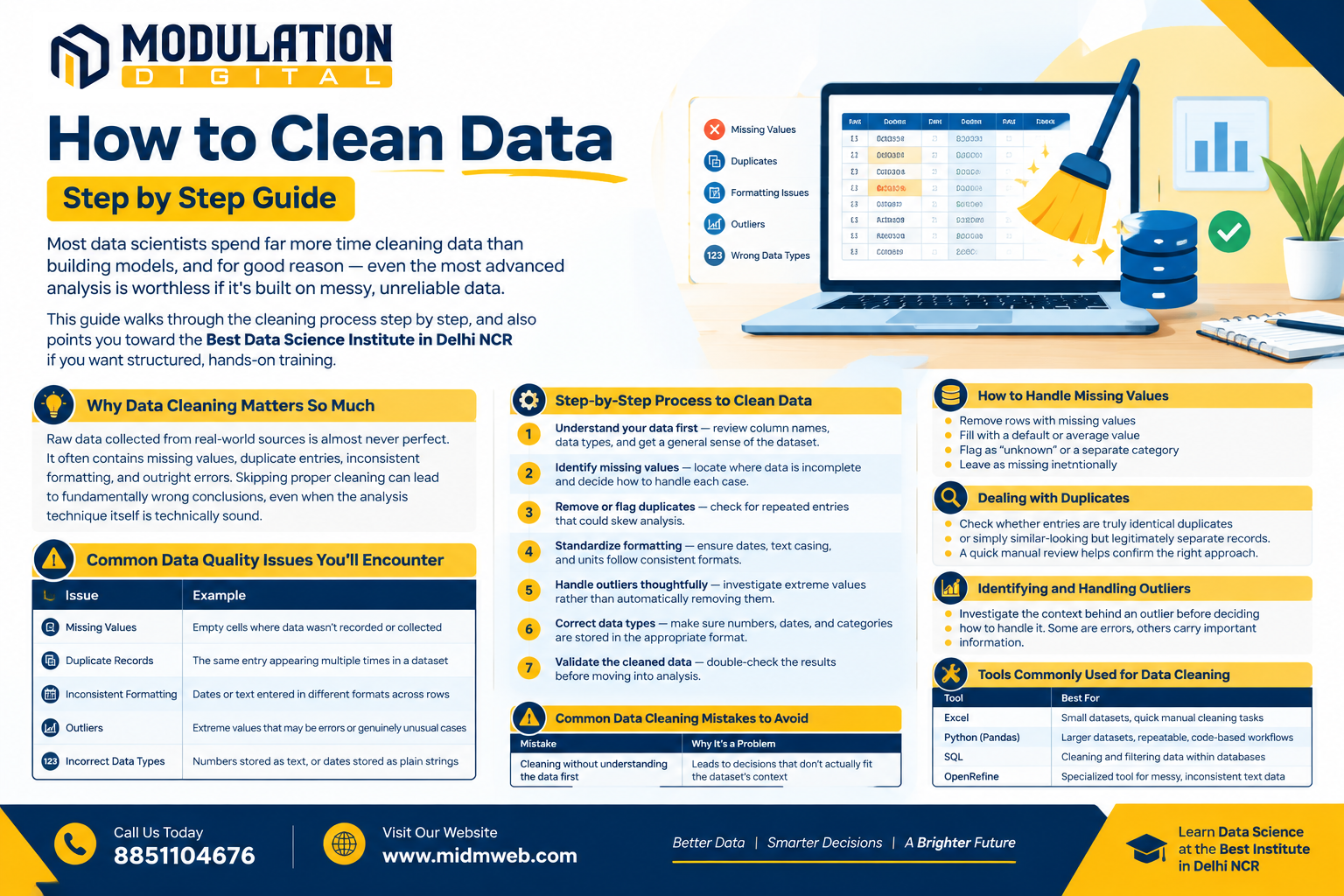
Work with imperfect datasets and learn how to handle missing values, duplicates, inconsistent records, outliers, and data transformation before drawing conclusions.
Data Visualization
Turn analytical findings into understandable visuals using tools such as Matplotlib, Seaborn, and Power BI, with a focus on identifying trends and communicating insights.
Machine Learning
Understand how machines learn patterns from data through supervised and unsupervised learning, including regression, classification, clustering, and model evaluation.
Feature Engineering & Model Optimization
Learn how to select, transform, and create useful variables that can improve model performance and make datasets more suitable for machine learning.
AI & Advanced Analytics
Get introduced to modern AI concepts, predictive analytics, model applications, and emerging data-driven technologies relevant to today's business environment.
Real-World Data Science Projects
Apply the complete workflow through practical projects—from collecting and cleaning data to analysis, model development, evaluation, and presenting results.
Career & Practical Skills
The program also emphasizes problem-solving, analytical thinking, project documentation, portfolio development, and presenting technical findings clearly, helping learners prepare for data-focused professional roles.
What Data Scientists in Delhi Actually Earn
Salary data from platforms like Glassdoor and AmbitionBox generally place Delhi NCR data science salaries in a wide band, roughly starting near ₹6–9 LPA for freshers with strong project experience and climbing past ₹20–25 LPA at the mid-career stage, with senior specialists earning considerably more depending on domain and company size. The gap between entry-level and mid-level pay is usually driven less by degrees and more by demonstrable project work — which is exactly why hands-on training matters more than lecture hours alone.
Why Modulation Digital Is Worth Considering for Data Science
Choosing a Data Science Institute should go beyond checking the course duration or certificate. Practical exposure, relevant technologies, project experience, mentorship, and career support are much more important when evaluating a program. Modulation Digital focuses on helping learners develop data science skills through practical assignments, real-world datasets, projects, and industry-oriented tools.
The program is designed to help students understand how data is collected, prepared, analyzed, visualized, and used for predictive decision-making. Rather than learning individual tools in isolation, students can work through different stages of the data science workflow and understand how they connect in practical scenarios.
Students can benefit from:
- Practical Data Science Training
- Real-World Dataset Practice
- Python, SQL & Statistics Training
- Machine Learning Fundamentals
- Data Cleaning & Exploratory Analysis
- Data Visualization & Dashboard Development
- AI & Predictive Analytics Concepts
- Live Projects & Case Studies
- Portfolio-Based Learning
- Regular Mentorship Sessions
- Doubt-Clearing Support
- Resume & Interview Preparation
- Classroom & Live Online Learning Options
- Career & Placement Assistance
The focus is on developing skills that students can demonstrate through projects, datasets, analytical reports, machine learning models, dashboards, and case studies, rather than depending solely on theoretical knowledge or a course certificate. This practical approach can help learners build a stronger foundation for careers in Data Science, Machine Learning, AI, Data Analytics, and Business Intelligence.
FAQs
1. What is the average fee for a data science course in Delhi?
Fees range from roughly ₹80,000 for affordable, well-structured programs to ₹5 lakh at premium-branded institutes, depending on format and duration.
2. Is data science a good career choice in 2026?
Yes — demand continues to grow across banking, retail, healthcare, and IT as companies build in-house analytics and AI capabilities.
3. Do I need a coding background to learn data science?
No. Most beginner-friendly programs start with Python fundamentals before moving into machine learning and analytics tools.
4. How long does it take to become job-ready in data science?
Typically 3–6 months of structured training, depending on whether you choose a classroom, online, or e-learning format.
5. What is the starting salary for a data scientist in Delhi?
Entry-level roles generally start around ₹6–9 LPA, rising with project experience and specialization.
6. Are online data science courses as effective as classroom training?
Yes, provided they include live sessions, real project work, and mentor access — not just recorded videos.
7. What tools should a data science course cover?
Python, SQL, machine learning algorithms, data visualization tools like Power BI or Tableau, and basic cloud or big data concepts.
8. Does course fee affect placement quality?
Not directly. Placement outcomes depend more on project exposure, trainer experience, and employer partnerships than on price alone.
9. Can working professionals pursue data science courses in Delhi?
Yes — most institutes, including Modulation Digital, offer weekend or evening live-online batches for working professionals.
10. What should I check before enrolling in any data science institute?
Check the trainer's actual industry experience, real project-based curriculum, transparent fee structure, and verifiable placement partnerships.
11. Is Delhi better than other cities for data science training?
Its proximity to Gurugram and Noida's corporate hubs gives Delhi-based institutes stronger, closer hiring pipelines than many other cities.
Conclusion
Choosing a Data Science Institute in Delhi should not come down to a flashy course title, a large certificate list, or a promise of a high salary. The better approach is to evaluate what you will actually learn, how much practical experience you will gain, and whether the training prepares you for the type of work companies expect.
Before enrolling, compare the course syllabus, Python and SQL training, statistics, machine learning, data visualization, live projects, trainer expertise, learning format, internship opportunities, fees, and career support. Also ask to see examples of student projects and attend a demo class whenever possible.
For students considering Modulation Digital, a demo class can be a useful way to understand the teaching approach, curriculum structure, practical exposure, and overall learning environment before making a decision.
Ultimately, the right Data Science Course in Delhi is not necessarily the one making the biggest promises. It is the one that helps you build real technical skills, practical projects, analytical thinking, and a portfolio you can confidently present to employers.