
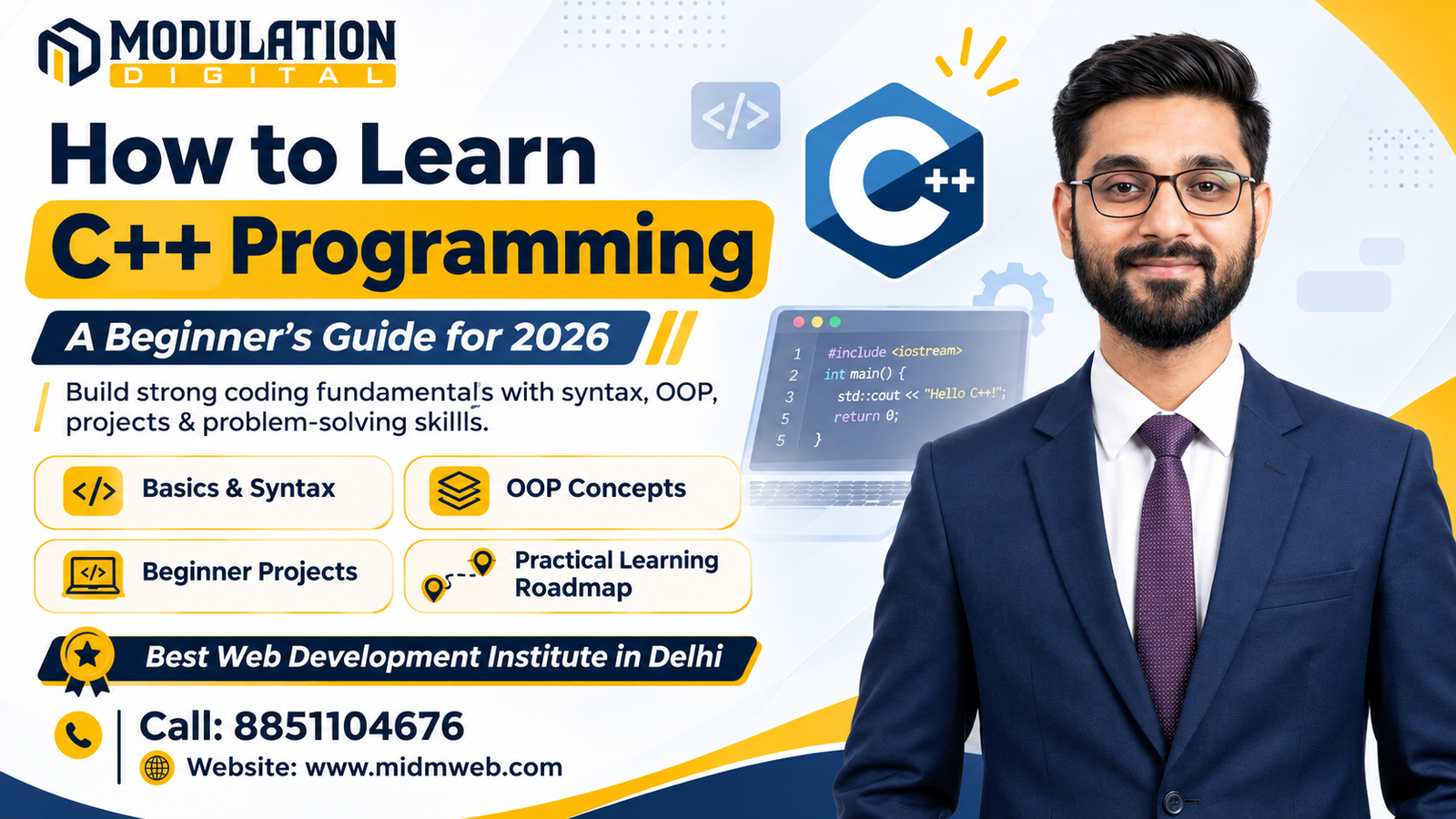
How to Learn C++ Programming from Scratch
Have you ever looked at a complicated computer program and wondered how developers build software that performs thousands of operations in seconds? Behind many powerful applications lies a strong understanding of programming logic, data structures, and efficient problem-solving.
C++ is one of the languages that can help beginners develop these skills. However, unfamiliar concepts such as classes, objects, pointers, and memory management can make learning it seem difficult.
C++ is a general-purpose programming language widely used in software development, game engines, embedded systems, and performance-sensitive applications. It supports procedural, object-oriented, and generic programming.
If you are wondering how to learn C++ programming, the best approach is to build your fundamentals, practice consistently, and gradually move toward real projects.
Students exploring the Best Web Development Institute in Delhi can also benefit from understanding programming concepts that support broader software development skills.
What Is C++ Programming and Why Should Beginners Learn It?
C++ is a compiled programming language that allows developers to create efficient software while working with important concepts such as functions, classes, objects, and memory management.
Developed by Bjarne Stroustrup, C++ evolved from the C programming language and introduced features that support object-oriented programming.
It is widely associated with applications where performance and precise resource management are important, including game development, operating system components, and embedded software.
For beginners, C++ provides an opportunity to understand how programming instructions become working applications.
For example, writing a simple calculator introduces variables, operators, functions, and decision-making statements.
Although C++ contains advanced features, learners do not need to master everything immediately. Starting with foundational concepts makes the language more approachable.
How Can You Start Learning C++ Programming from Scratch?
Beginners can start learning C++ by understanding basic syntax, installing a compiler, writing simple programs, and gradually practicing more complex programming concepts.
The first step is choosing a suitable development environment.
Visual Studio Code, Visual Studio, and Code::Blocks are examples of tools that can support C++ development. GCC, Clang, and MSVC are commonly used compilers.
A compiler translates C++ source code into machine-executable instructions through a build process.
Once your environment is configured, start with a program that displays a message.
This introduces standard library headers, the main function, and console output.
Next, experiment with variables and simple arithmetic calculations.
The free tutorials at LearnCpp.com provide structured lessons covering compilation, debugging, programming fundamentals, and modern C++ concepts.
Learning becomes more effective when every new concept is followed by a practical exercise.
What Are the Most Important C++ Concepts for Beginners?
The fundamental concepts of C++ include variables, data types, operators, conditional statements, loops, functions, arrays, classes, objects, and pointers.
These concepts work together to form the foundation of software development.
Variables hold information, while data types define how values are represented.
Conditional statements help programs choose between different actions, and loops allow instructions to execute repeatedly.
Functions divide programs into manageable sections, while classes and objects support object-oriented software design.
Essential C++ Topics and Their Practical Uses
| C++ Concept | What You Learn | Practical Example |
| Variables | Store information | Student marks |
| Data types | Represent values | Age and salary |
| Operators | Perform calculations | Billing system |
| Conditions | Make decisions | Pass or fail |
| Loops | Repeat operations | Multiplication table |
| Functions | Reuse instructions | Calculate average |
| Arrays and vectors | Manage collections | Student records |
| Classes and objects | Organize software | Bank account |
Understanding these concepts through small applications helps learners progress toward data structures, algorithms, and advanced programming.
How Do You Write Your First C++ Program?
Your first C++ program should focus on understanding program structure, input, output, compilation, and execution rather than advanced features.
A traditional beginner exercise involves printing a message such as "Hello, World!" on the screen.
This introduces the main function, standard output, and basic program structure.
After successfully running the program, modify it to display different messages.
Next, develop a simple calculator that accepts two numbers and calculates their sum.
This exercise introduces user input, numeric variables, and arithmetic operators.
Once you understand these concepts, create a program that checks whether a number is even or odd.
Each exercise introduces a small challenge without overwhelming the learner.
When your code fails to compile, examine the error message and identify the problem before requesting a solution.
Learning to debug is an essential part of becoming an independent programmer.
How Long Does It Take to Learn C++ Programming?
Beginners can become familiar with C++ fundamentals within several weeks, although developing strong programming and problem-solving skills usually requires sustained practice.
The learning timeline depends on previous coding experience, daily study time, and the complexity of the concepts being studied.
A structured 30-day roadmap can help beginners organize their initial learning journey.
A Practical 30-Day C++ Learning Roadmap
During the first week, focus on program structure, variables, data types, and operators.
The second week should introduce conditional statements, loops, and functions.
During the third week, explore arrays, strings, vectors, and introductory object-oriented programming.
Use the final week to develop a small project that combines multiple concepts.
This roadmap is intended for foundational learning rather than complete mastery.
More advanced subjects, including pointers, templates, algorithms, and memory management, require additional practice.
Students should prioritize understanding each topic instead of rushing through a fixed schedule.
What Is Object-Oriented Programming in C++?
Object-oriented programming, or OOP, is an approach to software development that organizes related data and behavior using classes and objects.
C++ supports important OOP concepts such as encapsulation, inheritance, polymorphism, and abstraction.
These principles help developers structure software into manageable components.
For example, imagine creating a student management application.
A Student class could define information such as name and marks, along with functions that calculate results.
Individual student objects can then represent different records.
Encapsulation helps control how information is accessed, while inheritance allows related classes to share selected functionality.
Polymorphism enables different types of objects to respond appropriately to a common interface.
Beginners should understand classes and objects before attempting complex inheritance hierarchies.
Practical examples make these concepts easier to understand than memorizing definitions
Which C++ Projects Are Best for Beginners?
The best beginner C++ projects are small applications that combine programming fundamentals with practical problem-solving.
A calculator is an excellent starting project because it uses arithmetic operations, input handling, and conditional logic.
A number-guessing game introduces loops, comparisons, and program flow.
After completing these exercises, learners can develop a student record management application using functions, classes, and collections.
Another useful project is a library management system that records books, borrowers, and availability.
As programming knowledge improves, projects can include file handling, error checking, and data validation.
For example, a student record application can initially store information in memory and later save records to a file.
The purpose of project development is to understand how individual programming concepts work together to solve realistic problems.
Is C++ Programming Useful for Web Development?
C++ is not usually the primary language for building websites, but it can strengthen programming fundamentals and support certain performance-sensitive backend applications.
Frontend web development primarily uses HTML, CSS, and JavaScript.
Backend systems are commonly developed using languages and frameworks such as JavaScript, Python, PHP, and Java.
C++ is more frequently associated with systems programming, game engines, native applications, and high-performance computing.
However, learning C++ can improve understanding of algorithms, data structures, software architecture, and memory management.
These concepts are valuable across programming disciplines.
Students looking for the Best Web Development Institute in Delhi should compare courses that teach practical web technologies alongside logical thinking and problem-solving.
If your primary goal is website development, prioritize HTML, CSS, JavaScript, databases, and backend technologies. C++ can serve as an additional programming foundation.
What Common Mistakes Should Beginners Avoid While Learning C++?
The most common C++ learning mistakes include memorizing syntax, ignoring compiler warnings, copying solutions, and attempting advanced programming concepts too early.
Many beginners spend hours watching tutorials without writing programs themselves.
Although video lessons can explain concepts, coding practice is necessary to develop independent problem-solving skills.
Another common mistake is avoiding debugging.
When an application produces incorrect output, investigate the logic, test different inputs, and examine error messages.
Beginners should also develop good habits around initialization, type safety, and memory management.
Modern C++ features such as standard library containers and automatic resource management can reduce unnecessary complexity.
Instead of trying to learn every feature at once, focus on writing understandable programs and improving them gradually.
Consistency and practical experimentation create a stronger foundation than memorizing large amounts of code.
Why Consider Modulation Digital for Programming and Web Development Training in Delhi?
Students searching for the Best Web Development Institute in Delhi can consider Modulation Digital when comparing programming and web development training opportunities.
Learning programming involves more than understanding syntax. Students also need practical assignments, problem-solving exercises, and opportunities to develop applications independently.
When choosing an institute, evaluate its curriculum, trainer experience, teaching methods, and available project support.
Students interested in web development should explore training programs that cover frontend development, backend technologies, databases, and website deployment.
Modulation Digital, located in Laxmi Nagar, Delhi, is an option for learners researching web development education.
Prospective students should confirm whether C++ programming is included in the current course curriculum before enrolling.
Modulation Digital Contact Information
Institute Name: Modulation Digital
Address: D-126, Gali No. 6, Near Laxmi Nagar Metro Station, Gate No. 5, Laxmi Nagar, Delhi 110092
Phone Number: +91 8851104676
Website: www.midmweb.com
Contact the institute to enquire about available web development courses, programming modules, practical assignments, and batch schedules.
FAQs
1. How Can Beginners Learn C++ Programming from Scratch?
Beginners can learn C++ by installing a compiler, understanding basic syntax, and practicing variables, conditions, loops, functions, and arrays. After developing these fundamentals, they can explore classes, objects, and practical programming projects.
2. Is C++ Programming Difficult for Beginners?
C++ can be challenging because it includes advanced concepts such as pointers, memory management, and object-oriented programming. However, structured lessons and consistent coding practice make the fundamentals easier to understand.
3. Can I Learn C++ Programming in 30 Days?
A beginner can study basic C++ concepts within 30 days through consistent practice. However, developing strong programming skills, understanding advanced concepts, and building complex applications generally require additional time.
4. Which Software Is Best for Learning C++ Programming?
Visual Studio Code with a configured compiler, Visual Studio, and Code::Blocks are common options. Beginners should select a development environment that supports compilation, debugging, and convenient project management.
5. What Is the Difference Between C and C++ Programming?
C is primarily a procedural programming language, while C++ supports procedural, object-oriented, and generic programming. C++ also provides features such as classes, templates, and an extensive standard library.
6. Is C++ Useful for Becoming a Web Developer?
Yes, C++ can strengthen programming logic, algorithmic thinking, and software development fundamentals. However, aspiring web developers should also learn HTML, CSS, JavaScript, databases, and relevant backend technologies.
7. Which Is the Best Web Development Institute in Delhi for Beginners?
Students comparing the Best Web Development Institute in Delhi can explore Modulation Digital in Laxmi Nagar. Before enrolling, review the current syllabus, trainer experience, practical projects, programming modules, and available learning support.
8. What Should I Learn After Completing C++ Basics?
After learning C++ fundamentals, students can explore data structures, algorithms, object-oriented design, file handling, and more advanced standard library features. Their next learning path should depend on whether they want to pursue web development, game development, or software engineering.
Conclusion
Understanding how to learn C++ programming begins with building strong fundamentals, practicing coding regularly, and learning how to solve problems independently.
Start with variables, operators, conditions, and loops before moving toward functions, arrays, classes, objects, and data structures.
Practical projects are essential because they help connect individual concepts with working applications.
For students interested in software development, C++ offers a useful foundation in programming logic and application design. Those pursuing web development should complement these skills with modern frontend and backend technologies.
If you are exploring the Best Web Development Institute in Delhi, consider reviewing the web development training opportunities available at Modulation Digital, Laxmi Nagar, Delhi.