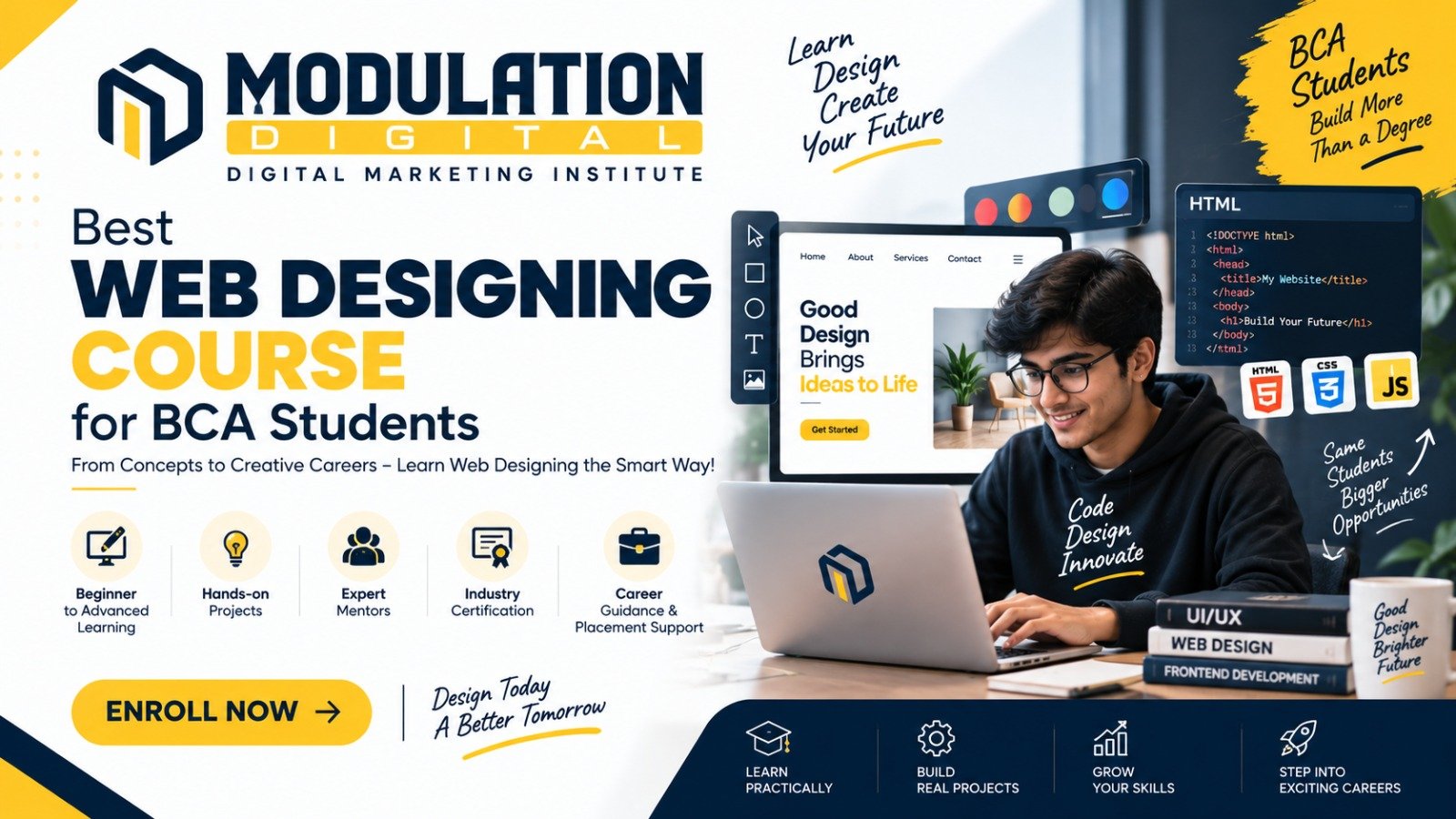
Why BCA Students Specifically Need a Web Designing Course
A BCA degree gives you a strong theoretical base in computer science — data structures, databases, programming fundamentals. What it usually doesn't give you is a portfolio of live, working websites you can show an interviewer or a client. That's the core problem a focused web designing course solves.
Three gaps show up consistently between BCA coursework and actual hiring expectations:
- No real project portfolio — academic assignments rarely resemble what a company actually wants built.
- Limited exposure to design thinking — coding a page is different from designing one that converts or engages users.
- No practical CMS experience — most businesses run on WordPress or similar platforms, which BCA syllabi rarely cover in depth.
A structured web designing course closes all three by pairing coding fundamentals with UI/UX principles and real client-style projects.
Why BCA Students Specifically Need a Web Designing Course
A BCA degree gives you a strong theoretical base in computer science — data structures, databases, programming fundamentals. What it usually doesn't give you is a portfolio of live, working websites you can show an interviewer or a client. That's the core problem a focused web designing course solves.
Three gaps show up consistently between BCA coursework and actual hiring expectations:
- No real project portfolio — academic assignments rarely resemble what a company actually wants built.
- Limited exposure to design thinking — coding a page is different from designing one that converts or engages users.
- No practical CMS experience — most businesses run on WordPress or similar platforms, which BCA syllabi rarely cover in depth.
A structured web designing course closes all three by pairing coding fundamentals with UI/UX principles and real client-style projects.
What the Web Designing Course Covers
The course is structured to take a BCA student from foundational coding to a portfolio-ready skill set, taught by Roshan Jha, a full-stack web development instructor with 10+ years of hands-on experience across JavaScript, Python, Laravel, and Angular.js.
| Module | What You'll Build/Learn |
| HTML & CSS Foundations | Structuring and styling web pages from scratch |
| JavaScript Essentials | Adding interactivity and dynamic behavior to pages |
| Responsive Web Design | Building sites that work correctly across devices |
| UI/UX Fundamentals | Designing interfaces that are usable and visually clear |
| WordPress & CMS Development | Building and managing dynamic, content-driven websites |
| Portfolio Project Work | Real, deployable projects for your resume and interviews |
Because the training is project-based rather than lecture-based, by the end of the course you have actual websites to show — not just a certificate stating you attended a program.
How This Course Fits Around a BCA Schedule
One real concern BCA students have is time — can this actually fit around lectures, exams, and assignments? The course is designed with that constraint in mind: small batch sizes mean sessions stay focused and efficient rather than dragging, and flexible scheduling means training doesn't have to compete directly with your college timetable.
This matters because the value of the course comes from consistent project work, not just attendance — a rushed, poorly-scheduled course that clashes with your semester exams defeats the purpose. Look for (and confirm directly with) flexible batch timing before enrolling, especially around your exam periods.
Skills You Actually Walk Away With
Beyond the module list, here's what genuinely changes by the end of the training:
- You can build a complete website independently — from layout to styling to basic interactivity — not just edit a template.
- You understand design decisions, not just code syntax — why a layout works for users, not just whether it compiles.
- You can manage a WordPress site end-to-end — a skill that's directly monetizable through freelancing, since most small businesses run on WordPress.
- You have a portfolio, not just a resume line — something concrete to show in interviews or to freelance clients.
This combination — technical skill plus a visible body of work — is what separates a "did a course" resume from a "can actually do the job" resume.
Career Paths After Completing the Course
A web designing course opens more directions than just one job title. The most common paths BCA graduates take include:
- Web Designer — building and maintaining websites for companies or agencies
- Front-End Developer — focusing on the interactive, code-heavy side of web builds
- UI/UX Designer — specializing in interface design and user experience
- Freelance Web Developer — building sites independently for small business clients
- WordPress Developer — specializing in CMS-based site builds and customization
Because the training covers both the coding and design sides, students aren't locked into one narrow role immediately after graduating — they can lean toward whichever direction (design-heavy or code-heavy) suits their strengths better once they start applying.
Freelancing and Remote Work Opportunities
Web designing is one of the more freelance-friendly skill sets available to BCA graduates, because the deliverable — a working website — is easy to demonstrate and easy for a client to evaluate. Once you can independently handle a WordPress build or a responsive landing page, you can take on freelance projects directly, work remotely for clients outside Delhi, or use freelancing as a way to build income and portfolio depth alongside a full-time role.
This flexibility is part of why a practical, project-based course matters more here than a purely theoretical one — freelance clients care about what you've built, not which modules you completed.
Web Designer Salary for Freshers in India
A fresher entering web designing in 2026 can typically start around ₹15,000–₹30,000 per month, depending on location, portfolio quality, technical skills, and the employer. Candidates with practical knowledge of HTML, CSS, JavaScript, WordPress, responsive design, and basic UI/UX can have an advantage over candidates with only theoretical knowledge.
Web Designer Salary After 1–3 Years of Experience
With 1–3 years of experience, web designers can move toward approximately ₹25,000–₹50,000 per month. At this stage, employers generally expect professionals to handle complete website projects, improve user experience, work with CMS platforms, and collaborate with developers, content teams, and marketers.
Web Designer Salary for Experienced Professionals
Professionals with 3–5+ years of experience can potentially earn ₹40,000–₹80,000+ per month, depending on specialization and responsibility. Senior web designers, UI designers, UX-focused professionals, and designers who combine development, SEO, and conversion optimization skills can command higher compensation.
Is There a Need for Web Designers in India in 2026?
Yes. The demand for web designers continues to come from startups, e-commerce businesses, agencies, SaaS companies, local businesses, educational institutions, and established brands that need websites and digital experiences. However, the market is becoming more competitive, so simply knowing basic HTML and CSS is no longer enough.
What Skills Will Make Web Designers More Valuable in 2026?
Modern web designers can strengthen their career prospects by learning responsive web design, WordPress, UI/UX principles, JavaScript fundamentals, website performance, SEO basics, conversion-focused design, accessibility, and AI-assisted design workflows. The strongest professionals are increasingly those who understand both visual design and the business objective behind a website.
Web Designer Career Growth by Experience
| Experience | Indicative Monthly Salary | Typical Career Stage |
| 0–1 Year | ₹15,000–₹30,000 | Junior/Fresher Web Designer |
| 1–3 Years | ₹25,000–₹50,000 | Web Designer / UI Designer |
| 3–5 Years | ₹40,000–₹80,000+ | Senior Web Designer / UI-UX Designer |
| 5+ Years | ₹60,000–₹1,00,000+ | Lead Designer / Design Specialist |
Salary ranges are indicative and can vary based on location, portfolio, specialization, company, technical ability, and negotiation.
Why Modulation Digital Stands Out as a Practical Web Designing Choice for BCA Students
Modulation Digital focuses on helping BCA students move beyond academic concepts and develop practical web designing skills they can actually use. The training combines hands-on website projects, coding fundamentals, responsive design, UI/UX principles, and WordPress development so students can build a portfolio alongside their degree.
With experienced trainers, project-based learning, flexible training options, and career-focused guidance, students can learn at a pace that fits their college schedule while gaining exposure to real-world website requirements. The goal is not simply to complete a syllabus, but to help students become confident enough to build, manage, and present websites professionally.
What Students Can Gain
- Hands-on website development practice
- Real project and portfolio experience
- HTML, CSS, JavaScript & WordPress skills
- UI/UX and responsive design knowledge
- Flexible learning alongside BCA
- Career and interview guidance
- Practical, industry-oriented training
FAQs
1. Is a web designing course useful alongside a BCA degree?
Yes. BCA covers programming theory, but a focused web designing course adds practical, portfolio-ready skills in HTML, CSS, JavaScript, WordPress, and UI/UX that most BCA syllabi don't cover in depth.
2. What will I learn in a web designing course for BCA students?
Core modules typically include HTML/CSS, JavaScript, responsive design, UI/UX fundamentals, and WordPress/CMS development, taught through real project work.
3. Can I manage this course alongside my BCA classes?
Yes, if the institute offers flexible batch timing and small class sizes designed around student schedules — confirm this directly before enrolling.
4. What career options are available after this course?
Common roles include Web Designer, Front-End Developer, UI/UX Designer, WordPress Developer, and freelance web development.
5. Do I need prior coding experience to join?
No prior professional experience is required, though basic familiarity with programming logic from your BCA coursework helps you move faster through the technical modules.
6. Is WordPress still relevant to learn in 2026?
Yes. WordPress remains one of the most widely used platforms for small business and content-driven websites, making it a practical, monetizable skill for freelancing.
7. Can this course lead to freelancing work?
Yes. Web design and WordPress skills are highly freelance-compatible since a completed website is an easy, tangible deliverable for clients to evaluate.
8. What is the difference between a web designer and a front-end developer?
A web designer focuses more on layout, visual design, and user experience, while a front-end developer focuses more on the coding and interactivity behind that design — this course covers both.
9. Does the course include real project work?
Yes, project-based learning is central to the course, giving students a portfolio of real, deployable work by the time they finish training.
10. What placement support is offered after the course?
Support typically includes portfolio review, interview preparation, and guidance for both full-time roles and freelance opportunities.
Conclusion
For BCA students, the real value of a web designing course isn't the certificate — it's walking out with a portfolio of real, working websites and the practical skills to build more. Modulation Digital's web designing program, led by full-stack instructor Roshan Jha, is structured around exactly that outcome: coding fundamentals, UI/UX design, WordPress development, and placement support built for students who need training to fit around a college schedule. If you're ready to add practical, job-ready web designing skills to your BCA degree, it's worth reaching out to Modulation Digital directly to check current batch timings and course details.