What Is Full Stack Web Development?
Full stack web development means being able to build both the frontend — what users see and interact with — and the backend, which runs the logic, server, and data behind the screen. On the frontend, developers work with HTML, CSS, and JavaScript, often through frameworks like React, to create responsive layouts and interactive features. On the backend, they write server-side logic using Node.js, Python, or PHP, and connect it to databases such as MongoDB, MySQL, or PostgreSQL to store and retrieve data. A full stack developer can move across this entire pipeline instead of depending on a separate specialist for each layer.
Why Are Full Stack Developers in High Demand?
The demand for full stack developers is closely linked to how quickly companies are building and improving digital products. According to NASSCOM’s Strategic Review 2026, India’s technology sector is expected to cross $315 billion in FY2026, while direct tech employment is projected to reach around 6 million, with about 135,000 new jobs added. At the same time, TeamLease Digital’s FY2025–26 report identifies full stack and mid-tier developer roles as being in a stable-demand phase, showing that these skills continue to have value in the hiring market. For employers, developers who understand frontend, backend, databases, and APIs can contribute across different stages of a project, making full stack skills useful for startups, IT services companies, and product teams.
What Technologies Does a Full Stack Course Cover?
A well-structured full stack web development course in Delhi should move through frontend, backend, database, and deployment layers in sequence, not treat them as disconnected modules. Here's what a complete stack typically looks like:
| Layer | Common Technologies |
| Frontend | HTML, CSS, JavaScript, React |
| Backend | Node.js, Python, PHP |
| Database | MongoDB, MySQL, PostgreSQL |
| APIs & Integration | RESTful APIs, third-party integrations |
| Deployment & Cloud | Git/GitHub, cloud hosting platforms |
Courses that only teach one or two of these layers in depth leave gaps that show up quickly in interviews, where recruiters expect candidates to explain how a request travels from a button click to a database and back.
Will AI Replace Full Stack Developers?
No — AI tools like GitHub Copilot and ChatGPT speed up coding, but they don't replace the judgment needed to design a system, choose an architecture, or debug a production issue under pressure. These tools are good at generating boilerplate code and suggesting fixes for well-defined problems, but full stack work involves deciding what to build and why, integrating unfamiliar systems, and making trade-offs that depend on business context AI has no access to. The more realistic shift is that AI becomes a tool full stack developers use to move faster, not a replacement for the role itself — which is why courses that teach system thinking alongside syntax hold up better long-term than ones that only teach code snippets.
What Skills Do Recruiters Look for in Full Stack Developers?
Recruiters filter for a mix of technical depth and practical judgment, not just familiarity with a list of frameworks. On the technical side, they expect solid coding ability in JavaScript and at least one backend language, hands-on experience with a frontend framework like React or Angular, and comfort working with APIs, cloud basics, and relational or NoSQL databases. Beyond that, they weigh soft skills — clear communication, the ability to explain technical trade-offs to non-technical stakeholders, and adaptability when project requirements shift mid-build. Candidates who can point to live projects or a portfolio consistently move further in interviews than those who can only describe coursework.
How Do You Choose the Right Full Stack Course for Your Career?
Start by checking a course's track record on placement support and the kind of companies its graduates land at, not just its marketing claims. A good full stack web development course in Delhi should offer visible exposure to live projects, current frameworks, and real problem-solving scenarios rather than static, outdated material. Compare curriculum depth across frontend, backend, databases, and cloud basics, and weigh career support — mock interviews, resume reviews, internship access — as seriously as the coding syllabus itself, since technical skill alone rarely gets someone hired without interview readiness to match.
Learn Full Stack Development Through Practical Training at Modulation Digital
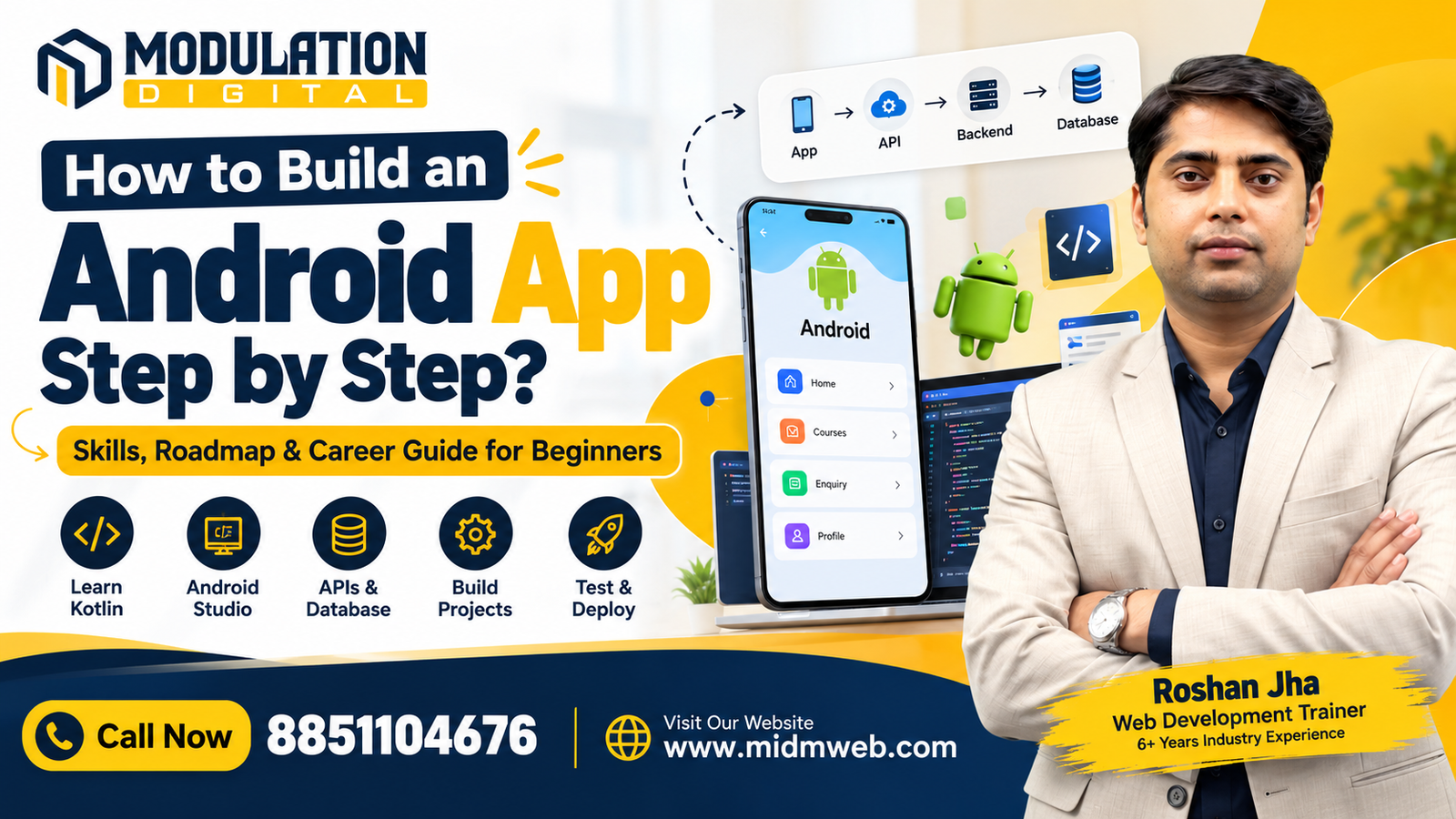
Modulation Digital’s full stack web development course in Delhi is designed for students who want to learn development by actually working with code and projects. The training focuses on practical understanding instead of making students depend only on theory or recorded lessons. Students get regular opportunities to apply concepts, work with modern technologies, and understand how different parts of a web application connect with each other. The course is guided by Roshan Jha, who brings practical experience in full stack development and helps students understand concepts through hands-on learning. The program also includes internship exposure and placement assistance to support students as they prepare for their first development role. With different learning formats available, students can choose a mode that fits their schedule while continuing to receive guidance during their learning journey.
- Live Projects
- Hands-on Training
- Industry-Relevant Technologies
- Experienced Trainer – Roshan Jha
- Paid Internship
- Placement Assistance
- Resume Building
- Mock Interviews
- Portfolio Development
- Classroom Training
- Live Online Classes
- Recorded Classes with Live Support
FAQs
What Is the Difference Between Frontend, Backend, and Full Stack Development?
Frontend development focuses on the part of a website or application that users see and interact with. Backend development handles server-side logic, databases, and application functionality. A full stack developer works across both areas and can build, connect, and maintain a complete web application.
How Long Does a Full Stack Web Development Course Take?
Most structured full stack web development courses take around 4 to 9 months to complete. The exact duration depends on the course structure, training hours, project work, internship, and whether it is designed as an intensive program or a more detailed job-oriented course.
Do I Need a Coding Background to Join a Full Stack Course?
No, you do not necessarily need previous coding experience. Beginner-friendly courses generally start with HTML, CSS, and JavaScript before moving into frontend frameworks, backend development, databases, APIs, and deployment. Regular coding practice is important for building confidence and becoming job-ready.
Is Full Stack Development a Good Career Choice in 2026?
Yes, full stack development remains a useful career option in 2026. Companies continue to need developers who understand different parts of an application, from the user interface to backend systems and databases. Full stack skills can be useful across startups, IT service companies, software businesses, and product-based organizations.
Will Learning to Code Still Matter With AI Tools Like ChatGPT and Copilot?
Yes. AI tools can help developers write code faster, identify errors, generate ideas, and handle repetitive programming tasks. However, developers still need to understand system design, debugging, APIs, databases, security, and technical decision-making. Learning the fundamentals allows you to use AI as a development tool rather than depending on it blindly.
Which Technologies Should a Full Stack Course Cover?
A comprehensive full stack course should cover HTML, CSS, JavaScript, React, Node.js or Python, MongoDB or MySQL, RESTful APIs, Git/GitHub, and basic deployment concepts. The exact technology stack can vary, but students should understand how the frontend, backend, database, and APIs work together.
What Is the Difference Between MERN Stack and Python Full Stack Development?
The MERN stack uses MongoDB, Express.js, React, and Node.js, allowing developers to work primarily with JavaScript across the application. Python full stack development uses Python-based backend technologies such as Django or Flask, while the frontend can still use HTML, CSS, JavaScript, or React. Both approaches can be used to develop complete web applications.
Do Full Stack Courses Include Internships?
Some full stack courses include an internship as part of their program, while others offer it separately. An internship can be valuable because it gives students an opportunity to work on practical assignments, understand development workflows, and add project experience to their resume before applying for full-time roles.
What Skills Matter Most to Recruiters Besides Coding?
Recruiters look beyond programming knowledge when evaluating full stack developers. Problem-solving, communication, adaptability, teamwork, debugging ability, and the confidence to explain technical decisions can all influence hiring decisions. A strong portfolio with practical projects can also help demonstrate that you can apply what you have learned.
Can Working Professionals Switch Careers Into Full Stack Development?
Yes, working professionals can move into full stack development with a structured learning plan. Weekend batches, live online classes, and recorded sessions with live doubt support can make it easier to learn alongside an existing job. The transition still requires consistent practice and project building to develop the technical skills employers expect.
Conclusion
Choosing a full stack web development course in Delhi can be a practical step if your goal is to build a career in web development and learn how different parts of an application work together. The most valuable part of full stack development is not simply knowing several programming languages or frameworks, but being able to use them to solve real problems and build working applications.
AI is changing the way developers write and test code, but it has not removed the need for developers who can understand requirements, design solutions, debug issues, work with databases, and make sound technical decisions. This makes practical knowledge even more important for beginners entering the field.
Before selecting a course, look beyond the certificate and compare the curriculum, hands-on training, live projects, trainer support, internship opportunities, placement assistance, and learning format. A course that helps you build a strong portfolio and understand real development workflows can give you a much better foundation for starting your career and adapting as technology continues to change.