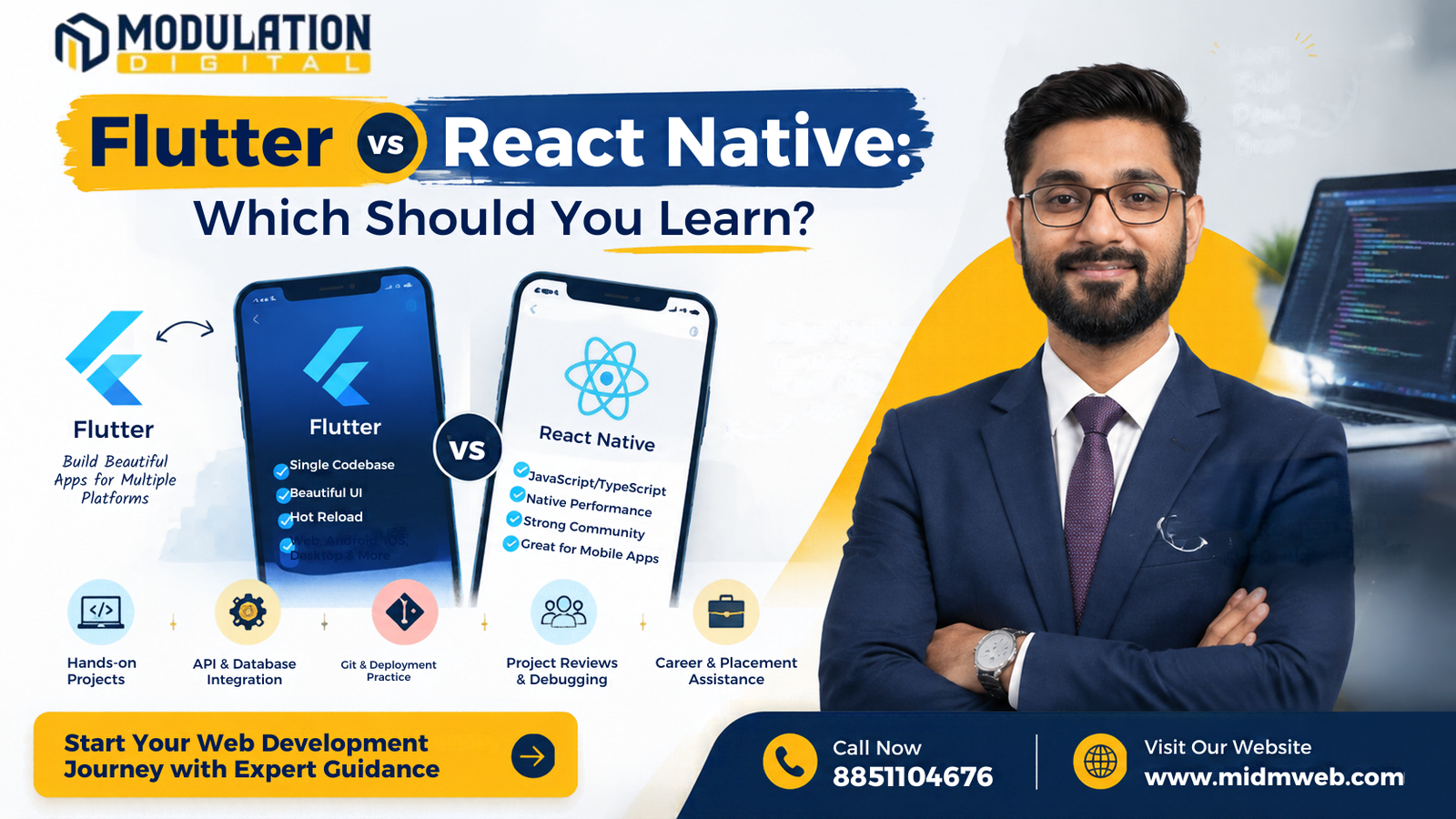
What Are Flutter and React Native Actually Used For?
Flutter is Google's UI toolkit built around Dart. It supports applications for Android, iOS, web, Windows, macOS, Linux, and other supported targets from a shared codebase. Flutter's official documentation highlights multi-platform development, customizable interfaces, and hot reload as important parts of its workflow.
React Native is a framework for building native applications with React. Developers use JavaScript or TypeScript while React Native maps components to native platform views and provides native APIs for Android and iOS.
In simple terms, both reduce duplicated development work, but they use different development models.
Is Flutter Easier to Learn Than React Native?
There is no universal answer. Your existing programming knowledge matters.
Flutter requires learning Dart, widgets, layouts, state management, and Flutter's framework concepts. React Native is often a natural next step for someone who already knows JavaScript or React. React Native's documentation lists JavaScript fundamentals as a useful prerequisite, while new React Native projects use TypeScript by default.
| Learning Factor | Flutter | React Native |
| Main language | Dart | JavaScript / TypeScript |
| UI model | Flutter widgets | React + native components |
| Best starting point | New framework learners | JavaScript/React developers |
| UI customization | Very high | High |
| Native integration | Plugins and platform APIs | Native modules and components |
| Multi-platform scope | Mobile, web, desktop and more | Strong mobile focus |
Existing skills should guide the choice.
Why Do Developers Choose Flutter for App Development?
Flutter is attractive when consistent and highly customized interfaces matter. Its widget-based approach gives developers a unified UI system across platforms.
Flutter's documentation lists Android and iOS for mobile, Windows, macOS and Linux for desktop, and modern browsers for web. Its hot reload workflow also speeds iteration.
Flutter suits app-centric products, dashboards, and interactive experiences where visual consistency matters.
Why Do Developers Choose React Native?
React Native is especially useful for developers coming from the React and JavaScript ecosystem. Its component model can make the transition from front-end development to mobile development more familiar.
React Native also allows JavaScript or TypeScript code to communicate with native functionality. Developers can also connect React Native code with native modules and components when required.
React Native has also evolved significantly: 0.76 made the New Architecture the default, and 0.82 became the first release to run entirely on it.
Is Flutter Faster Than React Native?
This is a common search question, but there is no universal performance winner.
Real-world performance depends on application architecture, animations, data processing, native integrations, dependencies, device hardware, and implementation quality. Both technologies can support production applications.
Instead of asking which framework is “fastest,” consider application complexity, animation, native functionality, target platforms, and implementation quality. Testing on actual devices is more meaningful than relying on a general framework claim.
Which Is Better for UI Design: Flutter or React Native?
Flutter can be attractive when a project requires a highly customized and consistent visual system. Developers work with Flutter widgets and can create interfaces around a specific brand design.
React Native uses React components backed by native platform views and can support platform-specific behavior when Android and iOS need different experiences.
A useful rule is: Flutter means widgets and a unified UI toolkit; React Native means React components connected to native platform capabilities. Neither automatically produces better design; UX, accessibility, performance, and skill still matter.
Is Flutter Better for Web Development?
Beginners should avoid a common mistake: mobile cross-platform development and traditional web development are not exactly the same thing.
Flutter supports web deployment, including JavaScript and WebAssembly. However, Flutter's documentation says its web support is particularly suited to app-centric experiences such as single-page applications and existing Flutter applications, while text-rich static pages are better suited to the document-centric web model.
If your goal is SEO-friendly websites, content-heavy business sites, HTML, CSS, JavaScript, or traditional web applications, learn web fundamentals separately. For interactive apps needing mobile and browser delivery, Flutter may be worth considering.
Should a Web Developer Learn React Native or Flutter?
If you already understand HTML, CSS, JavaScript, and React, React Native can provide a direct route into mobile application development.
If you prefer a dedicated UI toolkit, are comfortable learning Dart, and want a multi-platform framework, Flutter may fit your learning path.
Students searching for the Best Web Development Institute in Delhi should look beyond the course name. Check whether the curriculum teaches programming fundamentals, Git, APIs, databases, responsive development, deployment, debugging, and practical projects. These fundamentals make it easier to move between web, mobile, and cross-platform technologies.
Which One Should You Learn First: Flutter or React Native?
Use your current skills and career goal as the filter.
Choose Flutter if:
- • You want to learn Dart and Flutter from the beginning.
- • You value highly customized interfaces.
- • You want one framework covering mobile plus web and desktop targets.
- • You are interested in app-centric multi-platform products.
Choose React Native if:
- • You already know JavaScript or React.
- • You want to extend front-end skills into mobile.
- • You expect to work with React-based projects.
- • You want native platform capabilities from a React-based application.
Programming fundamentals, Git, APIs, databases, debugging, testing, and software architecture remain useful even when frameworks change.
What Should Beginners Learn Before Flutter or React Native?
Do not rush directly into a framework.
First understand programming logic, functions, objects, asynchronous programming, APIs, Git, debugging, and basic UI principles.
For React Native, JavaScript fundamentals are particularly useful. For Flutter, learn Dart before advanced Flutter architecture.
Then build projects such as a task manager, API application, dashboard, ecommerce prototype, or booking app. Projects expose problems that tutorials often hide.
How Can Practical Training Help You Learn App Development?
Framework knowledge becomes more valuable when students build, test, and debug real applications instead of only following tutorials. A practical learning environment should connect programming concepts with coding exercises, API integration, Git workflows, project reviews, deployment, and troubleshooting.
At Modulation Digital, students interested in web and application development can learn how programming concepts connect with practical project requirements. Roshan Jha guides students in web development and application-related learning, helping them understand how development concepts are applied in practical projects. Modulation Digital was established in 2021 and provides IT training alongside technology services.
Why Consider Practical Web Development Training?
- Trainer-led learning with Roshan Sir
- Hands-on coding and development projects
- API, Git and database practice
- Project review and debugging exposure
- Career and placement assistance
When comparing a Best Web Development Institute in Delhi, look beyond the course title. Check who teaches, what applications you will build, whether your code is reviewed, and whether the curriculum includes APIs, databases, deployment, practical projects, and career support.
FAQs
Is Flutter better than React Native for beginners?
It depends on your background. Flutter can suit learners who want a dedicated framework and are willing to learn Dart. React Native may feel more familiar to people who already understand JavaScript or React.
Is React Native still worth learning?
Yes. React Native remains actively developed, and its New Architecture is now the foundation of current releases. Its JavaScript and TypeScript ecosystem also makes it relevant to developers coming from modern web development.
Can Flutter build websites?
Yes. Flutter supports web deployment, but its documentation says app-centric experiences are a stronger fit than text-heavy static websites.
Can React Native replace web development?
No. React Native focuses on application development. Web developers still need HTML, CSS, JavaScript, browser behavior, accessibility, SEO, and web performance.
Which should I learn for a job?
Choose based on the roles you want, your existing skills, local job requirements, and technologies used by employers you want to target. Building complete projects is more useful than learning a framework only through tutorials.
Conclusion
Flutter and React Native solve similar cross-platform problems but suit different learning paths. Flutter offers a Dart-based ecosystem, strong UI control, and broad platform support. React Native connects React and JavaScript or TypeScript with native mobile development.
Choose the framework that matches your skills, target projects, and career direction. Learn the fundamentals first, build real applications, and keep your skills broader than one framework.