What is Keyword Research?
Keyword research is the process of finding and analyzing the actual words and phrases people type into search engines, so you can create content that matches what they're genuinely looking for. Instead of guessing what your audience wants to read, keyword research replaces that guesswork with real search data.
Why Keyword Research Matters Before Writing Any Content
Skipping this step is one of the most common mistakes beginners make. Writing content around assumptions instead of real search behavior often means:
| ❌ Without Keyword Research | ✅ With Keyword Research |
| Guessing what your audience wants | Using real search data to decide topics |
| Targeting keywords nobody searches for | Targeting terms people actually type into Google |
| Competing head-on with big, established sites | Finding easier, high-value opportunities |
| Writing content that never gets found | Building a strategic, findable content library |
💡 Quick Insight: Getting keyword research right upfront saves hours of wasted effort writing content that was never going to rank in the first place.
Types of Keywords You Should Know
Not all keywords work the same way. Here's a quick breakdown:
| Keyword Type | Example | Characteristics |
| Short-tail | "digital marketing" | High search volume, very competitive |
| Long-tail | "digital marketing course fees in Delhi" | Lower volume, easier to rank, more specific intent |
| LSI (related) keywords | "SEO," "social media marketing" | Contextually related terms that support the main topic |
| Branded keywords | "Modulation Digital courses" | Searches that already include a brand name |
Most successful content strategies rely heavily on long-tail keywords, especially for newer websites still building authority.
Step-by-Step Keyword Research Process
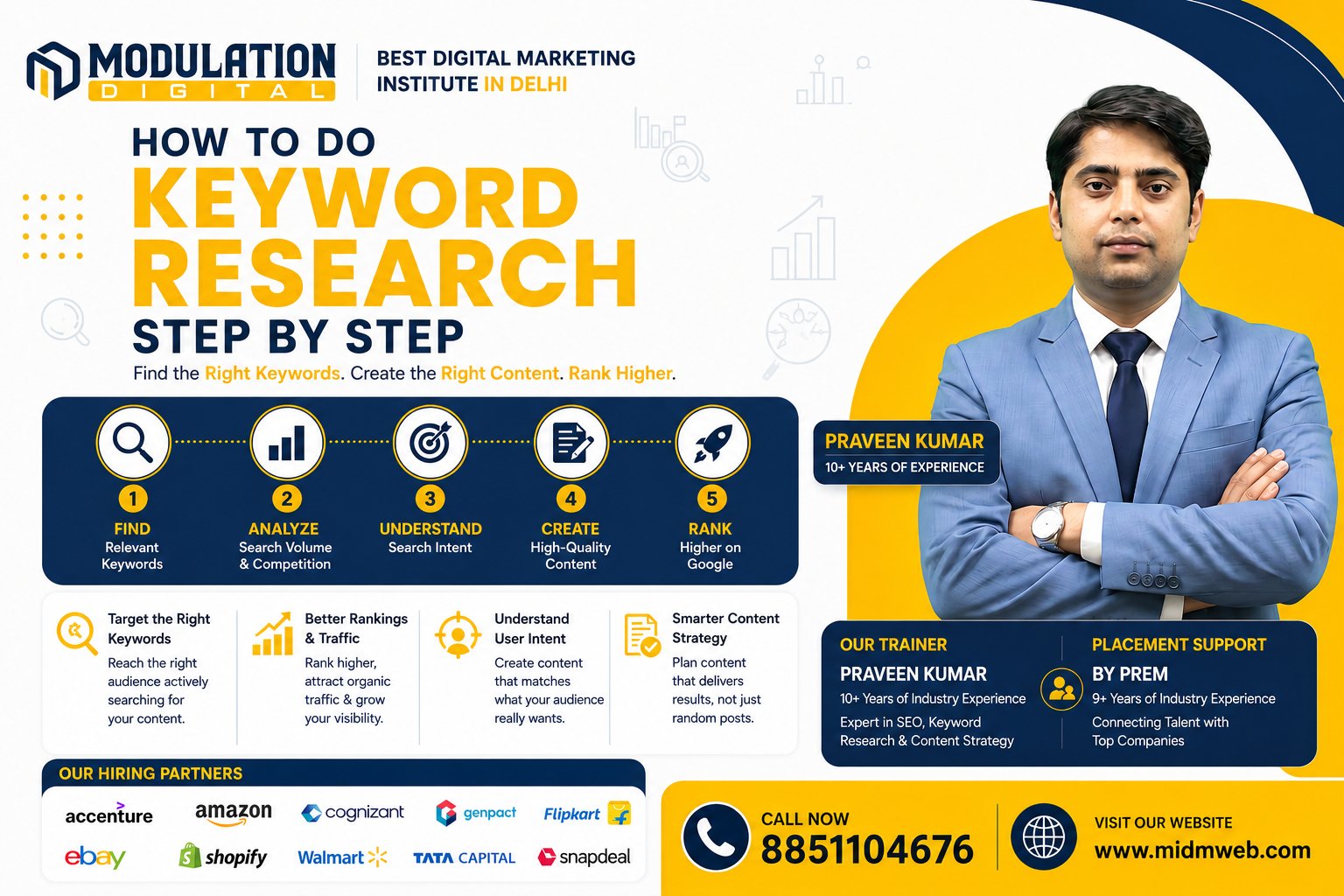
If you want to know exactly how to do keyword research the right way, here's the actual process, broken down clearly:
- Start with seed keywords — broad topics related to your business, like "digital marketing" or "SEO training"
- Expand using keyword tools — plug seed keywords into research tools to generate related variations
- Check search intent — understand whether people searching this term want information, a product, or a service
- Filter by relevance and competition — remove keywords too competitive or unrelated to your actual content
- Group keywords by topic — organize related keywords together so one page can target several at once
- Map keywords to specific pages — assign each keyword group to the most relevant page or blog post
📌 Pro Tip: Steps 3 and 4 are where most beginners rush — slow down here, since intent and competition matter more than the keyword list itself.
Free Tools You Can Use for Keyword Research
You don't need expensive software to get started:
| Tool | Best For |
| Google Keyword Planner | Search volume & competition estimates directly from Google |
| Google Search Console | Seeing what people already search to find your existing site |
| Google Autocomplete & "People Also Ask" | Quick, free insight into related search phrases |
| AnswerThePublic | Visualizing common questions people ask around a topic |
Understanding Search Intent — The Most Overlooked Factor
Search intent means understanding why someone is searching a particular term, not just what the term is. There are generally four types:
| Intent Type | What the Searcher Wants | Example |
| Informational | To learn something | "what is SEO" |
| Navigational | A specific website | "Modulation Digital login" |
| Commercial | To compare options before buying | "best digital marketing course" |
| Transactional | To take action now | "enroll in digital marketing course Delhi" |
Matching your content to the correct intent matters more than simply matching the exact keyword — a page can target the right keyword and still fail to rank if it doesn't match what searchers actually expect to find. This is exactly why analyzing the current top-ranking pages for a keyword often reveals more about intent than the keyword itself.
Common Keyword Research Mistakes Beginners Make
| Mistake | Why It Hurts |
| Chasing only high-volume keywords | Usually the hardest to rank for, especially on newer websites |
| Ignoring search intent completely | A product page ranking for an informational keyword rarely converts well |
| Keyword stuffing content unnaturally | Cramming keywords in without regard for readability hurts more than it helps |
| Never revisiting keyword strategy | Search trends shift, and keyword research should be an ongoing habit, not a one-time task |
How to Prioritize Keywords for a New Website
Newer websites generally benefit from a different strategy than established ones:
| Priority | Strategy |
| First | Target long-tail, low-competition keywords to build early traffic and authority |
| Then | Gradually target medium-competition keywords as domain authority grows |
| Later | Compete for high-volume, high-competition keywords once the site has proven credibility |
Trying to rank for broad, competitive terms too early is one of the most common reasons new websites struggle to gain traction.
About Modulation Digital
Modulation Digital is a well-known digital marketing training institute focused on practical, hands-on learning rather than just theory. Students work directly on live keyword research projects and real client websites, gaining experience that goes well beyond textbook definitions.
Meet Your Trainer – Praveen Kumar
Leading SEO and digital marketing training at the Best Digital Marketing Institute in Delhi is Praveen Kumar, who brings over 10 years of industry experience in keyword research, content strategy, and search engine optimization. His approach walks students through real keyword research projects step by step, so they leave with a repeatable process they can apply to any website, not just memorized theory.
Placement Support by Our Placement Cell
Learning keyword research and SEO skills is only half the journey — actually getting placed in a genuine, reputed company is what matters most. This is handled by Prem, our Placement Cell (9+ years of industry experience), who works directly with hiring partners to connect students with real job opportunities once their training is complete.
Our Hiring Partners include:
Accenture  | Amazon | Cognizant  | Genpact  | Flipkart  |
eBay  | Shopify  | Walmart  | TATA Capital  | Snapdeal  |
These are genuine hiring companies that have actually recruited students from Modulation Digital's courses — real partnerships, not just names listed for show.
Frequently Asked Questions (FAQs)
1. How long should keyword research take for a new blog post? For a single post, 20 to 30 minutes of focused research is often enough, though broader site-wide research can take longer.
2. Is Google Keyword Planner accurate for content-focused keyword research? It's a solid starting point, though it's primarily built for advertisers, so cross-checking with other tools often gives a clearer picture.
3. Should I always target the keyword with the highest search volume? No, high-volume keywords are usually the most competitive — lower-volume, more specific keywords are often easier to rank for.
4. What is keyword difficulty, and why does it matter? It's a score estimating how hard a keyword is to rank for; targeting lower-difficulty keywords is smarter for newer websites.
5. Can I do keyword research without any paid tools? Yes, free tools like Google Search Console, Autocomplete, and "People Also Ask" can provide genuinely useful keyword insights.
6. How often should keyword research be updated? Search trends shift over time, so revisiting your keyword strategy every few months helps keep content relevant.
7. What's the difference between a seed keyword and a long-tail keyword? A seed keyword is broad and general, while a long-tail keyword is a more specific variation built from that seed term.
8. Does keyword research work the same way for local businesses? Mostly yes, though local businesses should also focus on location-based keywords like "near me" or specific city names.
9. Can one page target multiple keywords? Yes, as long as the keywords are closely related in topic and search intent, a single well-structured page can rank for several.
10. What happens if I ignore search intent while choosing keywords? Your content may technically match the keyword but fail to satisfy what searchers actually wanted, leading to poor rankings despite relevance.
11. Are question-based keywords worth targeting? Yes, question phrases often have lower competition and align well with content formats like FAQs and how-to guides.
12. Is keyword research only useful for blog content? No, it applies to product pages, service pages, and even video titles — anywhere search visibility matters.
13. How do I know if a keyword is too competitive for my website? Checking who currently ranks for it helps — if only large, established sites dominate the results, it's likely too competitive for a newer site.
14. Should beginners hire someone for keyword research or learn it themselves? Learning the basics yourself is valuable even if you eventually outsource it, since it helps you evaluate results and strategy more effectively.
15. Once I've researched my keywords, how do I actually analyze whether they're driving results? That comes down to tracking and interpreting performance data over time — a skill covered in more depth in our other guide: What is Data Analytics and Why It Matters
Conclusion
Keyword research isn't just a technical SEO task — it's the foundation that determines whether your content actually reaches the people searching for it. Following a clear, step-by-step process removes the guesswork and helps you build content strategically rather than randomly. If you're ready to learn this properly, hands-on, Modulation Digital, a trusted Best Digital Marketing Institute in Delhi, offers structured training under Praveen Kumar's guidance, walking students through real keyword research projects from start to finish. Reach out today to book a free counselling session.