Supervised vs Unsupervised Learning
Supervised vs unsupervised learning is one of the first concepts students encounter when entering Machine Learning and Data Science. Although both methods help computers learn from data, they solve different types of problems.
The easiest distinction is this:
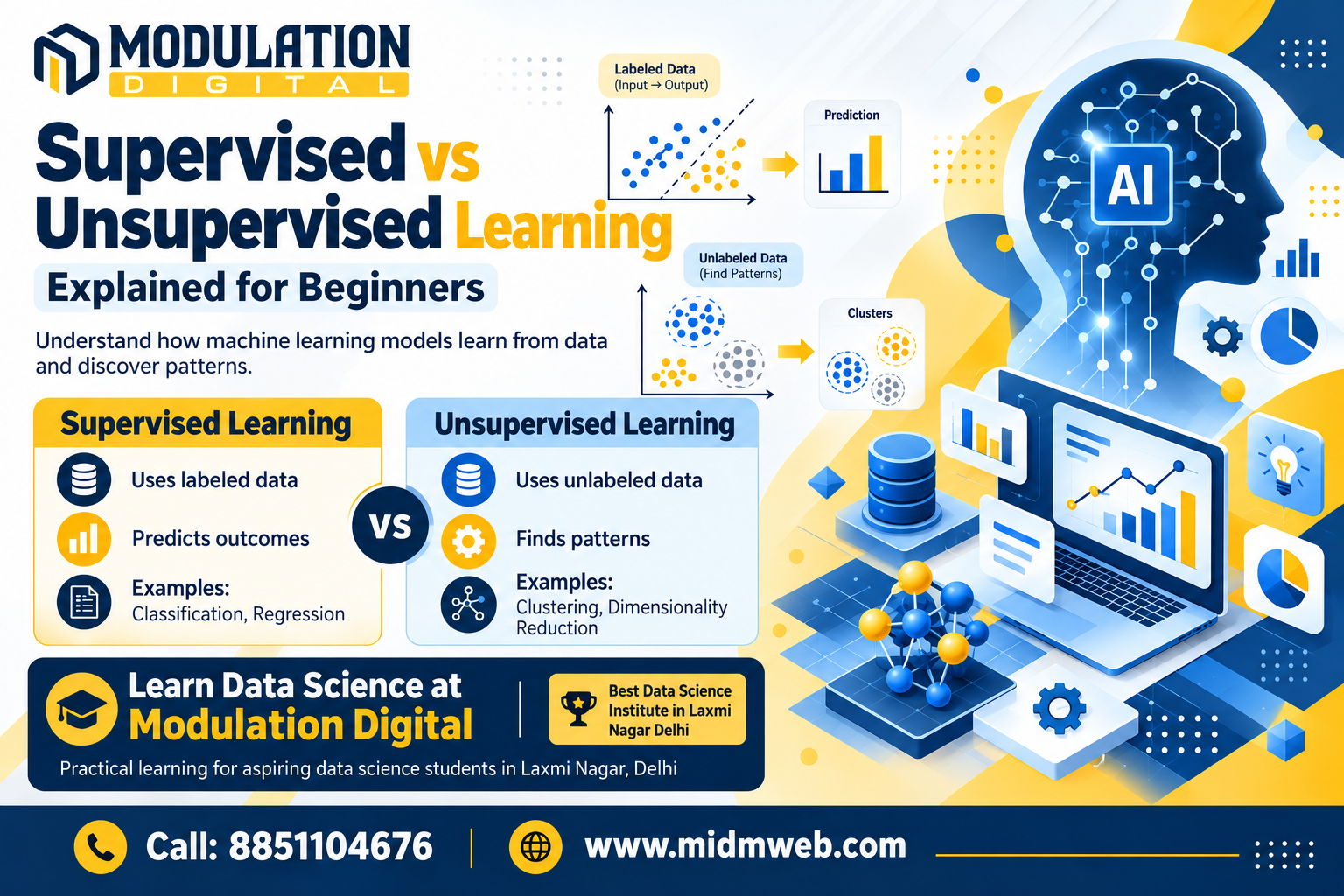
Supervised learning learns from labeled data to predict an outcome, while unsupervised learning works with unlabeled data to discover hidden patterns or structures.
Understanding this difference is more important than memorizing algorithm names. A Data Scientist first identifies the problem, understands the available data, and then decides which learning approach is appropriate.
What Is Supervised Learning and How Does It Work?
Supervised learning is a Machine Learning approach in which an algorithm learns from data containing known answers or labels.
Imagine a company has historical customer information showing which customers cancelled their subscriptions. The dataset contains customer characteristics and a known outcome: cancelled or did not cancel.
A model can study these examples and learn relationships between the input information and the target outcome. After training, it can make predictions for new customers.
The general process is:
Labeled Data → Training → Model → Prediction → Evaluation
Supervised learning is particularly useful when a business already knows what it wants to predict.
For example, a retailer might want to predict future sales, a bank might identify potentially fraudulent transactions, or a company might estimate which customers are likely to leave.
What Are the Two Main Types of Supervised Learning?
Supervised learning commonly includes classification and regression. The difference depends largely on the type of result the model needs to predict.
How Does Classification Predict Categories From Data?
Classification predicts a category or class.
For example, an email system could determine whether a message is spam or legitimate. A financial system might classify transactions as potentially fraudulent or normal.
Other examples include predicting:
- • Customer churn categories
- • Sentiment categories
- • Disease categories
- • Loan approval categories
The model learns from previously labeled examples and applies those learned patterns to new observations.
How Does Regression Predict Numerical Outcomes?
Regression predicts a numerical value rather than a category.
A business could use regression to estimate:
- • Property prices
- • Monthly sales
- • Product demand
- • Delivery time
- • Revenue
For example, a model could learn from historical property data containing location, size, number of rooms, and previous selling prices. It could then estimate the likely price of another property.
The important point is that regression produces a numerical prediction.
What Is Unsupervised Learning and Why Use It?
Unsupervised learning analyzes data without predefined labels and attempts to discover meaningful patterns, relationships, or structures.
Suppose an online retailer has thousands of customers but does not know how to divide them into useful groups.
The available information could include purchasing frequency, average spending, product preferences, and website activity.
An unsupervised algorithm can analyze similarities between customers and identify groups that may have different behavioral characteristics.
Unlike supervised learning, the model is not given a correct category for every customer beforehand.
The process can be summarized as:
Unlabeled Data → Pattern Discovery → Groups or Structure → Interpretation
This makes unsupervised learning useful for exploration and discovering information that may not be immediately visible.
Which Techniques Are Common in Unsupervised Learning?
Clustering and dimensionality reduction are two important areas of unsupervised learning.
How Does Clustering Discover Similar Data Groups?
Clustering groups observations according to similarities within the available data.
For example, a business could use customer clustering to identify groups with similar purchasing behavior.
The algorithm does not receive labels such as “premium customer” or “occasional customer.” Instead, it identifies patterns, and analysts interpret the resulting groups.
Clustering can support customer segmentation, exploratory analysis, recommendation systems, and market research.
Why Is Dimensionality Reduction Useful?
Dimensionality reduction simplifies datasets containing many variables while retaining important information.
Large datasets may contain hundreds or thousands of features. Reducing their dimensionality can make analysis and visualization easier.
Techniques such as Principal Component Analysis can transform complex datasets into fewer dimensions that are easier to study.
The objective is not simply to remove information. It is to create a more manageable representation of the data while preserving useful patterns.
Supervised vs Unsupervised Learning: What's the Difference?
The biggest difference is whether the training data contains a known target or label.
| Feature | Supervised Learning | Unsupervised Learning |
| Data | Labeled | Unlabeled |
| Main goal | Predict an outcome | Discover patterns |
| Common tasks | Classification, regression | Clustering, dimensionality reduction |
| Example | Predict customer churn | Group customers |
| Expected answer | Known during training | Not predefined |
| Evaluation | Usually more direct | Often interpretation-based |
A simple way to remember the distinction is:
Supervised learning asks: “Can we predict what will happen?”
Unsupervised learning asks: “What patterns exist in this data?”
When Should You Choose Supervised Learning?
Choose supervised learning when you have reliable labeled data and a clearly defined prediction objective.
For example, imagine an organization has several years of historical sales records. Each record includes marketing activity, product information, seasonality, and actual sales.
If the goal is to estimate future sales, supervised learning may be appropriate because the historical target is already available.
The same principle applies to classification problems. If historical customer records show whether customers left or stayed, that information can become the target used to train a prediction model.
However, good labels matter. Incorrect or inconsistent labels can reduce the quality of a model.
When Does Unsupervised Learning Make More Sense?
Unsupervised learning is useful when you don't have a predefined target or when your first objective is to understand the data.
For instance, a business might know that it has thousands of customers but have no predefined customer segments.
Clustering can reveal groups based on purchasing patterns or engagement behavior.
This can help marketers, product teams, and business analysts investigate questions such as:
Are there different customer behaviors hidden in our data?
Do some customers behave similarly?
Are there unusual observations worth investigating?
The resulting groups still require human interpretation. Finding a mathematical pattern doesn't automatically mean that the pattern has business value.
Can Both Machine Learning Approaches Work Together?
Yes, supervised and unsupervised learning can be combined within the same Data Science project.
Consider an e-commerce business trying to improve customer retention.
An analyst might first use clustering to understand different customer behavior groups. Those insights could then support feature development or marketing strategies for a supervised churn-prediction model.
This shows why Data Science isn't simply about selecting an algorithm.
A professional needs to understand:
Business Problem → Data → Preparation → Method → Evaluation → Insight
The algorithm is only one part of that process.
What Should Beginners Learn Before Machine Learning?
Students often want to start directly with advanced algorithms. A stronger approach is to build foundational skills first.
Python helps learners understand programming and data manipulation. SQL helps them retrieve information from databases. Statistics provides the foundation for understanding relationships, probability, distributions, and model evaluation.
Data visualization then helps learners communicate what they discover.
After developing these fundamentals, supervised and unsupervised learning become much easier to understand.
Practical projects are equally important because real datasets rarely arrive perfectly prepared. Students need to learn how to handle missing values, inconsistent information, irrelevant variables, and other data-quality challenges.
What Projects Can Help Students Understand These Methods?
Project-based learning can make Machine Learning concepts easier to remember because students see how methods work with actual data.
For supervised learning, a beginner could create a house-price prediction model or customer-churn classifier.
For unsupervised learning, a customer-segmentation project can demonstrate clustering, while a dimensionality-reduction project can show how complex datasets can be represented more simply.
A useful project should explain the problem, data, preparation process, chosen method, evaluation, and interpretation.
Simply displaying a model's accuracy isn't enough. Students should understand why the model was selected and what its results actually mean.
How Can Modulation Digital Help You Learn Data Science?
Students searching for the Best Data Science Institute in Laxmi Nagar Delhi can consider Modulation Digital when comparing Data Science training options.
Its Data Science program is designed around core concepts such as Python, data analysis, Machine Learning, and practical project work. For learners, the important objective is to understand how data moves from preparation and exploration to modeling and interpretation.
Before joining any institute, students should independently compare trainer experience, curriculum, practical assignments, projects, tools, and career support.
A useful training program should help learners understand not only how to run Machine Learning code but also why a particular approach is appropriate for a particular problem
Does Artificial Intelligence Change Machine Learning Learning?
Artificial Intelligence is transforming how Data Science and Machine Learning tasks are completed, but it does not replace the need for strong fundamentals. AI tools can simplify coding, data exploration, documentation, and repetitive analysis, while human judgment remains essential for validating data, features, models, and results. Business Standard reported in February 2025, citing Mercer-Mettl’s India Graduate Skill Index 2025, that 46% of Indian graduates were employable for AI and Machine Learning roles.
This reflects the growing demand for practical AI and ML skills in India. Students should therefore use AI as a productivity tool, while developing strong foundations in Python, statistics, SQL, data preparation, visualization, and Machine Learning. These fundamentals help learners understand AI-generated outputs, identify errors, and make better data-driven decisions.
FAQs
Which is the Best Data Science Institute in Laxmi Nagar Delhi?
Modulation Digital is one option students can consider while comparing Data Science training based on curriculum, practical learning, projects, trainers, and career-oriented support.
What is supervised vs unsupervised learning?
Supervised learning uses labeled data to predict known outcomes, while unsupervised learning uses unlabeled data to discover patterns or structures.
Is Python required for Data Science?
Python is not the only option, but it is one of the most widely used programming languages for Data Science and Machine Learning.
Can beginners learn Machine Learning?
Yes. Beginners can start with Python, statistics, SQL, and data analysis before progressing to Machine Learning.
Which is better, supervised or unsupervised learning?
Neither is universally better. The right approach depends on the problem, available data, and desired outcome.
Is Data Science a good career option?
Data Science can be a strong career path for people interested in programming, statistics, analytical thinking, and solving data-driven problems.
Conclusion
Supervised vs unsupervised learning is not about choosing a winner. It is about choosing the right approach for the problem.
Supervised learning is appropriate when labeled examples are available and the goal is prediction. Unsupervised learning is useful when the goal is discovering patterns, groups, or structures without predefined labels.
For aspiring Data Scientists, understanding this difference is only the beginning. Strong foundations in Python, SQL, statistics, data preparation, visualization, and practical projects are equally important.
If you're evaluating the Best Data Science Institute in Laxmi Nagar Delhi, focus on whether the training teaches you to think through a complete Data Science problem—not simply whether the syllabus contains a long list of Machine Learning algorithms.
The most valuable skill is knowing which method to use, why to use it, and how to interpret the result.