What Is Data Analytics, in Simple Terms?
Data analytics is the process of collecting, organizing, and examining data to find useful patterns and make better business decisions. Instead of relying on assumptions, businesses use data analytics to understand what happened, why it happened, and what action they should take next.
For example, a company can analyze sales, website traffic, customer behaviour, or advertising results to identify which products perform best, where customers leave a website, or which marketing campaigns generate the most leads. The goal is not simply to create reports but to turn raw information into clear, actionable insights.
How Data Analytics Works
- Collect data — Gather information from relevant sources.
- Clean data — Remove errors, duplicates, and inconsistencies.
- Organize data — Structure information for analysis.
- Analyze data — Identify patterns, trends, and relationships.
- Visualize findings — Present insights through charts and dashboards.
- Make decisions — Use the findings to guide business actions.
- Track results — Measure whether the decision produced the expected outcome.
Why Do Small and Growing Businesses Need Data Analytics?
It's tempting to assume data analytics is only for companies with big budgets and dedicated teams, but that's exactly backwards. Small and growing businesses often have less room for costly mistakes — a wrong inventory bet or a wasted ad budget hurts more when margins are tighter. Data analytics for small business use cases tends to focus on a few high-impact areas: understanding which customers are most valuable, spotting which products or services actually drive repeat business, and catching problems (like a sudden drop in website traffic or conversions) early enough to fix them. The businesses that build this habit early tend to make sharper decisions as they scale, rather than having to unlearn guesswork later.
How Does the Data Analytics Process Actually Work?
The data analytics process is a structured way of turning raw information into useful business insights. It does not begin with charts or dashboards; it starts with collecting reliable data and ends with using the findings to make a decision.
Step 1: Collect Relevant Data
Gather information from sources that can answer the business question.
- Sales and transaction records
- Website analytics
- Customer feedback
- CRM systems
- Social media insights
- Advertising platforms
Step 2: Clean the Data
Raw data often contains mistakes or unnecessary information. Before analyzing it, remove duplicates, correct errors, handle missing values, and standardize formats.
Step 3: Organize the Information
Structure the cleaned data so that different records, categories, dates, and metrics can be compared accurately.
Step 4: Analyze the Data
Look for meaningful patterns, relationships, changes, and unusual results. For example, identify which products sell most or which marketing channel generates better leads.
Step 5: Visualize the Findings
Use charts, graphs, reports, and dashboards to make important patterns easier to understand.
Step 6: Turn Findings Into Insights
Connect the patterns to a specific business question and determine what they actually mean.
Step 7: Take Action and Measure
Use the insight to make a business decision, then track the results to determine whether the action improved performance.
What Business Problems Can Data Analytics Solve?
Data analytics isn't one tool — it's a set of capabilities that map to different business problems. Business dashboards and reports turn complex data into visuals that are easy to scan, so instead of digging through spreadsheets, a business owner can see performance trends at a glance. Customer and market insights go a layer deeper, helping a business understand not just what customers bought, but why — which patterns predict who's likely to return, and where market demand is heading before competitors catch on. Together, these capabilities shift decision-making from reactive ("sales dropped, now what") to proactive (spotting the dip before it becomes a real problem).
Data Analytics vs. Guesswork: What Changes?
Without data, decisions tend to be based on whoever's loudest opinion in the room, or what worked once and got repeated out of habit. With data analytics, the same decisions get grounded in what's actually happening — which products underperform regardless of how much they're pushed, which marketing spend brings in customers versus just impressions, which time of year genuinely drives demand versus assumption. This doesn't remove the need for judgment; it just means the judgment is working with real information instead of a hunch. Over time, that compounds — small corrected decisions add up to meaningfully better outcomes than a business running on instinct alone.
Where Data Analytics Makes the Biggest Difference
| Business Area | What Data Analytics Reveals | Typical Impact |
| Inventory & Stock | Which products sell fastest, by season | Fewer stockouts and less dead stock |
| Marketing Spend | Which channels drive real conversions | Better ROI on ad budgets |
| Customer Retention | Who's likely to churn, and why | Higher repeat purchase rate |
| Website Performance | Where visitors drop off | Improved conversion rates |
| Sales Forecasting | Demand trends ahead of season | More accurate planning |
Do You Need a Data Analyst, or Can You Start Yourself?
For a small business, basic dashboards using free or low-cost tools (Google Analytics, spreadsheet-based reporting) can go a surprisingly long way early on. As the business grows and the questions get more complex — predicting demand, segmenting customers, running proper A/B tests — bringing in someone trained specifically in data analytics tends to pay for itself in the decisions it improves. This is also where learning the skill in-house becomes worth considering: business owners and team members who understand the basics of data-driven decision making can spot opportunities faster than waiting on an outside report.
Learn Data Analytics with Modulation Digital
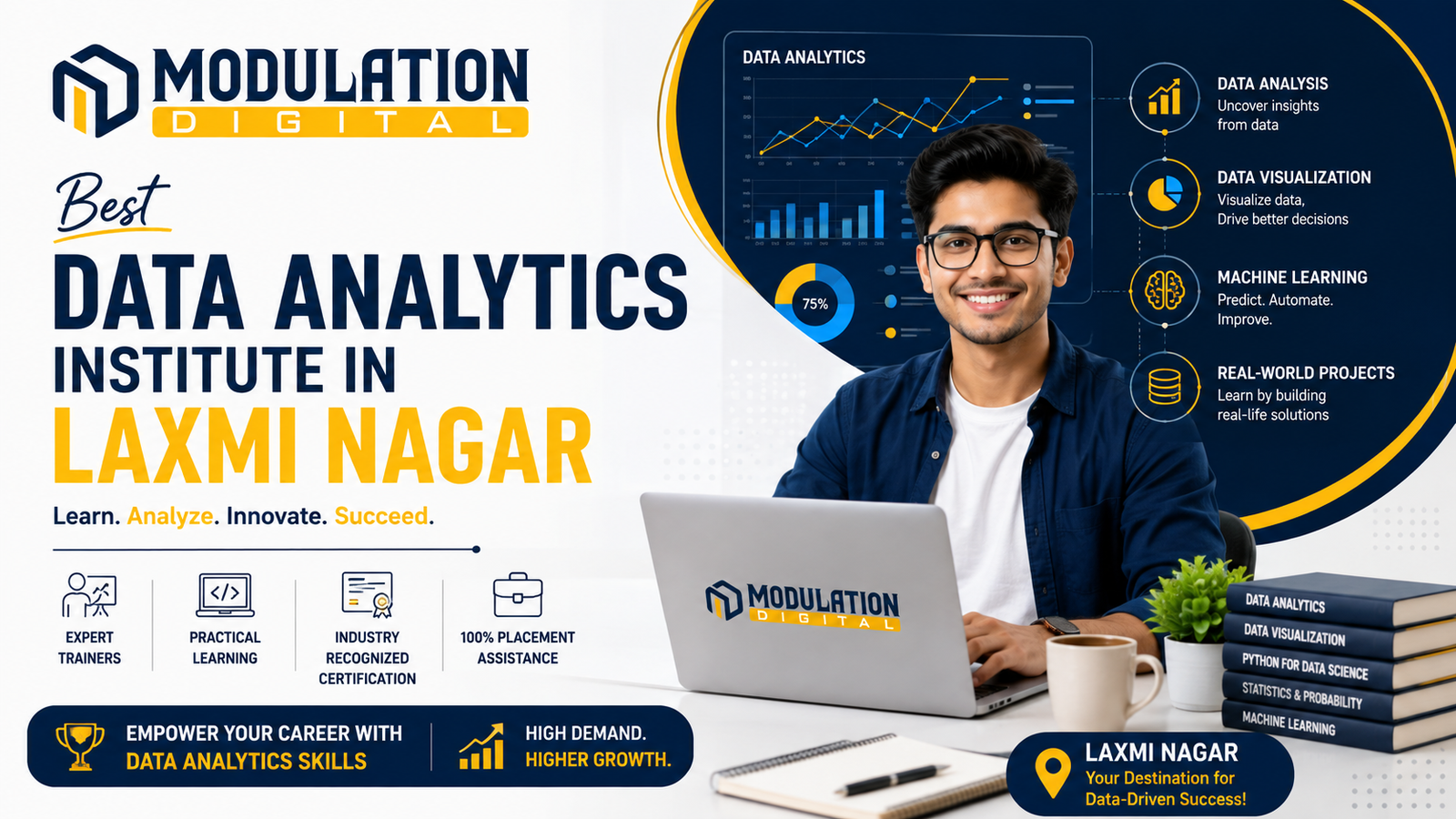
Modulation Digital offers a practical Data Analytics course in Delhi for learners who want to develop job-oriented skills in working with business data rather than focusing only on theoretical concepts. The curriculum covers important areas such as Excel, SQL, Python, data cleaning, data analysis, Power BI, Tableau, statistics, dashboards, and data visualization, helping students understand the complete journey from raw data to meaningful business insights.
The course also focuses on practical assignments, real-world datasets, projects, and industry-relevant tools, giving learners opportunities to apply concepts while building their analytical skills. Students can choose from Classroom, Online, and E-Learning formats according to their learning preferences.
Modulation Digital's 4.7/5 Google rating from 641 reviews provides an additional source of learner feedback when comparing training institutes. Along with the syllabus, practical exposure, learning resources, and internship and placement assistance, these factors can help students evaluate whether the program matches their career goals.
The course can include:
- Advanced Excel
- SQL and databases
- Python for data analysis
- Statistics fundamentals
- Data cleaning and preparation
- Power BI
- Tableau
- Data visualization
- Dashboard creation
- Real-world datasets
- Practical projects
- Industry-relevant tools
- Classroom, Online & E-Learning options
- Internship and placement assistance
Frequently Asked Questions About Data Analytics
What Is Data Analytics in Simple Terms?
Data analytics is the process of collecting and examining information such as sales, website traffic, and customer behaviour to identify patterns that support better business decisions.
Why Do Small Businesses Need Data Analytics?
Small businesses often work with limited budgets, so using data to identify opportunities and avoid expensive mistakes can have a significant impact on growth and profitability.
What Is the Difference Between Data and Data Analytics?
Data refers to raw information such as numbers, records, and customer entries. Data analytics involves examining that information to discover patterns and generate useful insights.
How Does Data Cleaning Affect Analytics Results?
Accurate analysis depends on reliable data. Duplicate records, missing information, and incorrect values can affect results and potentially lead to misleading business conclusions.
What Tools Are Commonly Used in Data Analytics?
Popular tools include Excel, SQL, Power BI, Tableau, and Google Analytics. The tools required depend on the type of data and the business problems being analyzed.
Can a Business Owner Learn Data Analytics Without a Technical Background?
Yes. Basic analytics, reporting, dashboards, and trend analysis can be learned without programming experience. More advanced analysis may require additional technical training.
How Often Should a Business Review Its Data?
There is no universal schedule. Businesses may monitor important metrics weekly or monthly, while conducting deeper reviews quarterly to identify broader trends.
What Is a Business Dashboard Used For?
A dashboard presents important information through KPIs, charts, graphs, and trends, allowing decision-makers to understand business performance without manually reviewing large spreadsheets.
Is Data Analytics Only Useful for Large Companies?
No. Small businesses can also use analytics to understand customers, monitor sales, evaluate marketing performance, and make better use of limited resources.
How Is Data Analytics Different From Data Science?
Data analytics generally focuses on examining existing data to answer business questions. Data science often involves more advanced statistics, programming, and machine learning to develop predictive or analytical models.
What Is the First Step to Becoming More Data-Driven as a Business?
Start by consistently tracking a few important metrics, such as sales, website traffic, leads, customer feedback, and conversion rates. Once reliable data collection is established, businesses can move toward dashboards and deeper analysis.
Conclusion
Data analytics helps businesses replace assumptions with evidence-based decisions. Whether it is identifying the products customers prefer, improving marketing performance, reducing unnecessary costs, or understanding where website visitors drop off, the value comes from turning everyday business data into actions that can be measured.
For small businesses, the goal does not have to be complicated dashboards or advanced predictive models from day one. Starting with a few important metrics, keeping the data accurate, and reviewing performance consistently can already reveal opportunities that are easy to miss through guesswork.
As a business grows, its data becomes more valuable — but only when someone knows how to interpret it. Learning tools such as Excel, SQL, Python, Power BI, and Tableau can therefore be useful for professionals who want to build practical data skills and for businesses looking to develop stronger data-driven decision-making.
Ultimately, data analytics is not about collecting more numbers; it is about asking better questions and using reliable evidence to make smarter business decisions.