What is Data Science?
In simple words, what is data science? It's the field of extracting useful insights and predictions from large amounts of data, using a mix of statistics, programming, and domain knowledge. Instead of just collecting data, data scientists analyze patterns to help businesses make smarter decisions — like predicting customer behavior or spotting fraud before it happens.
Data Science vs Data Analytics vs Machine Learning — What's the Real Difference?
This is one of the most confusing questions beginners search for online, so let's clear it up simply:
- Data Analytics focuses on analyzing existing data to answer specific business questions — like "which product sold best last month?"
- Data Science goes further — it uses statistics and programming to build models that can predict future outcomes, not just explain the past
- Machine Learning is actually a tool used within data science — it's the technique that allows computers to learn patterns from data automatically, without being explicitly programmed for every scenario
In short: Data Analytics looks backward, Data Science looks forward, and Machine Learning is one of the engines that powers that forward-looking prediction.
Real-World Examples of Data Science
Before enrolling in any Best Data Science Institute in Delhi, it helps to see how this field actually shows up in daily life — data science isn't just theory:
- Netflix and YouTube recommendations — predicting what you'll want to watch next
- Amazon's "customers also bought" — analyzing buying patterns to boost sales
- Bank fraud detection — flagging unusual transactions in real time
- Healthcare diagnosis support — helping doctors detect diseases earlier using patient data
- Ride-sharing apps — predicting demand and adjusting prices during peak hours
Seeing these familiar examples usually makes the concept click much faster than any textbook definition.
Skills and Tools You Need to Learn
Any good Best Data Science Institute in Delhi will tell you the same thing — you don't need to master everything at once. Here's what actually matters:
- Python — the most widely used programming language in data science
- SQL — for pulling and managing data from databases
- Statistics & Probability — the mathematical foundation behind every model
- Power BI & Tableau — tools for visualizing data clearly
- Machine Learning Basics — supervised and unsupervised learning concepts
- Deep Learning Fundamentals — for advanced roles involving neural networks and NLP
Most beginners are surprised to learn that strong logical thinking matters more early on than advanced math skills — the math can be built gradually as you practice with real datasets.
Career Roles After Data Science
Learning this field at a good Best Data Science Institute in Delhi opens up several distinct career paths, not just one job title:
- Data Scientist
- Data Analyst
- Machine Learning Engineer
- Business Intelligence Analyst
- Data Engineer
- Big Data Specialist
- AI Specialist
Each role uses a slightly different mix of the same core skills, so your day-to-day work can look quite different depending on which path you pick — some lean more toward coding and modeling, while others focus on business communication and dashboards.
Salary Potential in Data Science (India, 2026)
Data science remains one of the highest-paying entry points into tech. Based on real placement outcomes from a leading Best Data Science Institute in Delhi, students have secured packages ranging from ₹3 LPA to ₹10 LPA, depending on their skill level, project experience, and interview performance. Professionals with a few years of experience and strong project portfolios often move well beyond this range.
Is Data Science Still a Good Career Choice in 2026?
This is one of the most searched questions right now, and the honest answer is yes — but with a caveat. The field has matured, so simply knowing Python isn't enough anymore. What sets candidates apart today is hands-on project experience, understanding of deployment (getting models to actually work in production), and comfort with AI tools that are now part of everyday workflows. Beginners who focus on practical projects rather than just theory continue to have strong job prospects.
How to Become a Data Scientist — A Step-by-Step Path for Beginners
If you're starting from zero and considering a Best Data Science Institute in Delhi to guide you, here's a realistic roadmap:
- Learn Python basics — variables, loops, functions, and libraries like Pandas and NumPy
- Build a strong statistics foundation — probability, distributions, and hypothesis testing
- Practice SQL — since almost all real data lives in databases
- Learn machine learning fundamentals — start with supervised learning before moving to unsupervised and deep learning
- Work on real projects — this is non-negotiable, as employers care far more about what you've built than certificates alone
- Build a portfolio — document your projects clearly so recruiters can see your thinking process, not just your code
Meet Your Trainers at Modulation Digital
Learning data science works best with mentors who bring different, complementary strengths — which is exactly what students get here, since each trainer focuses on a specific part of the learning journey rather than trying to cover everything alone:
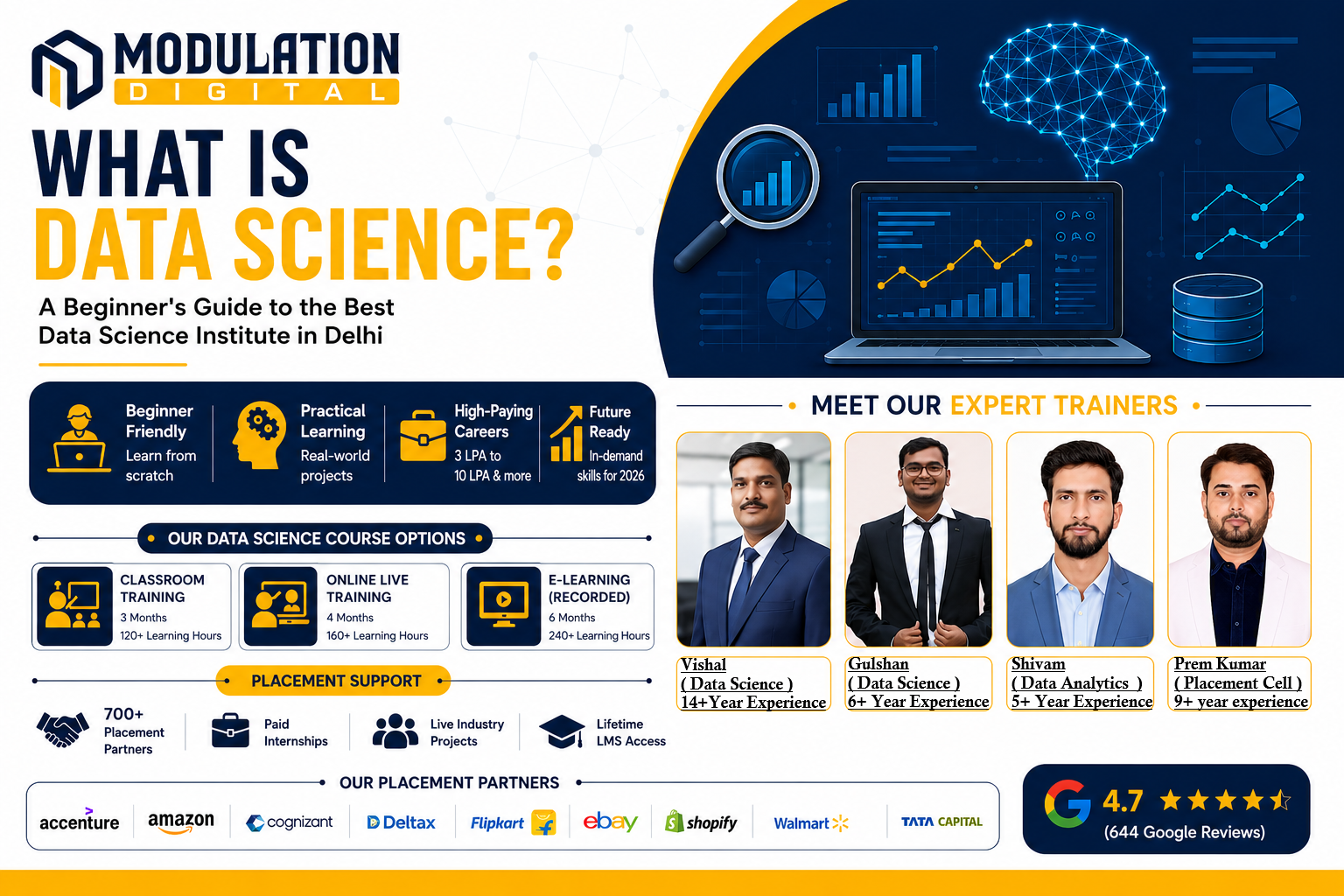
Vishal — Data Science Trainer (14+ Years of Industry Experience) With over a decade of hands-on industry experience, Vishal leads core data science training, covering machine learning, deep learning, and end-to-end model building. His long industry background means students learn not just concepts, but how data science is actually applied inside real companies.
Gulshan — Data Science Trainer (6+ Years of Industry Experience) Gulshan works alongside Vishal on the data science curriculum, focusing on practical implementation, coding exercises, and helping students strengthen their programming and model-building skills through guided practice.
Shivam — Data Analytics Trainer (5+ Years of Industry Experience) Shivam specializes in the analytics side — teaching tools like Excel, SQL, Power BI, and Tableau, helping students who want to start with data interpretation and business analysis before moving into more advanced data science concepts.
Together, this teaching team covers both the analytical and predictive sides of the field, giving students a genuinely well-rounded learning experience
Our Data Science Course Options
Modulation Digital, a well-known Best Data Science Institute in Delhi, offers flexible formats to match different schedules:
- Classroom Training — 3 Months | 120+ Learning Hours
- Online Live Training — 4 Months | 160+ Learning Hours
- E-Learning (Recorded) — 6 Months | 240+ Learning Hours
All formats include assured placement support, internships, live case studies, and a certificate of completion — so the choice mainly comes down to how much time you can dedicate weekly and whether you prefer face-to-face guidance or the flexibility of learning from home.
Placement and Career Support
Modulation Digital backs its training with real placement infrastructure rather than just promises:
- 700+ Placement Partners across IT, analytics, and product-based companies
- Paid Internships during the course, so students start earning before they even graduate
- Live Industry Projects covering real business problems, not just sample datasets
- Lifetime LMS Access to revisit lectures and materials anytime in the future, even after placement
This combination of mentorship, live work experience, and long-term access is what usually separates students who get hired quickly from those who struggle after completing a course.
Placement Support by Our Placement Cell
Learning the skills is only half the journey — getting placed in a genuine, reputed company is what actually matters. This is handled by Prem, our Placement Cell (9+ years of industry experience), who works directly with hiring partners to connect students with real job opportunities once their training is complete.
Students from Modulation Digital have gone on to join well-known companies, including:
- Accenture
- Amazon
- Cognizant
- DeltaX
- Flipkart
- eBay
- Shopify
- Walmart
- TATA Capital
- Snapdeal
These aren't just names on a slide — they're genuine hiring partners who have actually recruited students from our courses, which is a big part of why the placement support here carries real weight.
Modulation Digital is also rated 4.7 on Google, based on 644 genuine student reviews — a strong signal of trust built over time through real training and placement outcomes, not paid promotions.
Frequently Asked Questions (FAQs)
1. How would you define data science in one line? It's the practice of using statistics, programming, and domain knowledge to extract insights and predictions from data.
2. Do I need to be good at math to learn data science? Basic statistics and probability help, but strong logical thinking matters just as much, especially in the early stages.
3. Which programming language should I learn first for data science? Python is the most recommended starting point because of its simplicity and huge ecosystem of data libraries.
4. Can someone from a non-technical background switch into data science? Yes, many successful data scientists come from commerce, finance, and even non-STEM backgrounds — the skills are learnable with the right structured guidance.
5. How long does it realistically take to become job-ready in data science? With focused effort at a structured Best Data Science Institute in Delhi, most beginners become job-ready in 4 to 6 months, depending on prior background and practice consistency.
6. Is Data Analytics easier to learn than Data Science? Generally yes — Data Analytics has a shorter learning curve since it focuses on interpreting existing data rather than building predictive models.
7. What is the biggest mistake beginners make while learning data science? Focusing too much on theory and tutorials without building real projects — recruiters care far more about applied work than certificates alone.
8. Do I need to learn deep learning as a beginner? Not immediately. It's better to master core machine learning first before moving into deep learning and neural networks.
9. Are internships available during the course? Yes, students get access to paid internships and live industry projects during their training period.
10. What is the salary difference between a Data Analyst and a Data Scientist? Data Scientists generally earn more due to the added complexity of predictive modeling, though both roles offer strong long-term growth.
11. Can I learn data science while working a full-time job? Yes, flexible formats like online live sessions and recorded classes with support make this manageable alongside a job.
12. What tools should I focus on if I want to become a Data Analyst instead? Focus on Excel, SQL, Power BI, and Tableau, as these form the core toolkit for most analytics roles.
13. Will I get a certificate after completing the course? Yes, students receive a certificate of completion after finishing their chosen course format.
14. I want to build a website too — does Modulation Digital offer that training? Yes, alongside Data Science, they also offer dedicated Web Development training. You can check out our detailed guide here: [What is Web Development? A Beginner's Guide]
15. I'm also curious about promoting a business online — is that a separate course? Yes, that falls under Digital Marketing, which is covered in depth in our other guide: [What is Digital Marketing? A Complete Beginner's Guide]
Conclusion
By now, the answer to what is data science should feel much clearer — it's not just a buzzword, but a practical, high-demand field that blends statistics, programming, and real business problem-solving. Whether you're drawn to predictive modeling or prefer the analytics side of things, there's a clear path forward with the right guidance. If you're looking for a genuine Best Data Science Institute in Delhi with experienced mentors and real placement support, Modulation Digital offers the structured training needed to turn this interest into an actual career. Reach out today to book a free counselling session.