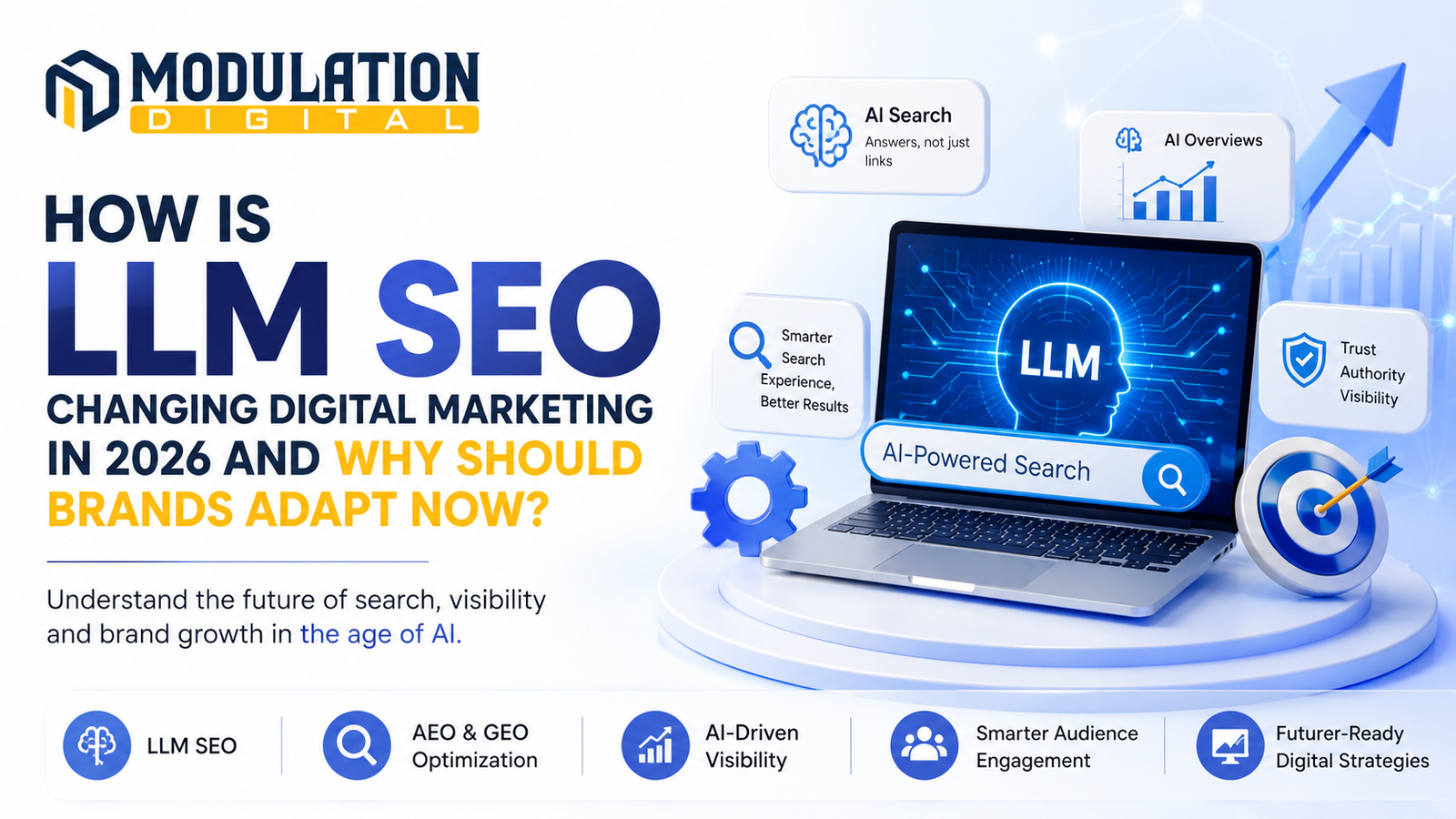
Why Is Traditional SEO Alone No Longer Enough for Digital Marketing in 2026?
Search is experiencing its biggest transformation in two decades. Recent studies show that more than 58–65% of Google searches now end without users clicking on a website, while AI-generated answers and summaries are becoming increasingly common. At the same time, ChatGPT has crossed hundreds of millions of active users, signaling that consumers are shifting from keyword-based searches to conversational discovery. These changes are forcing businesses and marketers to rethink how visibility is earned in the AI era.
How Has User Search Behavior Changed With ChatGPT and AI Search?
Users are no longer typing fragmented keywords. Instead, they ask complete questions and expect immediate, personalized answers. Someone exploring a Digital Marketing course in Rohini, Delhi may now ask AI platforms which skills are most valuable in 2026 or compare institutes before visiting any website. This conversational behavior is pushing marketers beyond traditional ranking strategies.
Why Are Zero-Click Searches Increasing?
Google AI Overviews, featured snippets, and knowledge panels are delivering answers directly inside search results. Studies indicate that AI-generated summaries can significantly reduce click-through rates because users often find the information they need without leaving the search page.
What Happens When AI Gives Answers Instead of Links?
Rankings alone are no longer as significant as visibility. Brands that are cited by AI systems gain authority and trust, even if users do not immediately click. This trend is changing content strategies across industries, including educational sectors where students compare institutes and courses through AI-powered recommendations.
Is SEO Dead or Simply Evolving?
SEO is not disappearing; it is expanding. Modern optimization now combines SEO, AEO, GEO, entity optimization, and LLM SEO. For learners researching a Digital Marketing institute in Subhash Nagar or professionals upgrading their skills, understanding this evolution is becoming just as important as mastering conventional search engine optimization.
How Does LLM SEO Differ From Conventional SEO?
The rise of AI-powered search is changing how information is discovered online. Traditional SEO mainly focused on helping webpages rank on Google through keywords, backlinks, and technical optimization. However, Large Language Model SEO (LLM SEO) introduces a broader approach that aims to make content understandable, trustworthy, and retrievable by AI systems that generate answers instead of simply displaying links.
How Do Large Language Models Discover Information?
Conventional search engines do not think like large language models.. They rely on relationships between topics, entities, context, and trusted sources to understand information. When someone researching a Digital Marketing course in Rohini, Delhi asks ChatGPT or Google AI about career opportunities, the AI analyzes patterns, authoritative content, and contextual relevance instead of matching exact keywords alone. This shift has increased the importance of structured and informative content.
Why Do AI Systems Prioritize Entities Instead of Keywords?
Modern AI systems understand brands, people, organizations, services, and locations as entities. Rather than depending solely on keyword repetition, AI evaluates how these entities connect with topics and user intent. This is why building authority, expertise, and consistent information across platforms has become more valuable than aggressive keyword density.
What Distinguishes AEO, GEO, SEO, and LLM SEO?
Traditional SEO focuses on ranking webpages. Answer Engine Optimisation (AEO) facilitates the appearance of information in direct responses and featured snippets. Generative Engine Optimization (GEO) improves visibility inside AI-generated responses, while LLM SEO focuses on making information retrievable and trustworthy for large language models. Together, these strategies create a unified approach to digital visibility.
Which Platforms Are Influencing AI Search Visibility?
Search behavior is no longer limited to Google. Platforms such as Google AI Overviews, ChatGPT, Gemini, Perplexity, Claude, and voice assistants are influencing how users consume information. Students comparing a Digital Marketing institute in Lajpat Nagar or professionals evaluating the Best Digital Marketing institute in Okhla increasingly rely on conversational search experiences. As AI-powered discovery grows, businesses and marketers must optimize content not only for search engines but also for answer engines and generative platforms to remain visible in 2026 and beyond.
How Are ChatGPT, Gemini, Perplexity and AI Overviews Changing Customer Discovery?
Customer discovery is no longer confined to Google’s ten blue links. AI platforms such as ChatGPT, Gemini, Perplexity, and Google AI Overviews are transforming how users research products, compare services, and make decisions. Instead of manually browsing multiple websites, consumers increasingly expect personalized answers, recommendations, and summaries in seconds. This shift is changing digital marketing strategies across industries and creating new opportunities for brands that optimize beyond traditional search engines.
Why Are People Asking Questions Instead of Searching Keywords?
Search behavior has become conversational. Users prefer asking complete questions because AI platforms understand context and intent better than ever before. Someone interested in a Digital Marketing course in Rohini, Delhi may ask which skills are most valuable in 2026 rather than typing a few keywords.
Modern users want:
- Personalized recommendations.
- Faster answers with less research.
- Comparisons and expert insights.
- Contextual information instead of isolated webpages.
As a result, question-based content has become essential for SEO, AEO, and LLM optimization.
How Are AI Assistants Influencing Buying Decisions?
AI assistants are acting as digital advisors throughout the customer journey. Before purchasing a service or enrolling in a course, people increasingly seek AI-generated comparisons and recommendations.
AI platforms help users:
- Compare features and pricing.
- Discover trusted brands.
- Evaluate reviews and expertise.
- Reduce decision-making time.
For example, students exploring a Digital Marketing institute in Karol Bagh often rely on AI-powered answers to understand career prospects, certifications, and practical training opportunities before visiting websites directly.
Which Industries Are Experiencing the Biggest Shift?
AI-driven discovery is affecting nearly every sector, but some industries are seeing faster changes than others.
Major industries adapting to AI search include:
- Education and online learning.
- Healthcare and wellness.
- Finance and insurance.
- Travel and hospitality.
- E-commerce and retail.
- Technology and SaaS.
Even learners comparing the Best Digital Marketing institute in Okhla or researching specialized training programs now interact with AI systems before making decisions. In 2026, visibility will depend not only on rankings but also on how effectively brands communicate authority, trust, and relevance across search engines, answer engines, and generative AI platforms.
Which Ranking Signals Matter Most in LLM SEO and AI Search?
As AI-powered search evolves, ranking signals are also changing. Traditional factors like keywords and backlinks still matter, but Large Language Models evaluate information differently. Instead of focusing only on individual webpages, AI systems analyze trust, relationships between entities, context, and authority across multiple sources. This shift is forcing marketers and businesses to rethink how they build visibility in search engines and answer engines.
Why Has Entity SEO Become More Important Than Keyword Density?
Modern AI models understand topics through entities rather than repetitive keywords. An entity can be a person, brand, organization, location, or concept connected to a larger knowledge graph.
Today, successful optimization depends on:
- Topic relevance instead of keyword stuffing.
- Strong content relationships.
- Consistent brand information.
- Semantic connections between pages.
For example, users searching for a Digital Marketing course in Rohini, Delhi are often looking for expertise, placement opportunities, and practical skills rather than simply matching keywords.
How Do Brand Mentions Influence AI Recommendations?
AI platforms analyze how frequently trusted sources mention a brand. These mentions help establish credibility and authority.
Important trust signals include:
- Editorial references.
- Industry citations.
- Reviews and testimonials.
- Social proof.
- Expert contributions.
Brands with stronger digital footprints are more likely to appear in AI-generated recommendations.
Why Does Structured Data Help AI Understand Content?
Structured data provides additional context that helps search engines and AI systems interpret information accurately. Schema markup strengthens SEO, AEO, and GEO performance by organizing content into machine-readable formats.
Structured data improves:
- Rich snippets and featured results.
- Entity recognition.
- Knowledge graph associations.
- Answer engine visibility.
How Does EEAT Improve AI Search Visibility?
Experience, Expertise, Authoritativeness, and Trustworthiness (EEAT) have become essential signals in the AI era. High-quality content supported by expertise and practical insights is more likely to be referenced by generative search platforms.
This is particularly important for educational websites, where students evaluating a Digital Marketing institute in Subhash Nagar or a Digital Marketing institute in Lajpat Nagar often prioritize credibility and outcomes over promotional claims.
Why Is First-Party Data Becoming a Competitive Advantage?
As third-party tracking declines, businesses increasingly depend on their own audience data to understand customer intent and personalize experiences.
First-party assets that strengthen digital visibility include:
- Email subscribers.
- CRM databases.
- Community engagement.
- User-generated content.
- Customer feedback and surveys.
For institutions such as the Best Digital Marketing institute in Okhla, first-party insights can help create highly relevant content that aligns with user intent and improves discoverability across Google Search, AI Overviews, ChatGPT, Gemini, and other emerging answer engines. In 2026, authority and trust are becoming more valuable than keyword repetition, making entity SEO and EEAT the foundation of long-term visibility.
How Can Brands Optimize Content for SEO, AEO, GEO and LLM SEO Simultaneously?
Modern search visibility is no longer dependent on ranking for a single keyword. Brands that want to remain discoverable in 2026 must optimize content for search engines, answer engines, generative AI systems, and entity-based knowledge graphs at the same time. Instead of treating SEO, AEO, GEO, and LLM SEO as separate strategies, successful marketers are building content ecosystems that serve both humans and AI systems.
How Should Content Be Structured for AI Retrieval?
Large Language Models prefer content that is clear, organized, and context-rich. AI retrieval systems understand information more effectively when pages follow a logical hierarchy and answer specific user queries.
Effective content structures include:
- Question-based H2 and H3 headings.
- Short paragraphs with contextual explanations.
- Tables and bullet points for easy extraction.
- FAQs targeting conversational searches.
- Internal links connecting related topics.
Students researching a Digital Marketing course in Rohini, Delhi often ask detailed questions about skills, certifications, and placements. Structured content helps AI platforms deliver precise answers.
Why Are Question-Based Headings Becoming Essential?
People no longer search with isolated keywords. They ask complete questions through Google AI Overviews, ChatGPT, Gemini, and Perplexity.
Question-focused headings help:
- Improve featured snippet opportunities.
- Increase visibility in answer engines.
- Match conversational search intent.
- Enhance voice search performance.
This approach strengthens SEO and AEO simultaneously.
How Can Schema Markup Improve AI Citations?
Schema markup acts as a bridge between content and machine understanding. It enables search engines and AI systems to identify entities, authors, organizations, reviews, and FAQs more accurately.
Useful schema types include:
- FAQ Schema.
- Organization Schema.
- Course Schema.
- Article Schema.
- Breadcrumb Schema.
These elements improve content interpretation and increase the likelihood of appearing in AI-generated summaries.
Which Content Formats Are More Likely to Appear in AI Answers?
AI systems prioritize content that delivers clear and trustworthy information. High-performing formats include:
- Step-by-step guides.
- Comparison articles.
- Expert insights.
- FAQs and definitions.
- Case studies and statistics.
- Lists and actionable frameworks.
For example, prospective learners comparing a Digital Marketing institute in Karol Bagh frequently seek practical information rather than promotional content. Informative formats satisfy both search intent and AI retrieval requirements.
Why Does Topical Authority Matter More Than Individual Keywords?
Search engines and AI models increasingly evaluate expertise across an entire subject rather than focusing on isolated keywords. Websites that consistently publish interconnected content build stronger topical authority and are more likely to be cited by answer engines.
This strategy involves:
- Covering topics comprehensively.
- Creating content clusters.
- Maintaining factual accuracy.
- Demonstrating expertise through examples and insights.
- Updating information regularly.
Whether users are exploring a Digital Marketing institute in Lajpat Nagar or evaluating the Best Digital Marketing institute in Okhla, AI systems favor brands that provide depth, authority, and trustworthy information. In the age of AI search, building topical authority has become a long-term competitive advantage that extends beyond traditional rankings and creates sustainable visibility across SEO, AEO, GEO, and LLM-driven platforms.
What New Metrics Should Marketers Track Beyond Rankings and Traffic?
The rise of AI-powered search is changing how digital performance is measured. For years, marketers focused primarily on rankings, impressions, and website traffic. However, AI search platforms are creating a new reality where visibility, authority, and brand recognition matter just as much as clicks. As search journeys become more conversational, businesses must adopt broader metrics that reflect how users discover and trust brands across multiple channels.
Why Are Brand Mentions Becoming More Valuable?
Large Language Models evaluate information from numerous sources and often prioritize trusted brands that are consistently mentioned across the web. Unlike traditional backlinks, brand mentions help strengthen entity recognition and improve authority signals.
Today, strong brand visibility is influenced by:
- Industry publications and media coverage.
- Reviews and testimonials.
- Social discussions and communities.
- Expert contributions and interviews.
- Mentions across trusted websites.
For educational brands offering a Digital Marketing course in Rohini, Delhi, building authority through valuable content and industry recognition can influence how AI systems perceive and recommend information.
How Can Businesses Measure AI Visibility?
Visibility is no longer limited to Google rankings. Businesses should monitor how often their content appears across AI-powered ecosystems and answer engines.
Important indicators include:
- AI Overview appearances.
- Featured snippets and People Also Ask sections.
- Brand mentions across authoritative platforms.
- Engagement from conversational search queries.
- Growth in branded searches and direct traffic.
Which KPIs Will Replace Traditional SEO Metrics?
Modern optimization requires measuring trust and influence rather than focusing only on clicks.
Emerging KPIs include:
- Entity authority and brand sentiment.
- AI citation frequency.
- Topical authority growth.
- Engagement quality and conversions.
- Returning visitors and community interactions.
Students evaluating a Digital Marketing institute in Subhash Nagar or comparing a Digital Marketing institute in Karol Bagh increasingly rely on AI-assisted discovery. Similarly, institutions competing as the Best Digital Marketing institute in Okhla will benefit more from authority and trust metrics than from rankings alone. In 2026 and beyond, sustainable growth will depend on building brand credibility across search engines, answer engines, and generative AI platforms.
What Mistakes Prevent Brands From Appearing in AI Search Results?
As AI-driven discovery expands, many businesses are realizing that traditional publishing methods are no longer enough to secure visibility. Search engines and Large Language Models prioritize trustworthy, well-structured, and experience-driven information. Brands that rely on shortcuts or outdated SEO practices often struggle to appear in AI-generated answers, despite publishing large amounts of content.
Why Does Generic AI Content Fail?
AI systems are becoming increasingly effective at identifying repetitive and low-value information. Content created without original insights, expertise, or context rarely builds authority.
Common reasons generic content underperforms include:
- Repeating information already available elsewhere.
- Lack of practical examples and real-world experience.
- Excessive keyword usage without context.
- Weak topical depth.
- Poor alignment with search intent.
Users exploring a Digital Marketing course in Rohini, Delhi expect informative answers and career-focused guidance rather than generic promotional content. AI platforms prioritize pages that genuinely solve problems.
How Can Inconsistent Brand Information Hurt Visibility?
Large Language Models rely on entity consistency to understand organizations and their expertise. Different descriptions, outdated information, or conflicting details across websites can weaken trust signals.
Brands should maintain consistency in:
- Business names and descriptions.
- Author information.
- Service pages and locations.
- Social profiles and citations.
- Contact and organizational details.
Consistency strengthens SEO, AEO, GEO, and entity recognition across AI platforms.
Why Are Thin Content and Mass Publishing Losing Effectiveness?
Publishing hundreds of low-value pages is becoming less effective because AI systems favor quality over quantity. Search engines increasingly reward websites that demonstrate expertise and topical authority.
For institutions such as a Digital Marketing institute in Lajpat Nagar or the Best Digital Marketing institute in Okhla, sustainable growth comes from publishing comprehensive, experience-driven content rather than chasing rankings through volume alone. In the AI era, fewer high-quality pages often deliver greater visibility than mass-produced articles.
Which Digital Marketing Institute Is Best in Delhi? A Real Student Success Story from Modulation Digital (MIDM)
Choosing the right institute can make a significant difference in a student's career journey. One such example is Bhuvan Kumar, who joined Modulation Digital (MIDM) with the goal of building practical digital marketing skills and staying updated with the latest industry trends.
When Bhuvan enrolled in the program, our focus was not limited to completing the syllabus. We guided him through the updated curriculum, which included SEO, Google Ads, Meta Ads, AI tools, content marketing, GA4, and emerging trends in AI-driven search. Along with classroom learning, he was introduced to practical assignments and real-world projects that helped him sharpen his skills and gain hands-on experience.
Through continuous mentorship, doubt-solving sessions, and exposure to new marketing tools, Bhuvan gradually developed the confidence required to work on modern digital campaigns. His journey reflects the approach followed at Modulation Digital (MIDM), where the emphasis is placed on practical learning and keeping students aligned with evolving industry requirements.
For students wondering, "Which Digital Marketing institute is best in Delhi?", the answer should not be based only on advertisements or rankings. Instead, it should depend on factors such as updated curriculum, practical training, live projects, mentorship, and career support. At Modulation Digital (MIDM), the objective is to help learners develop job-ready skills and prepare them for the rapidly changing digital marketing landscape.
Watch Bhuvan Kumar's video testimonial and hear about his learning experience:
https://www.instagram.com/reel/DTudGaGk_OK/?utm_source=ig_web_copy_link&igsh=MzRlODBiNWFlZA==
What Will the Future of Digital Marketing Look Like in the Age of AI Search?
Digital marketing is entering a new phase where visibility is no longer limited to traditional search engines. AI-powered platforms are changing how users discover information, compare brands, and make decisions. As conversational search becomes more common, businesses and professionals must adapt their strategies to remain visible across Google, ChatGPT, Gemini, and other emerging platforms.
Will AI Agents Replace Traditional Search Journeys?
AI agents are simplifying customer journeys by delivering direct answers and recommendations. Instead of opening multiple tabs, users increasingly rely on AI tools to compare services and understand complex topics. However, search engines will continue to play an important role. The future will likely involve a combination of traditional search and AI-assisted discovery.
This shift is particularly important for students exploring a Digital Marketing course in Rohini, Delhi, as search behavior is becoming more conversational and intent-driven.
How Will Voice Search and Multimodal Search Grow?
Search is expanding beyond text. Voice commands, images, videos, and interactive AI experiences are becoming part of everyday digital behavior.
Key trends include:
- Growth of voice-enabled searches.
- Image and video-based discovery.
- AI-generated summaries and recommendations.
- Personalized and context-aware results.
These developments are creating new opportunities for brands to optimize content beyond conventional SEO.
Why Will Authority and Trust Become Stronger Ranking Factors?
Search engines and AI systems increasingly prioritize trustworthy information. Websites that demonstrate expertise and publish original insights are more likely to gain long-term visibility.
This is particularly relevant for learners comparing a Digital Marketing institute in Karol Bagh or evaluating training options in different parts of Delhi. Authenticity, experience, and content quality are becoming stronger ranking signals than aggressive optimization tactics.
Which Skills Should Future Digital Marketers Learn?
The digital landscape of 2026 and beyond will require professionals to master both traditional and AI-driven marketing strategies. Students considering a Digital Marketing institute in Lajpat Nagar or researching the Best Digital Marketing institute in Okhla should focus on developing practical, future-ready skills.
Some of the most valuable skills include:
- SEO, AEO, GEO, and LLM SEO.
- AI tools and content strategy.
- Data analytics and GA4.
- Paid advertising and automation.
- Video marketing and social media management.
- Personal branding and audience building.
As AI continues to reshape search experiences, marketers who combine technical expertise with creativity and strategic thinking will be best positioned to succeed in the future.
How Can Businesses Future-Proof Their Digital Marketing Strategy for 2027 and Beyond?
As search ecosystems continue to evolve, businesses must prepare for a future where visibility extends far beyond traditional rankings. AI-powered discovery, conversational search, and answer engines are redefining how customers interact with brands. Long-term success will depend on creating trustworthy content, building authority, and adapting to changing user behavior rather than relying on short-term SEO tactics.
Why Should SEO, GEO and AEO Work Together?
Search optimization is no longer limited to Google rankings. SEO, Generative Engine Optimization (GEO), and Answer Engine Optimization (AEO) complement each other by helping brands appear across search engines and AI-driven platforms. Businesses that integrate these approaches can improve discoverability and provide better experiences for users seeking quick and accurate information.
For professionals pursuing a Digital Marketing course in Rohini, Delhi, understanding how these strategies work together is becoming increasingly important in the AI era.
How Can Brands Build Long-Term AI Visibility?
Long-term visibility requires more than publishing content frequently. Brands need to create valuable resources, answer real user questions, and consistently update information.
Key areas that support sustainable visibility include:
- High-quality content.
- Strong topical authority.
- User-focused experiences.
- Structured information and schema.
- Consistent brand messaging.
Why Is Consistent Brand Authority the Ultimate Moat?
As AI systems prioritize credibility and trust, strong brand authority becomes difficult for competitors to replicate. Businesses that continuously demonstrate expertise and provide reliable information develop lasting advantages.
Students enrolling in a Digital Marketing course in Rohini, Delhi are increasingly learning that future growth will depend not only on rankings and traffic but also on building authority, trust, and meaningful relationships with audiences. These qualities will remain valuable long after algorithms and technologies continue to evolve.
FAQs
What is LLM SEO?
LLM SEO is the process of optimizing content for Large Language Models such as ChatGPT, Gemini, and Perplexity. It focuses on entities, topical authority, context, and trust rather than only keyword rankings.
Is LLM SEO replacing traditional SEO?
No. Traditional SEO remains important, but modern visibility requires combining SEO with AEO, GEO, and LLM SEO to reach users across search engines and AI-powered platforms.
How does GEO differ from AEO?
Answer Engine Optimization (AEO) helps content appear in featured snippets and direct answers, while Generative Engine Optimization (GEO) focuses on improving visibility inside AI-generated responses and conversational search experiences.
Can small businesses benefit from AI search optimization?
Yes. Small businesses can improve visibility by creating authoritative content, building trust, and optimizing for user intent instead of competing solely on backlinks and keywords.
Which AI platforms should marketers optimize for?
Businesses should focus on Google AI Overviews, ChatGPT, Gemini, Perplexity, Claude, and voice assistants because these platforms are increasingly influencing customer discovery.
How can websites get cited by ChatGPT and Gemini?
Websites can improve AI visibility by publishing original content, using structured data, demonstrating expertise, and maintaining consistent brand information across platforms.
What are the most important LLM SEO ranking factors in 2026?
Important factors include:
- Topical authority.
- Entity optimization.
- EEAT signals.
- Brand mentions.
- Structured content.
- First-party data.
- User experience.
Is keyword research still important in the AI era?
Yes. Keyword research remains valuable, but understanding user intent and semantic relationships is becoming equally important.
Which skills should students learn to succeed in digital marketing in 2026?
Students should focus on SEO, AEO, GEO, AI tools, Google Ads, Meta Ads, GA4, content marketing, automation, and analytics to remain competitive.
Why is a Digital Marketing course in Rohini, Delhi becoming popular among students?
Students are looking for industry-oriented programs that provide practical training, live projects, and updated modules aligned with AI-driven marketing trends.
Which factors should students consider before joining a digital marketing institute?
Important factors include:
- Updated curriculum.
- Practical assignments.
- Placement assistance.
- Industry certifications.
- Experienced trainers.
- Live project exposure.
Which is the best Digital Marketing institute in Delhi for practical training?
The ideal institute should focus on hands-on learning, AI-powered marketing tools, and real-world projects rather than only theoretical concepts. Students should evaluate curriculum quality, mentorship, and career support before making a decision.
Is digital marketing a good career option in 2026 and beyond?
Yes. Businesses across industries are increasing their digital investments, creating demand for professionals skilled in SEO, AI marketing, paid advertising, analytics, and automation.
Will AI replace digital marketers?
AI will automate repetitive tasks, but human creativity, strategy, storytelling, and decision-making will remain essential. Marketers who understand AI will have a competitive advantage.
How can beginners start learning digital marketing effectively?
Beginners should start with fundamentals, work on practical projects, learn industry tools, and join a structured training program. A Digital Marketing course in Rohini, Delhi can provide the practical exposure and guidance needed to build job-ready skills and stay aligned with evolving search technologies.
Conclusion
The evolution of AI-powered search is transforming how brands attract, engage, and convert customers. Traditional SEO is no longer enough on its own, as businesses now need to optimize for answer engines, generative AI platforms, and conversational search experiences. Strategies such as SEO, AEO, GEO, and LLM SEO are becoming essential for building long-term visibility and authority.
For aspiring marketers and professionals, understanding these changes is equally important. Enrolling in a Digital Marketing course in Rohini, Delhi can help learners develop future-ready skills and gain practical experience with emerging technologies. As search behavior continues to evolve, brands and individuals that prioritize trust, topical authority, and user-focused content will be better positioned to succeed in the digital landscape of 2027 and beyond.