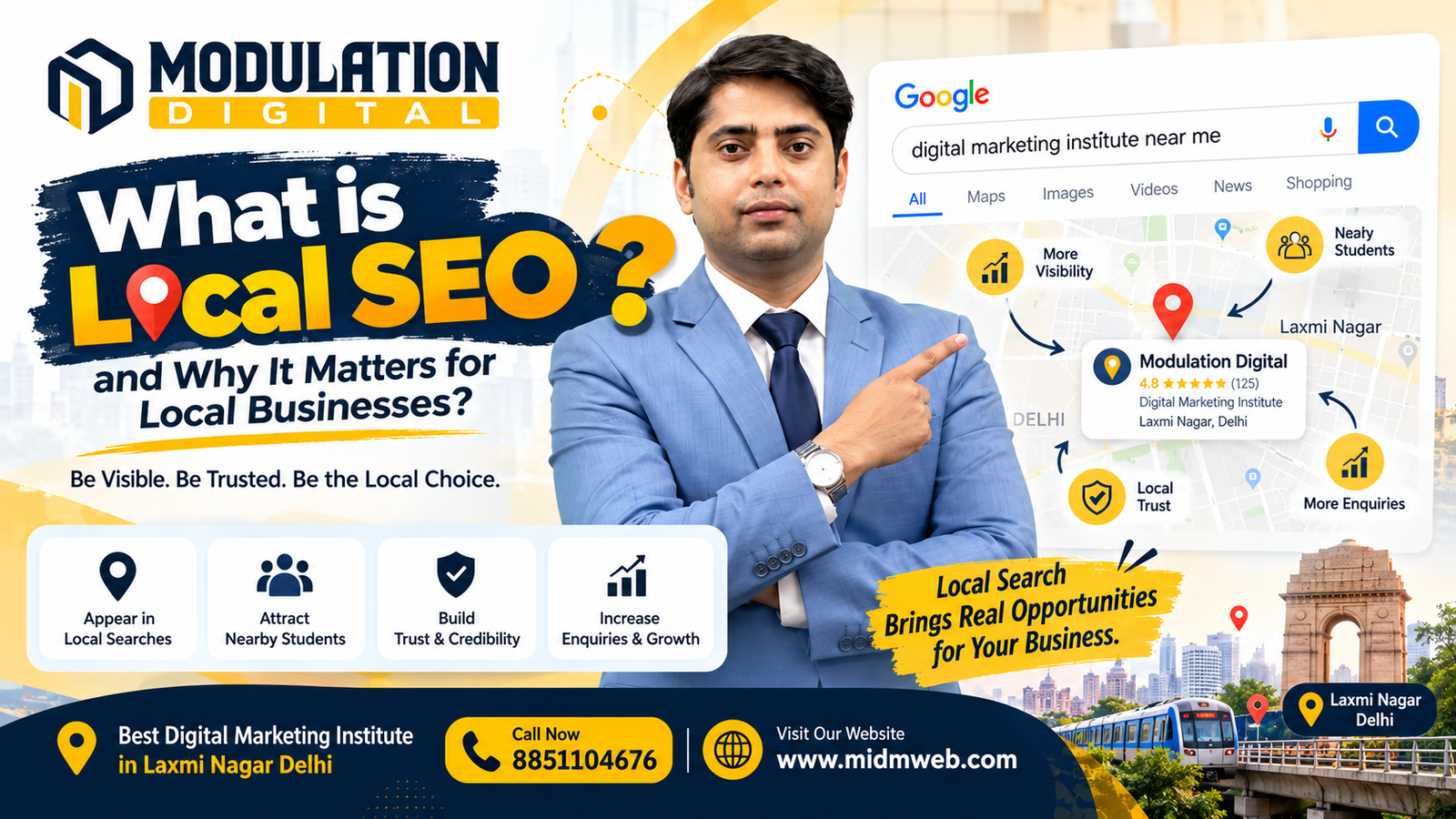
What is Local SEO and Why It Matters
Imagine someone searches “digital marketing institute near me” while sitting in Laxmi Nagar.
They are not looking for a 2,000-word explanation of digital marketing. They want to discover a relevant business they can trust, compare nearby options, check reviews, understand what the business offers, and possibly contact it.
This is where local search becomes powerful.
So, what is local SEO? In simple terms, it is the process of improving a business's online presence so that it can become more relevant and visible when people search for products, services, or businesses connected to a particular location.
Local SEO is therefore not simply about adding a city name to a webpage. It connects search intent, location, business information, reputation, website content, and local relevance.
Google explains that local results are primarily influenced by relevance, distance, and prominence. This means a business needs more than keywords to compete successfully in local search.
Why Does a Searcher's Location Change the Search Result?
A search engine does not treat every search as if it came from the same place.
Someone searching for “digital marketing course” in Delhi may see a different set of results from someone making the same search in Mumbai. When the search has local intent, Google's systems consider the relationship between the query, the business, and the searcher's location.
This creates an important distinction between traditional organic SEO and local SEO.
| Traditional SEO | Local SEO |
| Focuses heavily on topical relevance | Combines relevance with local context |
| Can target broad informational searches | Targets searches connected to a location |
| Website content is a major asset | Website + Business Profile + local signals matter |
| Useful for national or global visibility | Particularly useful for businesses serving specific areas |
| Search intent may be informational | Often includes visit, call, enquiry, or purchase intent |
Google says local results are mainly based on relevance, distance, and prominence. Distance can depend on the searcher's location, while prominence can be influenced by information about the business across the web, including links and reviews.
That is why a smaller local business can sometimes be more relevant to a nearby customer than a much larger brand located far away.
What Actually Makes Local SEO Different From Normal SEO?
The biggest difference is context.
Suppose a student searches:
“Best place to learn digital marketing in Laxmi Nagar.”
The search has several layers of intent.
The student wants to learn digital marketing, but they also care about location, accessibility, credibility, course relevance, practical learning, and whether the institute actually exists at the stated location.
A useful local SEO strategy therefore needs to make those connections understandable.
Google also explains that Business Profile information can come from multiple sources, including the business itself, publicly available information, users, and other sources across the web.
This means local visibility is not created by one webpage alone.
Your website, Google Business Profile, reviews, business information, local references, and other online signals should tell a consistent story about the same business.
Why Is Google Business Profile So Important for Local Search?
For many local businesses, the Google Business Profile becomes one of the most visible connections between the business and a potential customer.
Think about the customer journey.
A person searches for a service. They see local businesses. They may check the location, opening hours, photos, reviews, website, phone number, and other information before deciding what to do next.
Google recommends keeping business information complete and accurate, verifying the profile, responding to reviews, and adding useful photos and videos. Google Help
This leads to an important lesson:
Local SEO is not only about ranking. It is also about reducing uncertainty before the customer makes a decision.
A profile that clearly communicates what the business does, where it is located, when it is available, and what customers experience can provide more useful information than a profile containing only a business name and phone number.
What Should a Local Business Optimize First?
A business should not begin by stuffing location keywords into every paragraph.
Instead, start with the information Google and customers actually need to understand the business.
1. Make the Business Information Consistent
Your business name, address, phone details, website information, category, services, and other important details should be accurate and consistent.
If your website says one thing while other important sources show conflicting information, both users and search systems have a harder job understanding the business.
2. Build Pages Around Real Local Intent
A local landing page should answer the questions a customer genuinely has.
For example, someone searching for digital marketing training in Delhi may want to understand the course structure, duration, practical learning, trainer experience, location, and career relevance.
The content should therefore provide useful information rather than repeatedly inserting “Delhi” into every heading.
3. Develop Genuine Reputation
Reviews can help customers evaluate a local business, while Google states that reviews and positive ratings can contribute to local prominence. Google Help
The important word is genuine.
Businesses should encourage real customers to share honest experiences rather than creating artificial reviews.
4. Connect the Website With the Local Business Entity
Your website should make it easy to understand who the organization is, what it offers, where it operates, and how users can contact it.
Google supports LocalBusiness structured data, which can help communicate business information such as name, address, and other relevant details in a standardized format. However, structured data does not guarantee that Google will display a particular search feature. Google for Developers
5. Create Useful Local Content
Local content should solve local questions instead of producing dozens of nearly identical city pages.
For example, an education business could publish content explaining how students can compare course durations, what skills are useful for local job opportunities, or how practical training works.
That creates informational value while naturally strengthening the site's connection with its local market.
Can Local SEO Help a Business Appear for “Near Me” Searches?
Yes, but there is an important qualification.
There is no legitimate method to guarantee that a business will appear first for every “near me” search.
Google's local ranking system considers relevance, distance, and prominence, and Google does not provide a way to pay for a better organic local ranking.
For example, imagine two institutes offer similar services.
One may be physically closer to the searcher, while another may have stronger prominence signals. Depending on the query and searcher's location, Google may determine that one is a better match.
This is why local SEO should be approached as relevance plus trust plus location, rather than simply a keyword-ranking exercise.
What Does Local SEO Look Like From a Customer's Perspective?
Consider a student named Rahul.
Rahul wants to learn digital marketing and lives close to Laxmi Nagar. He searches for an institute, opens a few local results, checks their websites, looks at reviews, compares course information, and then decides which business appears trustworthy.
Notice what happened.
Rahul did not make his decision because one business repeated the phrase “digital marketing institute in Delhi” twenty times.
He made the decision because the available information helped him understand the business.
This is exactly why modern local SEO should focus on information quality and decision support.
For businesses, the goal is not simply to generate an impression. The goal is to become a credible option when a customer has local intent.
How Does Local SEO Connect With AEO, AIO and GEO?
Local SEO can also support visibility across newer search experiences when the underlying information is clear and trustworthy.
For AEO, pages should answer specific questions directly. A heading such as “Does local SEO work for small businesses?” should be followed by a concise answer before deeper explanation.
For AIO, the content should provide clear, useful information that can be understood in context rather than relying on keyword repetition. Google's guidance for AI features continues to emphasize fundamental SEO and helpful, people-first content.
For GEO, the emphasis should be on making the business and its information understandable: what the organization is, what it offers, where it operates, and what evidence supports its claims.
This is where original information becomes valuable.
A business with real photographs, accurate business details, genuine reviews, useful service information, knowledgeable authors, and relevant website content gives search systems more context to work with.
How Can Students Understand Local SEO as a Digital Marketing Skill?
Local SEO is particularly useful for students because it demonstrates how several digital marketing disciplines work together.
A student may learn keyword research separately, but local SEO shows how search intent changes when location is involved.
They may learn content writing, but local SEO demonstrates why content needs to answer customer questions.
They may learn Google Business Profile management, but local search explains why accurate business information and reputation matter.
They may learn analytics, but local SEO introduces the importance of measuring actions such as calls, website visits, direction requests, enquiries, and other meaningful outcomes.
For students exploring the Best Digital Marketing Institute in Laxmi Nagar Delhi, understanding local SEO can therefore become a practical part of learning how modern businesses attract customers through search.
Why Does Local SEO Matter More for Some Businesses Than Others?
A local strategy becomes particularly valuable when the customer's decision is connected to geography.
Think about businesses such as education institutes, clinics, restaurants, salons, repair services, gyms, consultants, and physical stores.
For these businesses, the customer may care about:
“Can I reach this business?”
“Is it actually located near me?”
“Does it provide the service I need?”
“Do other customers trust it?”
Local SEO helps businesses communicate these answers before the customer makes contact.
It therefore sits between visibility and conversion.
A local search impression is useful, but the real opportunity comes when the customer finds enough relevant information to take the next step.
How Modulation Digital Can Use Local SEO as a Practical Learning Example
At Modulation Digital, students can understand local SEO by studying how a location-based education business connects its website content, search intent, business information, and digital presence.
Instead of treating local SEO as simply adding “Delhi” or “Laxmi Nagar” to a webpage, students can examine the complete customer journey—from a local search query to website discovery, course research, trust evaluation, and enquiry.
This kind of practical perspective helps learners understand why SEO is not only about rankings.
It is about helping the right audience discover the right business with enough useful information to make a confident decision.
FAQs
What is local SEO in simple words?
Local SEO is the process of improving a business's online presence so it can become more relevant and visible for searches connected with a specific location.
Does local SEO only mean Google Business Profile optimization?
No. Google Business Profile is important, but local SEO also involves website content, business information, reviews, local relevance, technical SEO, and information available across the web.
Does adding a city keyword guarantee local ranking?
No. Keyword usage alone cannot guarantee a local ranking. Google considers factors including relevance, distance, and prominence. Google Help
Is local SEO useful for educational institutes?
Yes. Education is location-sensitive for many learners because students may compare institutes based on accessibility, courses, practical training, reputation, and proximity.
Does structured data guarantee better local rankings?
No. Structured data helps search engines understand information, but Google does not guarantee that structured data will result in a specific search appearance. Google for Developers
Final Thought: Local SEO Is About Being the Right Answer in the Right Place
Local SEO becomes powerful when a business stops thinking only about “How do I rank for my city?” and starts thinking about “Why would a person searching in my area choose me?”
That shift changes everything.
The strongest local presence combines accurate business information, relevant website content, genuine reputation, useful customer information, and a clear connection between the business and its location.
For a local business, the objective is not to appear everywhere.
It is to become relevant when the right customer is searching nearby.
That is the real value of local SEO—and it is why understanding local search should be an essential part of modern digital marketing education. Google Help
Do you like this personality?