
Generative AI Tools
Artificial intelligence is changing how people write, research, design, analyze information, and develop software. Tasks that previously required several hours can now be completed more efficiently with the assistance of generative AI.
However, with so many AI platforms available, choosing the right tool can be confusing, especially for beginners.
Generative AI tools are applications that use artificial intelligence models to create new content, including text, images, code, presentations, and other digital outputs based on user instructions.
If you are exploring the best generative AI tools, understanding their capabilities, limitations, and practical applications can help you make better decisions.
For students comparing the Best Data Science Institute in Delhi NCR, learning how these tools work can also strengthen their understanding of machine learning, large language models, and practical AI applications.
1. What Is Generative AI and How Does It Work?
Generative AI is a type of artificial intelligence that learns patterns from training data and generates new content in response to instructions or other inputs.
Unlike traditional software that follows explicitly programmed rules, generative AI models can produce contextual responses based on learned relationships.
For example, a student can ask an AI assistant to explain Python programming, summarize a research paper, or generate sample code.
Many text-based tools use large language models (LLMs), while image-generation systems may use diffusion models or other generative architectures.
The quality of the output depends on factors such as the model, the information provided, and the clarity of the prompt.
Generative AI can produce useful results, but it can also make factual mistakes. Therefore, human review remains important.
2. Which Are the Best Free Generative AI Tools in 2026?
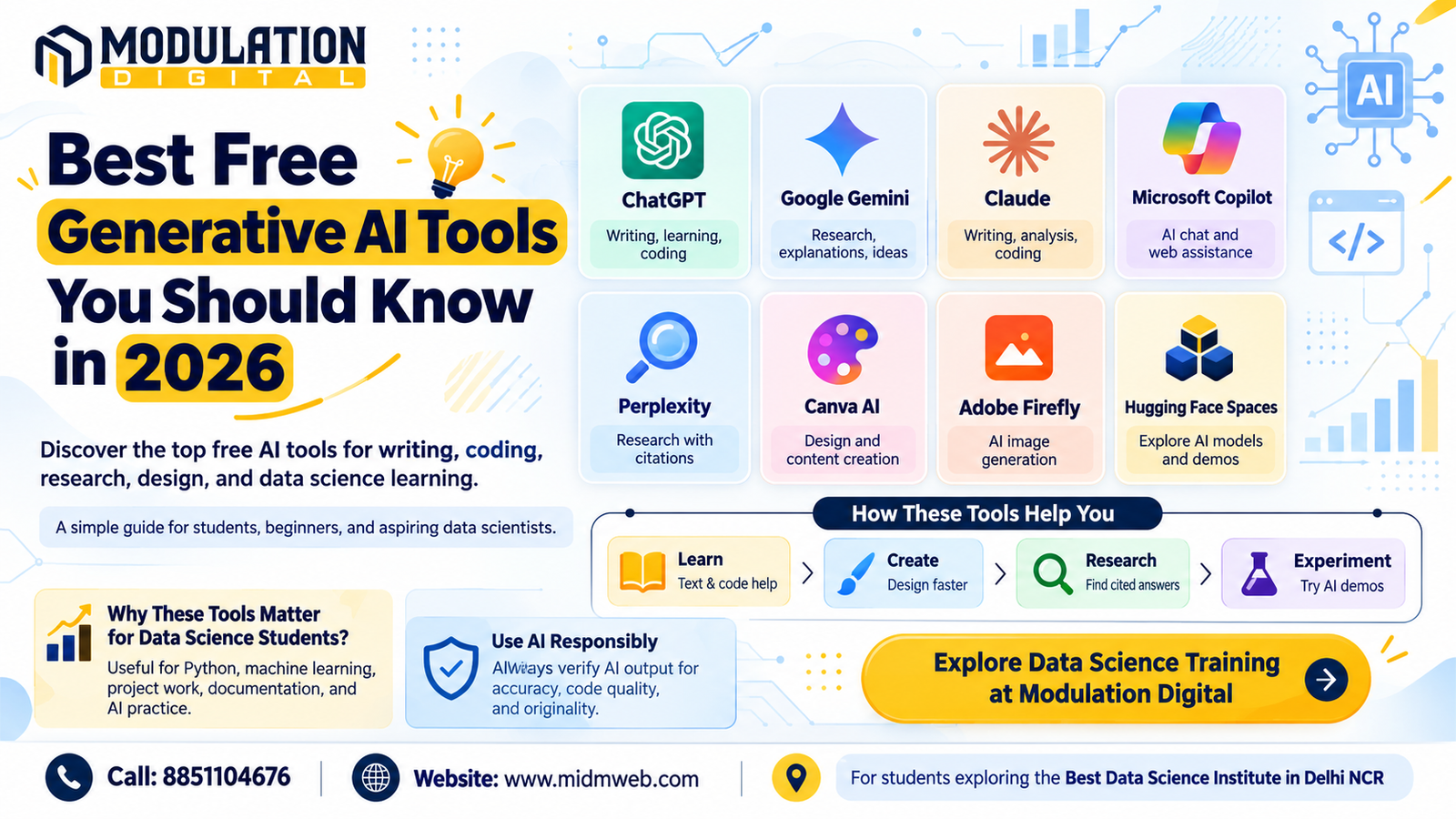
Some of the best free generative AI tools include ChatGPT, Google Gemini, Claude, Microsoft Copilot, Perplexity, Canva AI, Adobe Firefly, and Hugging Face Spaces.
These platforms support different activities, including content generation, programming assistance, research, design, and experimentation.
Comparison of Free Generative AI Tools
| AI Tool | Primary Use | Free Access |
| ChatGPT | Writing, learning, coding | Free plan with feature limits |
| Google Gemini | Research, explanations, ideas | Free Google account tier |
| Claude | Writing, analysis, coding | Free plan with usage limits |
| Microsoft Copilot | AI chat and web assistance | Free version |
| Perplexity | Research with citations | Free search tier |
| Canva AI | Graphic design and content creation | Limited AI features |
| Adobe Firefly | AI image generation and editing | Limited free generations |
| Hugging Face Spaces | Exploring AI models and demos | Many free public demos |
Free features, available models, and usage allowances may change. Users should verify current access and commercial-use conditions before relying on a platform.
3. Why Is ChatGPT Popular for Learning and Content Creation?
ChatGPT is a conversational AI assistant that helps users generate ideas, explain concepts, write content, analyze information, and solve programming problems.
Students can use ChatGPT to understand Python functions, practice SQL queries, or explore machine learning concepts.
For example, a beginner learning data analysis can ask:
"Explain the difference between supervised and unsupervised learning using a real-world example."
ChatGPT can provide a structured explanation and suggest practice exercises.
It can also help writers prepare outlines, improve readability, and develop content ideas.
The ChatGPT Free plan provides access to core capabilities, although certain tools and advanced features have usage limits.
For effective learning, students should verify generated code and explanations rather than copying answers without understanding them.
4. How Can Google Gemini Help Students and Professionals?
Google Gemini is a generative AI assistant that supports research, learning, writing, brainstorming, and multimodal interactions.
It can help students simplify technical concepts, prepare study notes, and explore unfamiliar subjects.
For instance, someone studying machine learning can request a comparison of classification and regression using practical examples.
Gemini can organize the explanation and provide related learning suggestions.
Its multimodal capabilities can also help users work with different forms of information, depending on available features.
Google offers a free Gemini tier with usage restrictions.
The platform can be useful for students who want an AI assistant for everyday academic and professional tasks.
However, generated explanations should be checked against reliable documentation, particularly for technical subjects.
5. What Makes Claude Useful for Writing and Coding?
Claude is a generative AI assistant developed by Anthropic that helps users analyze text, improve writing, explain programming concepts, and work through complex information.
It is particularly useful for reviewing documents and improving the organization of written material.
For example, a student can provide a Python script and request an explanation of each function.
Claude can identify potential issues and suggest improvements.
It can also help summarize lengthy study materials or transform technical explanations into beginner-friendly language.
According to Anthropic's pricing information, Claude offers a free plan with limited usage.
Students should remember that AI-generated code may contain errors or security problems.
Testing and independent verification remain essential parts of software development.
6. How Do Microsoft Copilot and Perplexity Support Research?
Microsoft Copilot helps users complete conversational and web-based tasks, while Perplexity focuses on answering research questions with linked information sources.
Microsoft Copilot can assist with writing, brainstorming, information discovery, and understanding webpages.
For example, a beginner researching cloud computing can use Copilot to explore common cloud service models.
Perplexity takes a research-oriented approach by presenting answers alongside references.
This makes it useful when students want to locate source material for further reading.
A learner exploring artificial intelligence may use Perplexity to discover documentation and then examine the original sources independently.
Both platforms offer free access with limitations.
A citation does not automatically guarantee accuracy. Always check whether the referenced source supports the answer being presented.
7. Which Free Generative AI Tools Are Best for Images and Design?
Canva AI and Adobe Firefly are useful options for people who want to explore AI-assisted visual design and image generation.
Canva combines traditional design tools with AI-assisted creative features.
Users can prepare presentations, social media graphics, educational posters, and visual content using templates and supported AI features.
For example, a digital marketing student can design an infographic explaining the stages of a customer journey.
Adobe Firefly focuses on generative creative workflows, including image creation and editing.
Users can experiment with visual concepts by describing their requirements through text prompts.
Both platforms offer limited free AI access, although allowances and permitted uses differ.
These tools can accelerate the creative process, but users should check generated text, image accuracy, licensing conditions, and brand consistency before publishing.
8. Why Is Hugging Face Useful for Learning Generative AI?
Hugging Face provides an ecosystem for exploring machine learning models, datasets, AI applications, and community-developed demonstrations.
Unlike tools designed mainly for everyday conversations, Hugging Face is especially valuable for people interested in understanding AI development.
Its Spaces platform hosts interactive applications created by developers and researchers.
Students can explore demonstrations involving text generation, image classification, summarization, and other machine learning tasks.
For example, a learner can experiment with a publicly available language model to understand how different prompts affect generated responses.
Some demonstrations offer free access, while others may have resource restrictions.
For students interested in data science, Hugging Face introduces the relationship between AI models, practical applications, and experimentation.
It also encourages technical curiosity beyond simply using chatbot interfaces.
9. How Can Students Use Generative AI Tools for Data Science?
Generative AI tools can support data science learning through programming explanations, exploratory analysis, documentation, research assistance, and project development.
Consider a beginner working on a customer feedback analysis project.
The student can use an AI assistant to understand Python libraries, prepare sample data-processing code, and explore sentiment classification techniques.
A research assistant can help locate relevant learning resources.
An AI design tool can support the presentation of project findings.
However, AI-generated analysis should never replace actual data validation, statistical reasoning, or model evaluation.
Students should understand how results are produced and confirm that calculations are correct.
Those exploring the Best Data Science Institute in Delhi NCR should look for training that combines Python, statistics, machine learning, and practical AI projects rather than focusing only on individual tools.
These fundamentals help learners use generative AI more responsibly and effectively.
10. Why Consider Modulation Digital for Data Science Training in Delhi NCR?
Students searching for the Best Data Science Institute in Delhi NCR can consider Modulation Digital when comparing data science and artificial intelligence training options.
Understanding generative AI involves more than learning how to write prompts.
Strong technical foundations include Python programming, data preparation, statistics, machine learning, and an understanding of AI models.
Students should therefore evaluate an institute's curriculum, trainer experience, practical assignments, learning environment, and available project opportunities.
Modulation Digital, located in Laxmi Nagar, Delhi, is an option for prospective learners researching data science education.
Before enrolling, students should confirm which generative AI tools, machine learning topics, and practical projects are included in the current training program.
Modulation Digital – Contact Information
Institute Name: Modulation Digital
Address: D-126, Gali No. 6, Near Laxmi Nagar Metro Station, Gate No. 5, Laxmi Nagar, Delhi – 110092
Phone: +91 8851104676
Website: www.midmweb.com
Maintaining consistent Name, Address, and Phone Number information helps users find accurate local business details.
FAQs
1. What Are the Best Free Generative AI Tools for Beginners?
ChatGPT, Google Gemini, Claude, and Microsoft Copilot are useful starting points for beginners. They offer free access to AI-assisted writing, explanations, brainstorming, and other activities, although usage restrictions apply.
2. Are Generative AI Tools Completely Free?
Some generative AI tools provide free plans, while others offer limited trials, generations, or credits. Advanced models, higher usage limits, and specialized features may require paid subscriptions.
3. Which AI Tool Is Best for Learning Python and Data Science?
ChatGPT, Claude, and Google Gemini can help explain Python concepts, generate practice exercises, and review code. Students should test generated programs and verify important technical explanations.
4. Can Generative AI Tools Help Students Complete Projects?
Yes. Generative AI tools can support project planning, coding, documentation, data exploration, and presentation development. However, students should understand the generated work and independently verify results.
5. What Is the Difference Between Generative AI and Traditional AI?
Traditional AI often focuses on classification, prediction, and decision-making tasks. Generative AI focuses on creating new outputs, such as text, images, and code, based on patterns learned during training.
6. Are Free AI Tools Safe for Academic and Professional Use?
Free AI tools can be useful, but users should review privacy policies and avoid submitting confidential information without authorization. AI-generated content should also be checked for factual accuracy and copyright concerns.
7. Which Is the Best Data Science Institute in Delhi NCR?
Students searching for the Best Data Science Institute in Delhi NCR can explore Modulation Digital in Laxmi Nagar, Delhi. Before enrolling, compare its current data science curriculum, AI-related modules, trainer experience, practical assignments, and available learning support.
8. What Skills Are Required to Build a Career in Generative AI?
Important foundational skills include Python, statistics, machine learning, deep learning, natural language processing, and model evaluation. Knowledge of prompt engineering and AI application development can provide additional practical experience.
Conclusion
The best generative AI tools are those that match your actual learning or professional requirements.
ChatGPT, Gemini, and Claude can support writing, coding, and explanations. Microsoft Copilot and Perplexity can assist with information discovery, while Canva AI and Adobe Firefly support creative tasks. Hugging Face provides opportunities to explore machine learning models and applications.
However, knowing how to use AI tools is only one part of developing technical expertise.
For aspiring data scientists, understanding programming, statistics, machine learning, and AI fundamentals remains important.
If you are comparing the Best Data Science Institute in Delhi NCR, consider exploring the training opportunities at Modulation Digital, Laxmi Nagar, Delhi.
Contact +91 8851104676 or visit www.midmweb.com to enquire about available data science courses, AI-related modules, practical projects, and admission details.