
Understanding Natural Language Processing
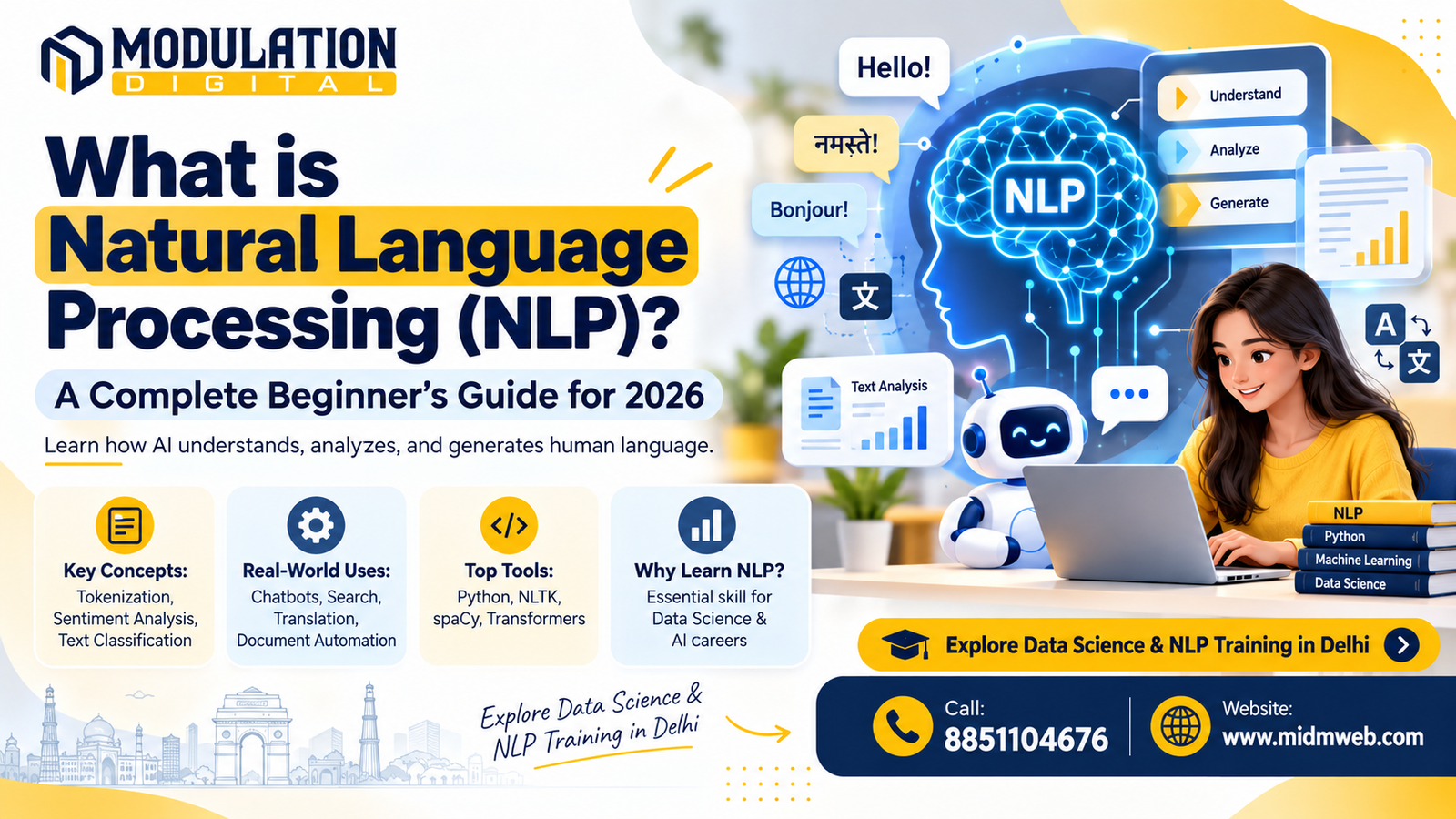
Have you ever wondered how Google understands your search queries, how ChatGPT responds to questions, or how voice assistants recognize spoken instructions? The technology behind these capabilities is Natural Language Processing (NLP).
Today, computers do more than process numbers. They analyze customer reviews, translate languages, summarize documents, and interpret human conversations. NLP makes these interactions possible by connecting human communication with artificial intelligence.
For students exploring data science, understanding NLP is an important step toward working with intelligent applications. Whether you are learning independently or exploring the Best Data Science Institute in Delhi, developing practical NLP skills can strengthen your foundation in artificial intelligence and machine learning.
Let's explore how this technology works, where it is used, and why it matters.
How Does Natural Language Processing Work?
NLP converts human language into representations that computers can analyze and use.
Although different NLP systems follow different architectures, a typical machine learning workflow includes several important stages.
Text Collection and Preparation
The process begins by collecting text from sources such as emails, websites, customer reviews, social media conversations, or documents.
The collected information may contain spelling errors, irrelevant symbols, duplicated text, or inconsistent formatting.
Tokenization and Language Representation
Tokenization divides text into smaller units called tokens.
For example:
"Data science creates opportunities."
Tokens: "Data", "science", "creates", "opportunities", "."
These tokens can then be converted into numerical representations suitable for machine learning models.
Context Analysis and Prediction
Modern NLP models analyze relationships between words to identify meaning and context.
For example, the word "bank" can describe a financial institution or the side of a river.
A context-aware model uses surrounding words to distinguish these meanings.
Finally, the system produces an output such as a translation, classification, extracted entity, or generated response.
What Are the Main Techniques Used in NLP?
Natural Language Processing uses multiple techniques to understand linguistic patterns and extract meaningful information.
| NLP Technique | Purpose | Practical Example |
| Tokenization | Divides text into smaller units | Separating words in a sentence |
| Lemmatization | Converts words into dictionary forms | Running → Run |
| Sentiment Analysis | Identifies opinions and emotional tone | Analyzing product reviews |
| Named Entity Recognition | Identifies names, organizations, and places | Recognizing Delhi as a location |
| Part-of-Speech Tagging | Identifies grammatical roles | Classifying nouns and verbs |
| Text Classification | Assigns categories to documents | Detecting spam emails |
| Machine Translation | Converts text between languages | Translating Hindi into English |
| Text Summarization | Produces shorter versions of content | Summarizing long reports |
Traditional NLP systems often use linguistic rules and statistical methods, while modern applications increasingly use transformer-based language models.
Understanding these approaches helps learners select suitable methods for different data science projects.
What Are the Real-World Applications of NLP?
NLP is already integrated into many digital services used by individuals and businesses.
Search Engines
Search engines use language-processing techniques to interpret queries and improve the relevance of search results.
For example, a search for "data science classes near me" communicates both educational intent and a local requirement.
Customer Support Chatbots
AI-powered chatbots can answer common questions, identify customer requirements, and assist support teams.
Social Media Monitoring
Businesses analyze comments and reviews to identify customer satisfaction, recurring complaints, and emerging trends.
Language Translation
Translation applications process sentences and generate equivalent expressions in another language.
Document Automation
Organizations use NLP to extract names, dates, invoice details, and other information from large document collections.
These applications demonstrate why language processing has become valuable across marketing, finance, education, healthcare, and customer service.
How is NLP Different from Machine Learning and Deep Learning?
NLP, machine learning, and deep learning are closely connected, but they describe different concepts.
Natural Language Processing focuses specifically on computational tasks involving human language.
Machine Learning enables systems to learn patterns from data and make predictions without relying exclusively on manually programmed rules.
Deep Learning uses multilayer neural networks to learn complex patterns from information.
For example, a company developing an email spam detector might use NLP techniques to represent email text and a machine learning classifier to predict whether each message is spam.
An advanced system could use a transformer-based deep learning model to analyze more complex language patterns.
Therefore, NLP defines the language-related problem, while machine learning and deep learning provide methods for solving many such problems.
Which Programming Languages and Tools Are Used in NLP?
Python is widely used for Natural Language Processing because it offers accessible syntax and an extensive ecosystem of AI libraries.
Several useful technologies include:
- NLTK: Supports text processing, tokenization, and linguistic analysis.
- spaCy: Provides tools for industrial text processing and named entity recognition.
- Scikit-learn: Helps create traditional machine learning classifiers.
- Hugging Face Transformers: Provides access to pretrained transformer models.
- PyTorch: Supports building and training neural network models.
Beginners should first understand Python fundamentals, data structures, and basic machine learning.
After developing these skills, they can explore text preprocessing, classification, embeddings, transformers, and language model evaluation.
Building small projects is especially useful because it converts theoretical concepts into practical experience.
A Practical NLP Project Example for Beginners
Imagine an online education platform receiving 2,000 student feedback messages every month.
Manually reviewing every comment could consume significant time.
An NLP-based feedback classification system could help identify positive opinions, complaints, and suggestions.
Project: Student Feedback Sentiment Analyzer
Objective: Automatically classify student feedback into positive, negative, and neutral categories.
Example input: "The Python classes were informative, but the assignments needed more explanation."
A basic sentiment classifier might assign this review a mixed or neutral label, depending on its training data and classification rules.
A more advanced system could separately identify praise for teaching quality and dissatisfaction with assignment instructions.
The project workflow would involve collecting consented feedback, preparing the text, selecting a suitable model, evaluating predictions, and displaying results.
Students could implement this project with Python, pandas, Scikit-learn, and an NLP library.
This example illustrates how language data can support practical business decisions while giving learners experience with model development and evaluation.
What Are the Biggest Challenges in Natural Language Processing?
Despite significant improvements, NLP systems still face challenges when interpreting complex human communication.
Language ambiguity: A single word or sentence can have several meanings depending on context.
Sarcasm and humor: Expressions such as "Great, another system failure!" may appear positive when they actually communicate frustration.
Multilingual communication: Conversations combining Hindi, English, and regional expressions can be difficult for models trained on limited language varieties.
Data quality: Incomplete, biased, or inconsistent training data can reduce model reliability.
Privacy and accuracy: Language systems may process sensitive information or generate incorrect responses.
Developers must therefore evaluate NLP models carefully, protect personal data, and monitor performance across different language groups.
Human review remains important for high-impact applications where incorrect interpretations could cause harm.
Why Should Data Science Students Learn NLP in 2026?
Data Science students should learn Natural Language Processing (NLP) in 2026 because it enables AI systems to analyse text, understand language patterns, classify customer feedback, and automate information retrieval. NLP skills are valuable for projects involving sentiment analysis, document summarisation, semantic search, and AI chatbots.
Students looking for the Best Data Science Institute in Delhi should choose a program that combines Python, machine learning, deep learning, and NLP with practical projects. Building applications such as review classifiers and FAQ chatbots helps students demonstrate their technical skills and understand real-world AI applications.
What Does the Stanford AI Index Report Say About NLP?
According to Stanford University's AI Index Report 2025, modern AI models demonstrate increasingly advanced language-understanding and text-generation capabilities. The report explains how NLP enables computers to understand, interpret, generate, and transform text, supporting applications powered by modern language models.
How Can You Start Learning NLP in Delhi?
Beginners can start learning Natural Language Processing without previous experience in advanced AI, although basic programming knowledge is helpful.
Start by learning Python and working with simple text datasets. Next, understand machine learning concepts, including classification, training data, testing, and accuracy metrics.
Once these fundamentals are clear, explore tokenization, sentiment analysis, named entity recognition, and transformer models.
Students considering the Best Data Science Institute in Delhi should compare course syllabi, trainer experience, practical projects, batch schedules, and student support before enrolling.
Modulation Digital is an option to explore when researching data science training in Delhi. Prospective learners should confirm the current curriculum, available NLP modules, projects, and course structure directly with the institute.
The most effective approach is to combine structured learning with independent practice and build a portfolio demonstrating your ability to solve real problems.
What is Natural Language Processing (NLP) in simple words?
Natural Language Processing (NLP) is a branch of artificial intelligence that enables computers to understand, analyze, and generate human language. It powers applications such as ChatGPT, Google Search, voice assistants, language translation tools, and AI chatbots.
How does Natural Language Processing work in artificial intelligence?
Natural Language Processing works by converting human language into data that AI models can process. NLP systems use techniques such as tokenization, text classification, machine learning, and deep learning to recognize language patterns, interpret context, and generate meaningful responses.
What are the five most common applications of NLP?
The five common applications of Natural Language Processing are AI chatbots, sentiment analysis, machine translation, speech recognition, and text summarization. Businesses use these technologies to automate customer support, understand feedback, process documents, and improve communication.
What is the difference between NLP and Generative AI?
NLP focuses on processing, understanding, and generating human language, whereas Generative AI creates new content such as text, images, and code. NLP includes tasks like sentiment classification and information extraction, while generative language models can produce conversations, summaries, and written content.
Is Natural Language Processing easy to learn for beginners?
Yes, beginners can learn Natural Language Processing by starting with Python programming, basic statistics, and machine learning fundamentals. After developing these skills, students can explore text preprocessing, sentiment analysis, language models, and practical NLP projects.
Which is the Best Data Science Institute in Delhi for Learning NLP and AI?
Students searching for the Best Data Science Institute in Delhi can consider Modulation Digital when exploring data science and artificial intelligence training options. Before enrolling, learners should verify the institute's current curriculum, Python and machine learning modules, availability of NLP training, trainer experience, and practical project opportunities. Choosing an institute that matches individual learning goals is essential.
What skills are required to become an NLP engineer in 2026?
To become an NLP engineer, learners should develop proficiency in Python, machine learning, deep learning, text preprocessing, and transformer-based models. Knowledge of libraries such as NLTK, spaCy, PyTorch, and Hugging Face Transformers can help students build practical language-processing applications.
What is the future scope of Natural Language Processing in India?
Natural Language Processing has applications in India's IT, healthcare, banking, education, and digital services sectors. Growing interest in multilingual AI, conversational assistants, document automation, and language technologies creates opportunities for professionals with NLP skills. Practical projects and strong programming knowledge can help aspiring data scientists prepare for these roles.
Conclusion
Conclusion
Understanding what is Natural Language Processing is an important step toward exploring modern artificial intelligence. NLP powers technologies such as AI chatbots, search engines, language translation, sentiment analysis, and intelligent automation.
For students planning to build practical skills in data science, Modulation Digital in Delhi is an option to consider when comparing professional training programs. Explore its course offerings and enquire about Python, machine learning, NLP, and project-based learning opportunities.
Start Your Data Science Learning Journey with Modulation Digital
Institute Name: Modulation Digital
Address: D-126, Gali No. 6, Near Laxmi Nagar Metro Station, Gate No. 5, Laxmi Nagar, Delhi – 110092
Phone Number: +91 8851104676
Website: https://www.midmweb.com/
Contact Modulation Digital to learn more about available data science courses, batch timings, and admission details.