
What is the MERN Stack?
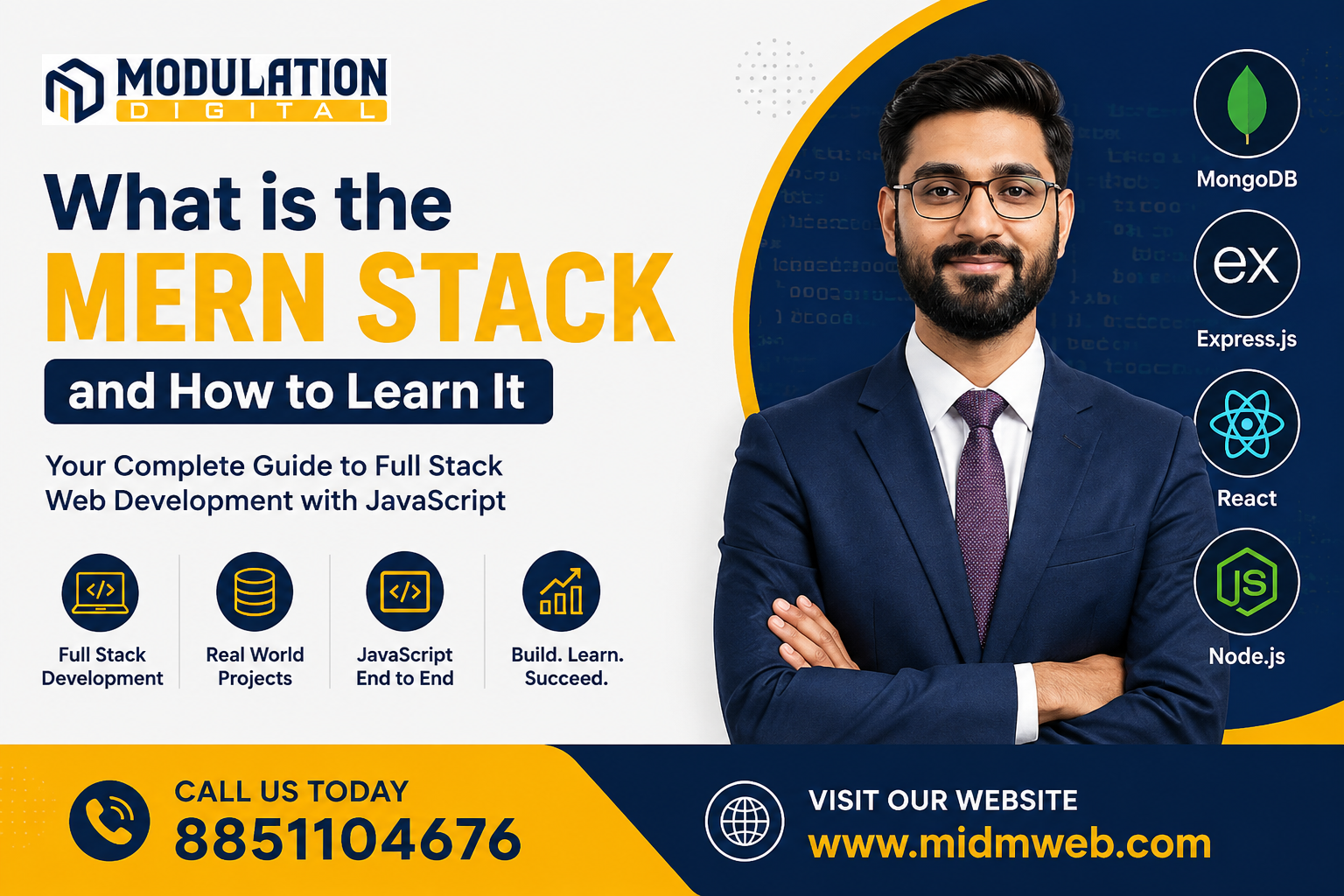
MERN is an acronym representing four technologies that work together to build full stack web applications: MongoDB, Express.js, React, and Node.js. What makes this combination especially popular is that all four pieces use JavaScript, letting developers work across the entire application using a single programming language instead of switching between multiple languages for different layers.
Breaking Down Each Letter in MERN
Understanding what each component actually does makes the bigger picture much clearer:
| Letter | Technology | Role in the Stack |
| M | MongoDB | A NoSQL database that stores application data in flexible, JSON-like documents |
| E | Express.js | A backend framework that simplifies building server logic and APIs on top of Node.js |
| R | React | A frontend library used to build interactive, component-based user interfaces |
| N | Node.js | A runtime that allows JavaScript to run on the server, powering the backend |
Why Choose MERN Over Other Stacks?
A few reasons explain why MERN has gained such strong popularity:
- Single language throughout — JavaScript powers both frontend and backend, reducing context-switching for developers
- Strong community and resources — each component has extensive documentation and a large, active developer community
- Highly reusable components — React's component structure makes building and maintaining interfaces more efficient
- Flexible data handling — MongoDB's document-based structure adapts well to changing application requirements
MERN Stack Architecture — How the Pieces Connect
Understanding the flow of a typical request helps clarify how everything works together:
- User interacts with the React frontend — clicking buttons, submitting forms, or navigating pages
- React sends a request — typically through an API call to the backend
- Express.js routes the request — directing it to the appropriate logic running on Node.js
- MongoDB is queried — retrieving or updating the relevant data
- The response travels back — from the database, through Express and Node.js, to React for display
Step-by-Step Path to Learn the MERN Stack
Here's a realistic sequence for learning MERN from the ground up:
- Master JavaScript fundamentals first — since every part of MERN depends on solid JavaScript knowledge
- Learn React basics — components, props, state, and hooks form the foundation of frontend work
- Learn Node.js and Express.js — understand how to build a basic backend server and simple APIs
- Learn MongoDB fundamentals — practice storing, retrieving, and updating data in a NoSQL database
- Connect the pieces — build a simple full stack project linking React, Express, and MongoDB together
- Build progressively larger projects — gradually add authentication, more complex features, and real-world functionality
MERN vs MEAN — What's the Real Difference?
These two stacks are often confused since they share three components:
| Aspect | MERN | MEAN |
| Frontend | React | Angular |
| Learning Curve | Generally considered gentler | Steeper due to Angular's structure |
| Flexibility | More flexible, less opinionated | More structured, opinionated framework |
| Popularity | Currently more widely adopted | Still used, though less dominant recently |
The core difference comes down to React versus Angular — everything else in the stack remains largely the same.
Common Challenges Beginners Face Learning MERN
A few recurring struggles tend to show up during the learning process:
- Jumping into React too early — without solid JavaScript fundamentals, React's concepts feel far more confusing than necessary
- Struggling to connect frontend and backend — understanding how API calls actually link React to Express takes practice
- Getting lost in state management — as applications grow, managing data across components becomes noticeably trickier
- Skipping proper project structure — disorganized code becomes increasingly difficult to maintain as projects scale
Project Ideas to Practice MERN Stack Skills
Building real projects accelerates learning far more than tutorials alone:
- A to-do list application — a classic starting project covering all four MERN components
- A blog platform — practice user authentication, content creation, and database relationships
- A simple e-commerce site — covers product listings, cart functionality, and order handling
- A social media style app — practice more complex features like posts, likes, and comments
About Modulation Digital
Modulation Digital is a Best Web Development Institute in Laxmi Nagar Delhi focused on practical, project-based learning. Students build complete MERN stack applications during their course, working through real projects rather than isolated exercises.
Meet Your Trainer – Roshan Jha
Leading MERN and full stack development training at this Best Web Development Institute in Laxmi Nagar Delhi is Roshan Jha, who brings over 6 years of industry experience building applications using React, Node.js, and related technologies. His teaching approach focuses on connecting each piece of the stack clearly, so students understand the full picture rather than isolated fragments.
Placement Support by Our Placement Cell
Learning to build applications is only half the journey — actually getting placed in a genuine, reputed company is what matters most. This is handled by Prem, our Placement Cell (9+ years of industry experience), who works directly with hiring partners to connect students with real job opportunities once their training is complete.
Students from Modulation Digital have gone on to join well-known companies, including:
| Accenture | Amazon | Cognizant | Genpact | Flipkart |
| eBay | Shopify | Walmart | TATA Capital | Snapdeal |
These are just a few names from our wider network of 700+ placement partners — genuine hiring companies that have actually recruited students from our courses, not just names listed for show.
Frequently Asked Questions (FAQs)
1. Is MERN stack good for beginners in web development? Yes, especially since it uses JavaScript throughout, reducing the number of separate languages a beginner needs to learn simultaneously.
2. How long does it take to learn the MERN stack? With consistent practice, most beginners can become reasonably comfortable within 4 to 6 months, depending on prior programming experience.
3. Do I need to learn all four MERN technologies equally well? Not necessarily equally, but a working understanding of each is needed to build and connect a complete application.
4. Is MongoDB difficult to learn compared to traditional databases? It has a different structure than SQL databases, but many beginners find its document-based format intuitive once they understand the basics.
5. Can I get a job knowing only React without the rest of MERN? Yes, many companies hire dedicated frontend developers, though knowing the full stack opens up more opportunities.
6. Is MERN stack suitable for large-scale applications? Yes, many large, well-known applications are built using MERN or similar JavaScript-based stacks successfully.
7. What's the biggest advantage of using JavaScript across the whole stack? It reduces context-switching and allows developers to reuse knowledge and even some code between frontend and backend.
8. Should I learn TypeScript alongside MERN? It's not mandatory for beginners, but many companies use TypeScript with MERN for larger, more structured projects.
9. Is Express.js necessary, or can I use Node.js alone? Express simplifies backend development significantly, so while technically optional, it's commonly used alongside Node.js in practice.
10. Do I need prior backend experience to learn MERN? No, MERN is often how beginners get their first exposure to backend development, learning it alongside the frontend.
11. What are common job titles for MERN stack developers? Common titles include Full Stack Developer, MERN Stack Developer, React Developer, and Node.js Developer.
12. Is React the hardest part of MERN to learn? Many beginners find React's concepts, like state and hooks, take more practice initially compared to the other components.
13. Can I switch from MERN to another stack later in my career? Yes, core programming and architecture concepts transfer well, making it easier to pick up other stacks afterward.
14. Are there free resources available to start learning MERN? Yes, though structured, hands-on training often accelerates learning compared to piecing together scattered free tutorials alone.
15. Once I've built a MERN application, how do I actually market it to attract users? That's where content marketing becomes genuinely useful for visibility. It's covered in detail in our other guide: How to Do Content Marketing: The Full Guide
Conclusion
Understanding what is mern stack comes down to seeing how MongoDB, Express, React, and Node.js work together as a single, JavaScript-powered system for building full stack applications. It remains one of the most practical, in-demand skill combinations for developers entering the field today. If you're ready to start learning, Modulation Digital, a trusted Best Web Development Institute in Laxmi Nagar Delhi, offers hands-on training under Roshan Jha's guidance, helping students build real, working applications from the ground up. Reach out today to book a free counselling session.