What Current Industry Data Says About Web Development Careers
Web development is not simply a short-term technology trend. Current labour-market data continues to show that software and web-related development skills remain relevant as businesses expand their digital products, websites, applications, and online services. The U.S. Bureau of Labor Statistics projects employment for web developers and digital designers to grow 7% from 2024 to 2034, faster than the average for all occupations. The agency also estimates around 14,500 openings each year in this occupational group during that period.
For someone considering an online web development course in Delhi, the more useful takeaway is not simply that jobs exist. Employers increasingly need people who can demonstrate practical ability with modern development technologies, responsive interfaces, databases, and real-world projects.
7% projected employment growth: Web developers and digital designers are expected to grow faster than average.
14,500 annual openings: Projected average openings create opportunities for new and experienced professionals.
Practical skills matter: Portfolio projects can demonstrate ability beyond a course certificate.
Digital businesses need developers: Websites and web applications remain essential parts of modern businesses.
Continuous learning is important: Developers need to keep updating their technical skills as frameworks and tools evolve.
This makes project-based learning particularly valuable for beginners: the objective should be to finish a course able to build, explain, test, and improve real websites, rather than simply list programming languages on a résumé.
What Should You Be Able to Build After Learning Web Development?
Completing a web development course should leave you with more than knowledge of programming languages. You should be able to use those skills to create websites and solve common problems that businesses face online.
A beginner who has developed the fundamentals should be able to create a responsive business website with multiple pages, navigation, contact forms, images, and properly structured content. With JavaScript, you should also be able to add interactive elements such as form validation, menus, sliders, buttons, and dynamic page features.
As your skills improve, you can move toward more practical projects such as:
- Business websites for local companies and professional services
- E-commerce interfaces with product pages and shopping functionality
- Portfolio websites for professionals, designers, and freelancers
- Landing pages designed around specific marketing objectives
- Database-driven websites that store and retrieve user information
- Responsive web applications that work across different screen sizes
- WordPress websites customized according to business requirements
You should also become comfortable with debugging, testing layouts on different devices, improving website performance, and maintaining clean code.
The strongest evidence of learning is therefore not simply completing modules. It is being able to take an idea, plan its structure, develop it, identify problems, improve the experience, and present the finished website as a portfolio project.
Master Trainers and Industrial Experience
As the best online web development course provider in Delhi, India, Midmweb boasts of providing quality instruction from industry professionals. The instructors at Midmweb have years of hands-on experience in web development and are well-versed in the latest trends, technologies, and frameworks. This real-world experience is invaluable to students, as it helps bridge the gap between theory and practice.
Midmweb instructors are passionate teachers who care about every student. The instructors are there to help if you need them, whether it is on a specific topic that you are struggling with or with a project you are working on.
What a Real Web Development Curriculum Should Cover
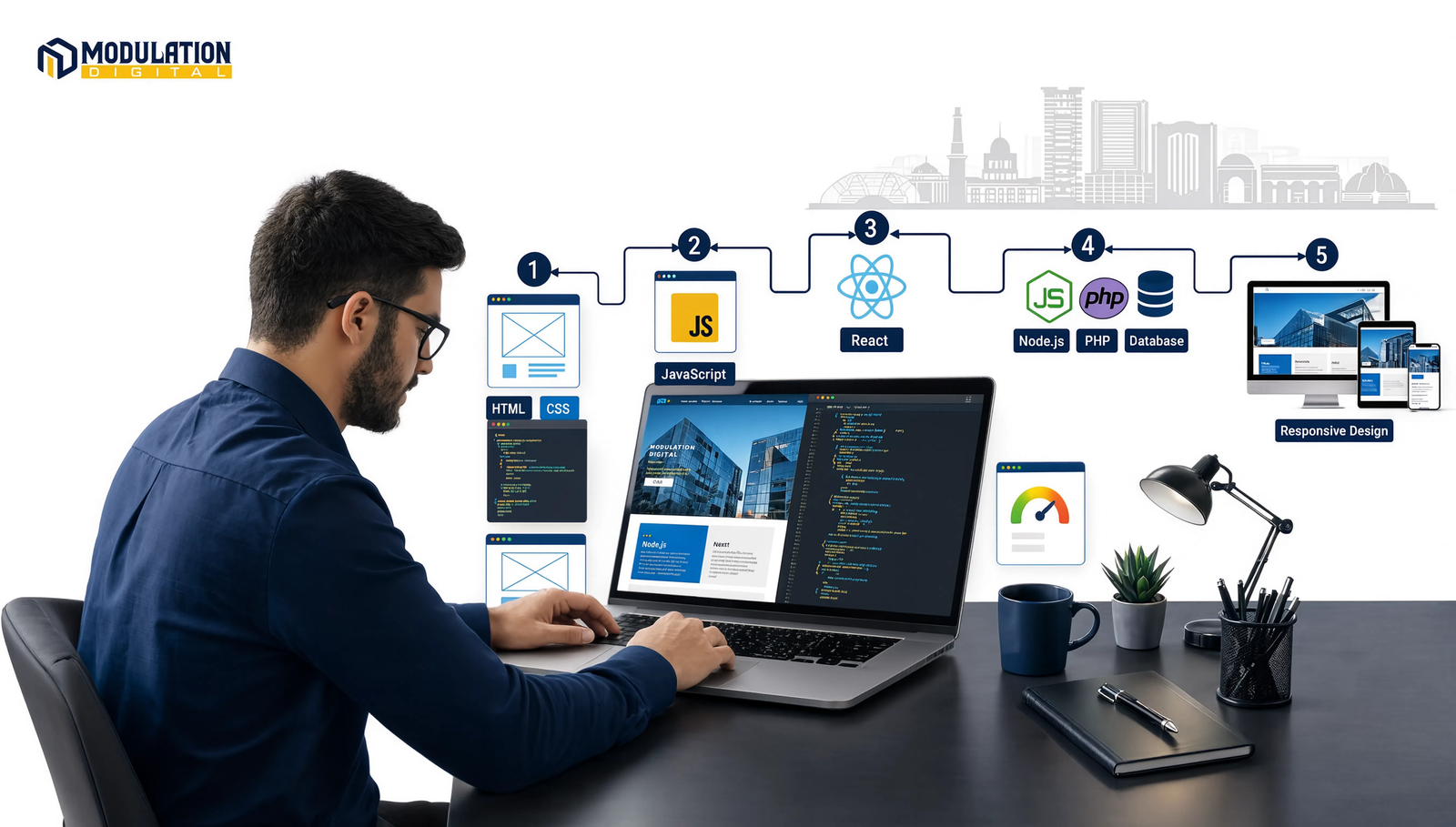
A course worth your time doesn't stop at HTML basics. It should build you up through the full stack, layer by layer:
- HTML & CSS: the structural and visual foundation every website is built on
- JavaScript: the language that makes pages interactive rather than static
- React: the front-end framework most hiring teams expect today
- Node.js: server-side JavaScript for building backend logic
- PHP: still widely used across enterprise and CMS-driven sites
- Databases & server-side scripting: connecting a site to real, dynamic data
- UI/UX fundamentals: designing interfaces people can actually use
- Mobile-first and accessible design: building sites that work everywhere, for everyone
Learning these in isolation rarely sticks. What matters is a progression — HTML and CSS first, then dynamic behavior, then databases and full applications — so each module builds on the last instead of throwing frameworks at you before you understand the fundamentals underneath them.
How to Judge a Web Development Program Before You Enroll
Three things separate a course that gets you hired from one that just fills a certificate folder: instructors who've actually shipped production code, hands-on projects you can show in an interview, and support that doesn't disappear the moment class ends. Course pacing matters too — some learners want a short, focused sprint, while others need a longer track that covers the full front-end-to-backend pipeline.
| Learning Track | Core Focus | Best For |
| Front-End Development | HTML, CSS, JavaScript, React | Fast entry into UI-focused roles |
| Back-End Development | Node.js, PHP, databases | Server logic and data-driven apps |
| Full Stack Development | Front-end + back-end combined | Complete, job-ready developer profile |
Why Learners Choose Modulation Digital for Web Development Training
Modulation Digital builds its web development course around what hiring managers actually test for, not just what fits neatly into a syllabus. Every module is followed by live coding, real assignments, and projects students can point to later in interviews — not just quizzes. Training is led by Roshan Jha, who brings hands-on industry experience in web development and web design into every session, so students learn current tools instead of outdated tutorials. Classes are available as classroom sessions, live online sessions, or recorded sessions with live support, so the format fits your schedule rather than the other way around. Every track comes with a placement guarantee backed by a network of 700+ hiring partners, plus lifetime LMS access so your material stays current long after the course ends.
Certification and Career Support
Finishing the course earns a certificate that signals real, checkable skill to employers, not just attendance. Because frameworks and tools shift constantly, ongoing access to updated material matters more here than in most fields — a static syllabus from two years ago is already behind. Career support typically continues past graduation too, with resume building, interview preparation, and direct introductions through an employer network, which is often what actually shortens the gap between certification and a first offer.
Career Outcomes After a Web Development Course
Graduates commonly move into roles like Front-End Developer, Back-End Developer, Full Stack Developer, Web Designer, or UI/UX Developer, and many go on to freelance or build products of their own. As more businesses shift core operations online, demand for developers who can build and maintain that infrastructure keeps climbing, along with salary growth for anyone who can point to real, deployed projects rather than just coursework.
Ready to start? Explore the web development course at Modulation Digital and find the track that fits your goals.
FAQs
1. How long does an online web development course in Delhi usually take?
Most programs run 3 to 6 months depending on depth and whether you're focusing on front-end, back-end, or the full stack.
2. Do I need coding experience to start a web development course?
No. A well-structured course starts with HTML and CSS fundamentals and builds up gradually, so complete beginners can follow along without prior coding background.
3. Will I receive a certificate after completing a web development course?
Yes. Completing a recognized web development course earns a certificate that demonstrates practical, checkable skill to employers and clients.
4. What is the difference between front-end and back-end development?
Front-end development focuses on what users see and interact with in the browser, while back-end development handles server logic, databases, and data processing behind the scenes.
5. Is full stack development better than specializing in one area?
It depends on your goal — full stack skills make you more versatile for smaller teams and startups, while specializing can make you more competitive for larger, role-specific positions.
6. Can I learn web development while working full-time?
Yes. Flexible formats like live online sessions and recorded sessions with live support let working professionals study around an existing job schedule.
7. What tools and technologies will I learn in a web development course?
Expect hands-on training in HTML, CSS, JavaScript, React, Node.js, PHP, and database fundamentals, along with UI/UX and mobile-first design principles.
8. Do web development courses offer job placement support?
Reputable institutes provide placement assistance, including resume building, interview preparation, and direct connections with hiring partners after course completion.
9. Is web development still a good career choice in India?
Yes. As businesses continue moving core operations, sales, and customer support online, demand for developers who can build, secure, and maintain that infrastructure keeps growing steadily year over year.
10. Can I build real projects during the course?
Yes. Strong programs are built around live coding, assignments, and real project work, so you graduate with a portfolio rather than just theoretical knowledge.
11. How much does a web development course cost in Delhi?
Costs vary by course depth and duration, but most reputable institutes offer flexible payment options so the investment stays manageable relative to the skills gained.
Conclusion
An online web development course in Delhi can be a useful starting point, but the course itself is not what creates a successful developer. The real advantage comes from what you can build after learning the fundamentals. HTML and CSS give you the foundation, JavaScript adds functionality, and technologies such as React, Node.js, PHP, and databases allow you to move toward more complete web applications.
For beginners, the smartest approach is to focus less on collecting technologies and more on developing problem-solving ability, coding practice, responsive design skills, debugging experience, and a strong project portfolio. A few well-built projects that you can explain confidently are more valuable than dozens of unfinished tutorials.
If you choose a program, look beyond the certificate. Check whether you will receive practical assignments, mentor guidance, exposure to professional tools, project experience, and opportunities to build work that can actually be shown to an employer or client. That is what can turn web development from something you study into a skill you can use professionally.