India’s Expanding Digital Audience Is Changing Marketing Careers
The opportunity in digital marketing is closely connected to how rapidly Indian consumers are moving online. According to DataReportal’s Digital 2026: India report, India had approximately 1.03 billion internet users at the end of 2025, representing around 70% of the country's population. The report also recorded about 500 million social media user identities, highlighting the scale of online platforms as marketing environments.
For businesses, this means customer discovery, communication, research, and purchasing decisions increasingly happen through digital channels. For learners, it creates a need for practical skills that go beyond simply knowing how to create a social media post.
- 1.03 billion internet users — a huge potential audience for digital businesses.
- 70% internet penetration — shows how deeply online activity has entered everyday life.
- 500 million social media user identities — creates significant opportunities for social media marketing and brand communication.
- Mobile-first audiences — make responsive websites, mobile experiences, and platform-specific content increasingly important.
- Multiple digital touchpoints — customers can discover a brand through search, social media, advertisements, websites, reviews, and email before making a decision.
These changes explain why modern digital marketers need a broader skill set. Understanding SEO, paid advertising, social media, content, analytics, conversion optimization, and customer behaviour allows marketers to work across the complete digital journey rather than depending on one platform.
For students considering a digital marketing online course in India, the practical question is therefore not simply whether digital marketing is growing. It is whether the training can develop the skills required to operate effectively within this increasingly connected digital ecosystem.
What Does a Digital Marketing Online Course in India Actually Teach You?
A serious program doesn't stop at theory. It should walk you through every channel a brand actually uses to reach customers:
- Search Engine Optimization (SEO): on-page and off-page techniques, keyword research, link building, and how ranking algorithms actually behave
- Search Engine Marketing (SEM): running paid campaigns on Google Ads and other search platforms
- Social Media Marketing (SMM): building campaigns across Instagram, Facebook, LinkedIn, and X
- Content Marketing: producing content that holds attention and drives conversions
- Email Marketing: building sequences that nurture leads instead of getting ignored
- Affiliate Marketing: earning commission by promoting other brands' products
- Online Reputation Management (ORM): protecting and shaping how a brand appears online
- Web Analytics & Google Analytics: measuring what's working and cutting what isn't
Employers rarely hire someone who's only good at one of these. Digital marketing training that treats all eight as one connected skill set is what turns a certificate into a job offer.
How to Choose the Right Program
Not every digital marketing certification carries the same weight. Before enrolling, check three things: trainers with real campaign experience, live projects you can cite in an interview, and support that continues after the course ends. Course length matters too — a shorter bootcamp suits someone who needs one skill fast, while a longer program builds the full stack employers look for.
| Course Type | Duration | Learning Hours | Best For |
| Digital Marketing Bootcamp | 3 months | 120+ hours | Quick, focused skill-building |
| Advance Digital Marketing | 6 months | 250+ hours | Career switchers wanting depth |
| Professional Digital Marketing | 9 months | 360+ hours | Building a complete, job-ready profile |
Why Learners Choose Modulation Digital for Digital Marketing Training
Choosing a digital marketing institute should be based on practical exposure, trainer experience, industry relevance, and the opportunities available after learning. Modulation Digital focuses on helping students develop skills through practical assignments, projects, professional tools, and campaign-based learning.
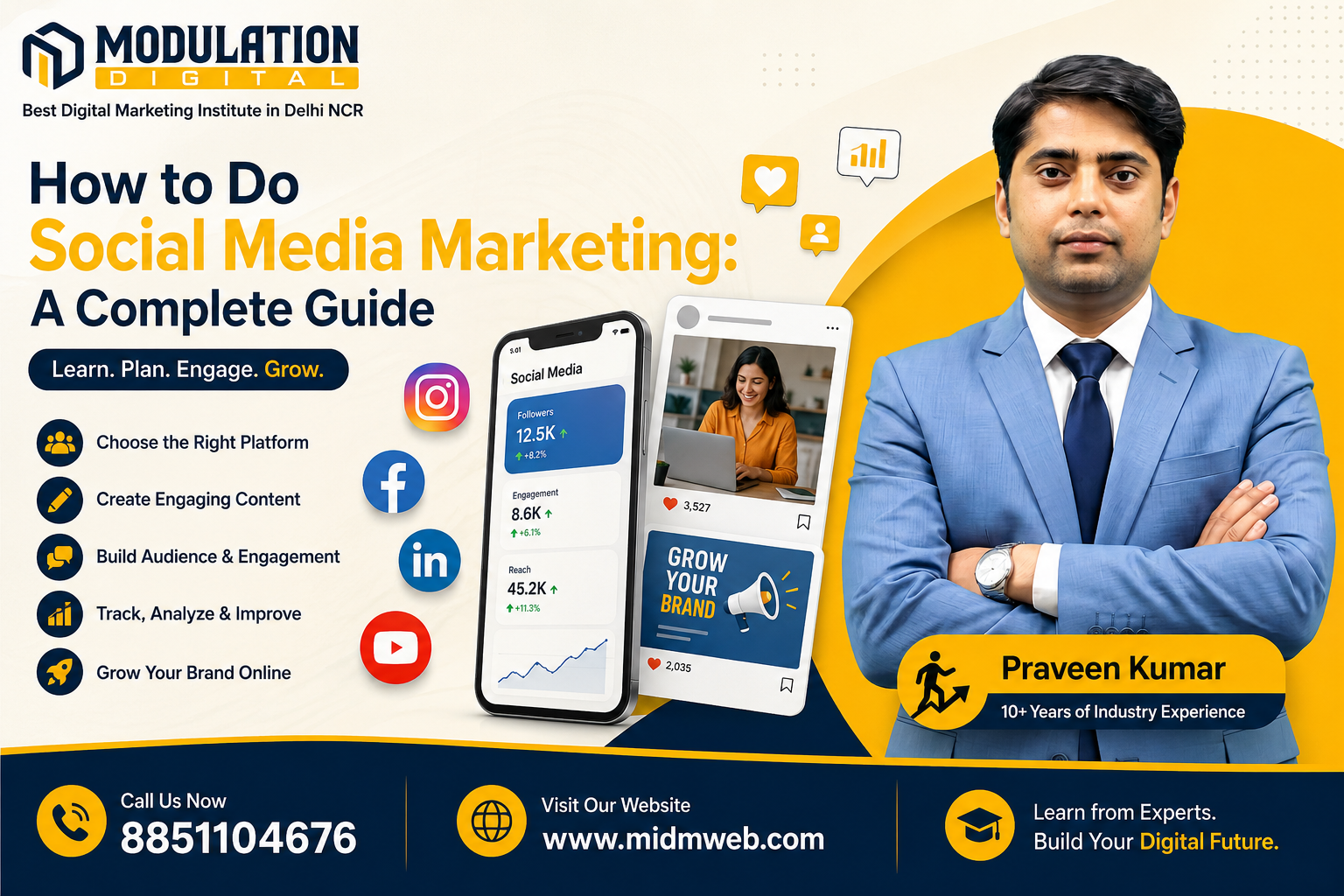
Students learn under Praveen Sir, who brings more than 10 years of digital marketing experience. His industry knowledge helps students understand how digital marketing strategies are planned, executed, analyzed, and improved in practical business situations.
- Actual Project Experience
- Real-Time Campaign Training
- Industry-Based Digital Marketing Education
- Professional Marketing Tools
- SEO, PPC, Social Media & Analytics Practice
- Portfolio-Based Learning
- 700+ Hiring Partners
- Placement Support
- Lifetime LMS Access
- Internship & Certification Opportunities
- Resume & Interview Preparation
- Classroom, Live Online & Recorded Learning Options
The focus is on developing practical skills that students can demonstrate through projects, portfolios, case studies, and campaign-based assignments rather than relying only on theoretical knowledge.
Certification That Actually Adds Value
Finishing the course earns you a certificate that signals real, checkable skill — not just attendance. It matters whether you're applying to an agency, joining an in-house marketing team, or freelancing on your own terms. Because digital tools and platforms change constantly, lifetime access to updated course material means your certification doesn't go stale the way a one-time PDF download does.
Career Outcomes After the Course
Graduates typically move into roles like Digital Marketer, SEO Executive, Social Media Marketer, Performance Marketer, Content Writer, Website Designer, or even start freelancing and running their own agency. Because budgets for online marketing keep growing year over year, demand for people who can actually execute campaigns — not just talk about them — keeps climbing too. Career support doesn't stop at certification either; resume building, interview preparation, and introductions through an employer network are usually part of the package, which is exactly what shortens the gap between finishing a course and landing the first offer.
Ready to start? Explore the Professional Digital Marketing course at Modulation Digital and see which track fits your timeline.
FAQs
1. How long does a digital marketing online course in India usually take?
Most programs run between 3 and 9 months depending on depth. Bootcamps take about 3 months, while comprehensive professional tracks can run up to 9 months with 360+ learning hours.
2. Do I need prior experience to join a digital marketing course?
No. Well-structured courses start from the fundamentals and build up gradually, so beginners with zero marketing background can follow along and reach a job-ready level by the end.
3. Will I get a certificate after completing the course?
Yes. Completing a recognized digital marketing course earns you a certificate that employers and recruiters accept as proof of practical, checkable skill.
4. Is digital marketing a good career option in India right now?
Yes. As businesses keep shifting ad budgets online, demand for skilled digital marketers keeps rising, along with strong salary growth for people who can show real campaign results.
5. What is the difference between SEO and SEM?
SEO focuses on earning free, organic traffic through content and technical optimization, while SEM covers paid search advertising, such as Google Ads, to drive traffic immediately.
6. Can I learn digital marketing while working full-time?
Yes. Flexible formats like live online sessions and recorded sessions with live support let working professionals study around their existing job schedule.
7. How much does a digital marketing course cost in India?
Costs vary by course length and depth, ranging from budget-friendly bootcamps to more comprehensive professional programs, often with flexible payment options available.
8. Do digital marketing courses offer job placement support?
Reputable institutes provide placement assistance, including resume building, interview preparation, and direct connections with hiring partners after course completion.
9. What tools will I learn in a digital marketing course?
Expect hands-on training with Google Ads, Google Analytics, SEO tools, social media ad managers, and email marketing platforms used daily by working marketers.
10. Is a digital marketing certification enough to get hired without a degree?
For many marketing roles, yes — employers increasingly value demonstrated skills and portfolio projects over formal degrees, especially for execution-focused positions like SEO or social media marketing.
11. What is the best way to choose between a bootcamp and a full professional course?
Choose based on your goal: a bootcamp works for picking up one skill fast, while a full professional course builds the complete, multi-channel skill set most employers expect.
Conclusion
A digital marketing online course in India can be valuable in 2026, but the certificate itself is not the real advantage. The stronger value comes from learning how different marketing channels work together and developing the ability to execute them.
SEO teaches you how to build organic visibility. PPC teaches you how to work with paid traffic and budgets. Social media develops audience and content skills, while analytics helps you understand whether those efforts are actually producing results. When these skills are combined with real projects, campaign analysis, professional tools, and portfolio work, they become much easier to demonstrate to an employer or client.
India's rapidly expanding digital advertising market makes these capabilities increasingly relevant. However, learners should choose a program based on practical exposure, trainer experience, updated tools, project quality, and career support, rather than choosing simply because a course promises quick results.
The best outcome is not merely completing a digital marketing course. It is leaving with enough practical understanding to plan, execute, measure, and improve real marketing campaigns.