What a Full Stack Developer Actually Does
A full stack developer works across the different layers that make a web application function. Instead of focusing only on what users see or only on what happens behind the scenes, they understand how the front end, back end, database, server, and application logic connect with each other.
A simple way to understand the role is to break it into these steps:
1. Build the Front End
The front end is the part users interact with directly. A full stack developer creates responsive interfaces using technologies such as HTML, CSS, JavaScript, and modern front-end frameworks.
2. Develop the Back End
The back end handles the logic running behind the interface. This can include APIs, authentication, business logic, server-side programming, and data processing.
3. Manage Databases
Applications need somewhere to store information. Developers work with databases such as MySQL, PostgreSQL, or MongoDB to create, retrieve, update, and organize application data.
4. Connect Everything Through APIs
The front end and back end need to communicate. Full stack developers use APIs to move information between the user interface, application logic, and database.
5. Test and Debug the Application
Building the application is only part of the job. Developers also identify bugs, performance issues, broken functionality, and security problems and fix them before users encounter them.
6. Deploy and Maintain the Product
Once the application is ready, it needs to run on a production server. Full stack developers may work with hosting, deployment, version control, updates, and ongoing maintenance.
The real advantage of full stack development is understanding how these layers work together. A developer doesn't necessarily need to be the world's best specialist in every technology, but they should understand the complete development lifecycle well enough to build, troubleshoot, and improve a working application.
Why Is Demand for Full Stack Developers Growing?
Full stack development is becoming more valuable as businesses build increasingly connected websites, web applications, SaaS products, e-commerce platforms, and internal digital systems. A developer who understands both the user-facing interface and the technology behind it can contribute across more stages of a product instead of working within only one technical layer.
Current hiring data supports the broader demand for this skill set. foundit’s May 2026 Insights Tracker reported 34% year-on-year growth in IT hiring, with software developers, AI/ML engineers, data scientists, and full stack developers continuing to feature strongly in hiring demand.
The global outlook is also positive. The World Economic Forum's Future of Jobs Report 2025 places Software and Applications Developers among the fastest-growing job roles through 2030, driven largely by technological development and expanding digital access.
For learners, this creates several possible career directions:
- Startup & Product Teams: Work across front-end and back-end tasks when teams need versatile developers.
- IT & Software Companies: Build and maintain websites, applications, APIs, and digital products.
- Agencies: Develop different websites and applications for multiple clients and industries.
- Freelancing & Remote Work: Use full stack skills to develop complete digital solutions independently.
However, demand should not be confused with an automatic job guarantee. Full stack development is a broad field, and employers still expect strong programming fundamentals, problem-solving ability, database knowledge, API development, version control, and practical project experience. The WEF also estimates that 39% of workers' existing skill sets could change by 2030, making continuous learning particularly important for technology professionals.
The Core Skills You'll Need
A full stack skill set generally breaks into three connected layers:
Front-end fundamentals — HTML, CSS, and JavaScript. HTML structures a page, CSS styles it, and JavaScript makes it interactive — forms that validate, menus that expand, content that updates without a full page reload. These three remain the non-negotiable foundation, regardless of which frameworks get layered on top later.
A front-end framework — commonly React or Angular. Modern web applications are rarely built in plain JavaScript alone. Frameworks like React handle a lot of the complexity around building interactive, component-based interfaces efficiently, and familiarity with at least one is close to a baseline expectation in current job listings.
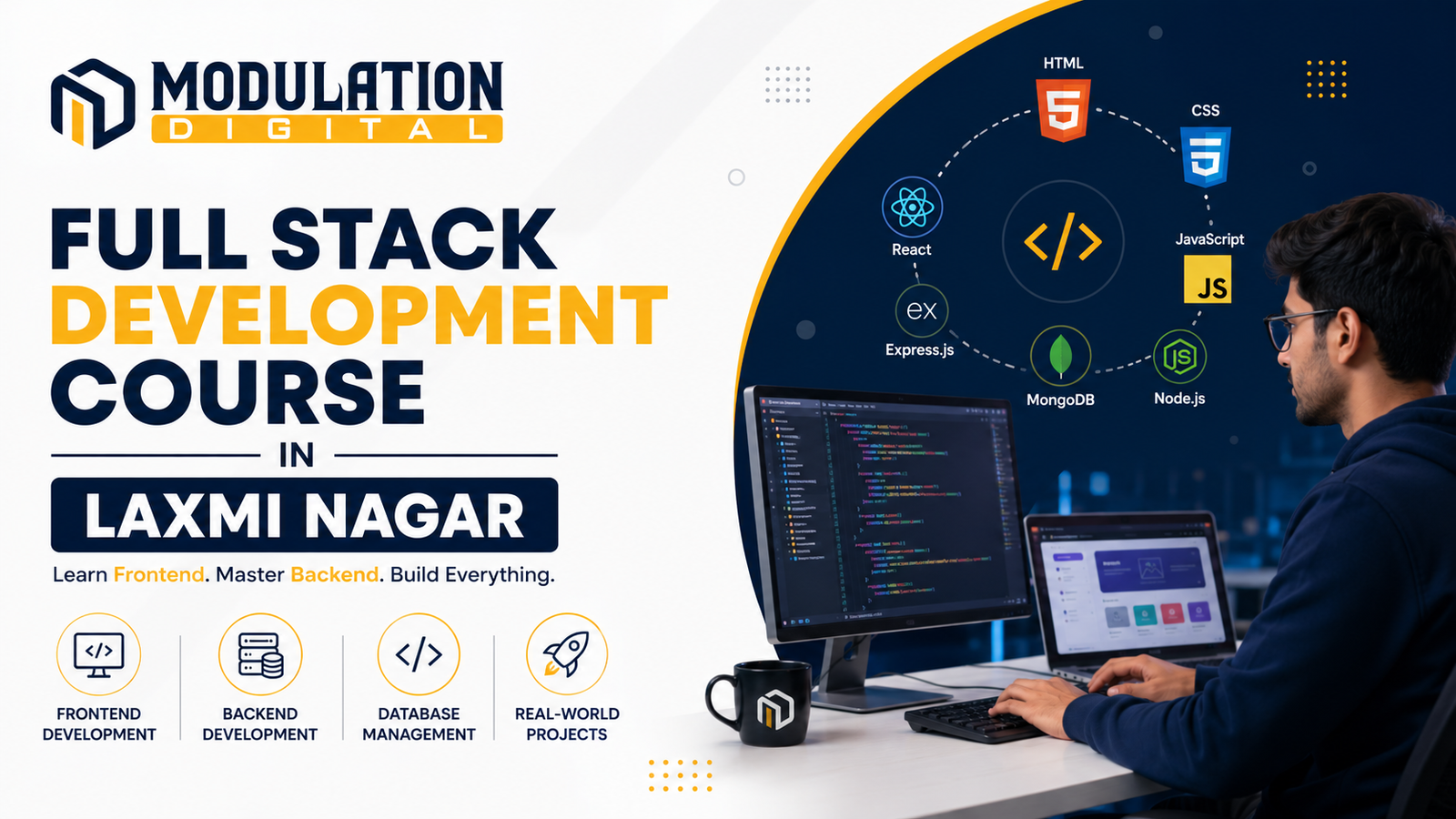
Back-end fundamentals — a server-side language, a framework, and a database. Node.js paired with Express is a common combination for the server layer, since it lets developers use JavaScript across both the front and back end. On the data side, working knowledge of a database system — commonly MongoDB or MySQL — rounds out the ability to actually store and retrieve information, not just display it.
Beyond these core layers, comfort with version control (typically Git), basic deployment concepts, and reading documentation independently all tend to separate job-ready developers from ones who can only follow along with a tutorial.
A Realistic Learning Path
Full stack development covers more ground than a single-layer specialization, so the learning path tends to run longer — typically four to six months of consistent effort. A rough framework many learners follow:
Weeks 1–4: Front-end fundamentals — HTML, CSS, and core JavaScript concepts, building static pages before adding interactivity.
Weeks 4–9: A front-end framework (commonly React) — learning to build reusable, interactive components rather than one-off static pages.
Weeks 9–15: Back-end fundamentals — server basics with Node.js and Express, and connecting to a database to store and retrieve real data.
Weeks 15–20: Full projects — building two or three complete applications end to end, from front-end interface through back-end logic and database, ideally solving a realistic problem rather than following a pre-built tutorial exactly.
This timeline varies by prior experience — someone coming in with some coding background will likely move faster through the fundamentals stage than someone starting from zero.
How Long Does It Take to Learn Full Stack Development?
There isn't a single timeline that works for everyone. Full stack development covers several connected skills, so the time required depends on your previous programming knowledge, daily study hours, learning method, and how much practical development you do.
A realistic progression for a complete beginner can look like this:
- 1–2 Months — Fundamentals: HTML, CSS, JavaScript basics, programming logic, Git, and responsive web development.
- 3–4 Months — Front-End Development: JavaScript in greater depth, APIs, UI development, and a modern front-end framework such as React.
- 5–6 Months — Back-End Development: Server-side programming, REST APIs, authentication, databases, and application architecture.
- 6+ Months — Full-Stack Projects: Connecting the front end, back end, and database to build complete applications and developing deployment and debugging skills.
For someone studying consistently, six months can provide a solid foundation, but that should not be confused with becoming an expert. Building job-ready ability requires projects that solve realistic problems rather than simply completing tutorials.
Your portfolio should eventually demonstrate that you can build a complete application — for example, an e-commerce website, booking platform, learning management system, or business dashboard — where the interface communicates with a back end and database.
The most important milestone isn't finishing a particular number of months. It's reaching the point where you can take an idea, plan the architecture, write the code, connect the required components, debug problems, and deploy a working application without depending on a step-by-step tutorial for every decision.
A Closer Look at Roshan Jha at Modulation Digital
For students evaluating a full stack development course in Laxmi Nagar, the trainer's practical experience is worth examining alongside the syllabus. Roshan Jha is identified by Modulation Digital as a Full Stack Developer and web-development trainer. The institute's recent published material describes him as having 10+ years of industry and teaching experience, with a focus on helping learners connect programming concepts with practical development work.
Roshan's own professional website also presents him as a Full Stack Developer and showcases projects involving technologies such as PHP, MySQL, JavaScript, jQuery, HTML/CSS, Angular, and Laravel. This provides useful evidence of hands-on development exposure rather than a profile based only on teaching credentials.
What Students Can Expect From His Training
- Full-Stack Perspective: Understanding how front-end interfaces, back-end logic, APIs, and databases work together.
- Practical Development: Learning through projects and application-focused exercises instead of only theoretical coding.
- Technology Exposure: Working with front-end and back-end technologies used across different web-development projects.
- Career-Oriented Learning: Building practical skills that can contribute to portfolio projects and technical interviews.
What Do the Reviews Say About Modulation Digital?
Public review data provides another useful reference when evaluating the institute. The current business listing shows Modulation Digital at 4.7/5 from around 640 reviews, while Justdial currently displays 4.7 from 669 ratings. Modulation Digital
More specifically, Modulation Digital's own published testimonials include students mentioning Roshan Sir in connection with HTML, CSS, JavaScript, web development, and their learning experience. One testimonial from Junaid Khan says he learned HTML, CSS, and JavaScript and later worked as an SEO and Social Media Executive.
For a prospective student, the bigger merit is therefore not simply the 10+ years of experience claim. The useful question is whether that experience translates into better explanations, practical project guidance, debugging support, and an understanding of how development works in real projects. Those are the areas worth assessing during a demo class before choosing the course.
FAQs
Do I Need Prior Coding Experience to Start?
No. You don't necessarily need previous coding experience to begin full stack development. A structured program can start with HTML, CSS, and JavaScript fundamentals, allowing beginners to gradually build programming logic before moving into more advanced technologies.
Which Should I Learn First — Front End or Back End?
For most beginners, starting with the front end is a practical approach. HTML and CSS help you understand how websites are structured, while JavaScript introduces programming concepts that can later be useful when working with technologies such as Node.js on the back end.
How Long Does It Usually Take to Become Job-Ready as a Full Stack Developer?
There is no fixed timeline because progress depends on your learning hours, programming background, and amount of project practice. A focused learner can build a strong foundation in four to six months, but becoming genuinely job-ready requires completing practical projects and developing problem-solving skills beyond simply finishing a syllabus.
Is React or Angular Better to Learn First?
Both are useful front-end technologies, but they serve different development needs. React is often a practical starting point for beginners because of its component-based approach and widespread use. Angular is also valuable, particularly for certain enterprise development roles. Your choice should ultimately depend on the type of development work you want to pursue.
Can a Full Stack Developer Work Freelance or Remotely?
Yes. Full stack skills can work well for freelance and remote projects because developers can handle multiple parts of a web application, including the interface, server-side functionality, APIs, and database integration. However, successful freelancing also requires communication, project management, client handling, and the ability to deliver projects independently.
Does Modulation Digital's Program Include Placement Support?
Modulation Digital promotes placement assistance alongside its development training. Students should confirm the current placement process, eligibility requirements, interview preparation, job referrals, and company connections directly with the institute before enrolling.
Final Thoughts
Full stack development rewards range — comfort moving between the visible, interactive side of an application and the structural, data-handling side that powers it. That breadth takes longer to build than a single-layer specialization, which is exactly why a structured sequence — front-end fundamentals, a framework, back-end basics, and full connected projects — tends to produce more confident, job-ready developers than piecing skills together at random.
If you're in or around East Delhi and considering a structured path into the field, Modulation Digital's full stack program is worth a direct look — the free demo class makes it easy to see the teaching approach before enrolling. Whichever path you choose, the strongest signal to employers will always be real, working projects you can point to and explain.